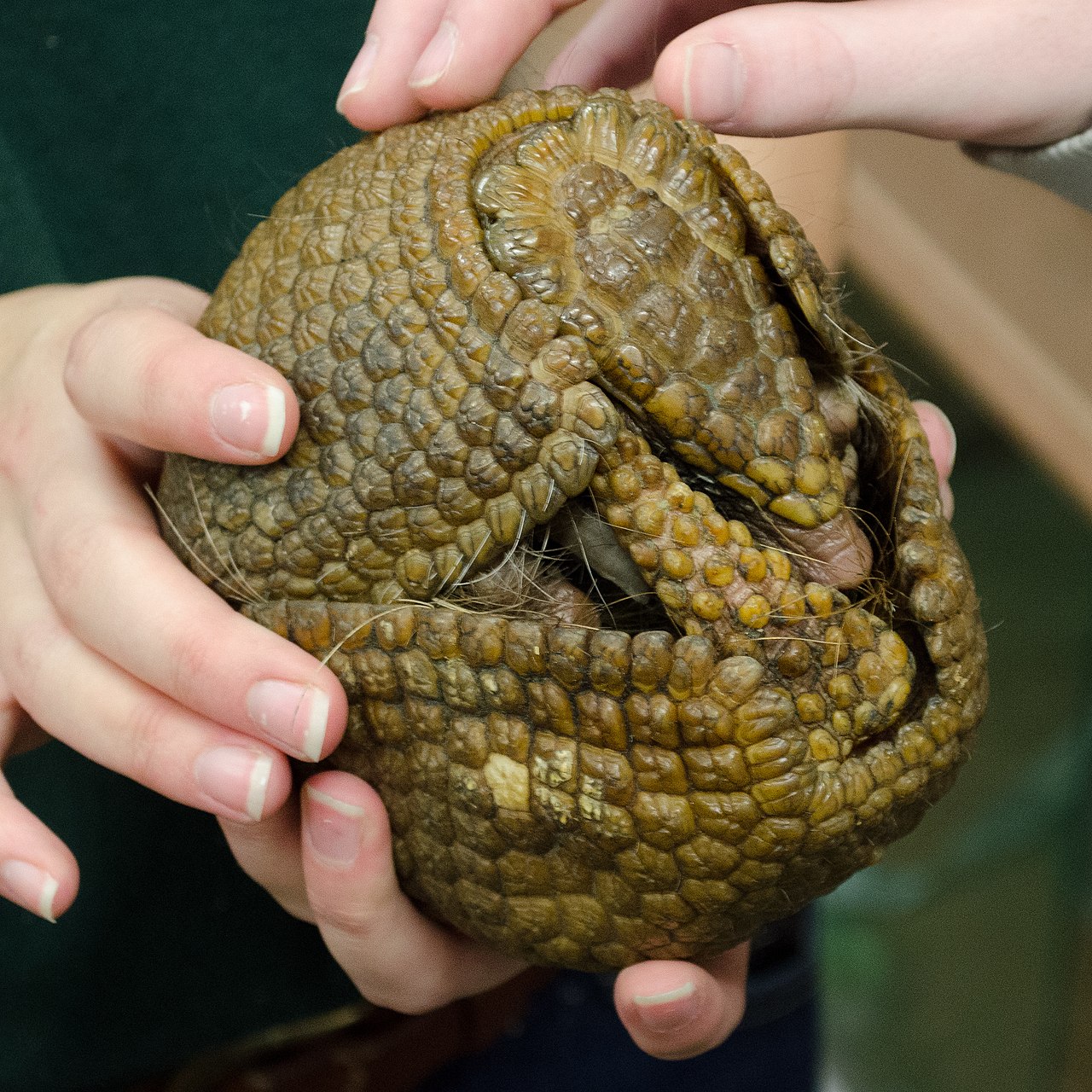
- The Short Answer: Only One Armadillo Can Truly Roll Into a Ball
- How the Armor Actually Works: Bands, Hinges, and Bone
- A Shell Made of Bone and Keratin
- Why Full Rolling Is So Rare
- Why Do Armadillos Roll Into a Ball? The Real Reasons
- Defense Against Predators
- Protection From Non-Predator Threats
- Not for Sleep, Play, or Temperature Control
- Meet the Three-Banded Armadillos: The Real Ball Artists
- Brazilian Three-Banded Armadillo
- Southern Three-Banded Armadillo
- What About the Nine-Banded Armadillo?
- Armadillo Armor: Myths, Misconceptions, and Real Risks
- Myth: Armadillos Are Living Fossils That Never Changed
- Myth: Armadillo Shells Are Bulletproof
- Myth: You Can Always Tell an Armadillo's Age by Its Bands
- Real Risk: Leprosy Transmission
- How Armadillos Live: Diet, Habitat, and Daily Life
- Conservation: A Rolling Defense Against a Changing World
- Conclusion: The Armor Truth
- ❓ Frequently Asked Questions
When most people picture an armadillo in trouble, they picture a living bowling ball: the animal tucks its head, pulls in its legs, and armadillos roll into a ball, presenting a seamless shell to the world. It is one of the most famous images in the animal kingdom — and also one of the most misunderstood. The truth is that only one armadillo out of roughly twenty recognized species can actually roll itself into a complete, sealed sphere, and even that species does not do it as often as cartoons suggest. The rest rely on very different defenses, from sprinting to digging to simply startling predators with a sudden leap. This article separates armor fact from armor fiction, explains how the ball-rolling trick works mechanically, and explores what armadillos are really like when nobody is watching.
The Short Answer: Only One Armadillo Can Truly Roll Into a Ball
If you want to see an armadillo roll into a perfect ball, you need to meet the Brazilian three-banded armadillo (Tolypeutes tricinctus) or its close cousin, the southern three-banded armadillo (Tolypeutes matacus). These two species are the only armadillos known to encase themselves completely inside their own armor.
The key is in the shell's design. Three-banded armadillos have a distinctive arrangement: a solid shield over the shoulders, a solid shield over the hips, and — crucially — several loose, flexible bands in the middle that act like hinges. When the animal contracts powerful muscles along its sides, those bands telescope together, the head shield and tail shield meet, and the gaps close. The result is a near-perfect sphere with no soft parts exposed.
All other armadillos, including the familiar nine-banded armadillo (Dasypus novemcinctus) that ranges across the southern United States, have too many rigid bands and not enough flexibility to seal the gap. A nine-banded armadillo can curl slightly and tuck its legs, but a predator would still find a way in. So it does what most armadillos do instead: it runs, digs, or startles its attacker.
How the Armor Actually Works: Bands, Hinges, and Bone
A Shell Made of Bone and Keratin
An armadillo's armor is called a carapace, and unlike a turtle's shell, it is not fused to the skeleton. The carapace is built from bony plates called osteoderms, each covered by a layer of tough keratin — the same material as your fingernails. These plates are arranged in two solid shields (shoulder and rump) separated by a series of overlapping bands.
The number of bands varies by species and even by individual, which is why the nine-banded armadillo is named for its typical count. Those bands are not decorative. They give the shell flexibility, allowing the animal to bend, twist, and — in three-banded species — fold completely. Underneath the carapace, loose skin and a layer of fat cushion the body, and the belly remains soft and vulnerable. That soft underside is exactly what a rolling armadillo is protecting.
Why Full Rolling Is So Rare
Rolling into a ball is an impressive trick, but it comes with trade-offs. A sealed armadillo cannot run, cannot bite, and cannot see. It is essentially betting that its armor will outlast the predator's patience. That strategy works well against a curious fox or a hungry ocelot, but it is useless against a jaguar that can simply bat the ball around, or against a human hunter who can pick it up.
There is also an anatomical cost. The muscles required to clamp the shell shut are heavy and energy-intensive, and the loose bands that make rolling possible offer less protection when the animal is walking around normally. Evolution settled on a compromise: a few species specialized for rolling, while the majority invested in speed, digging, or sheer toughness.
Why Do Armadillos Roll Into a Ball? The Real Reasons
Defense Against Predators
The primary reason is defense. When a three-banded armadillo senses a threat — a dog, a fox, a large bird of prey, or a human — it has three options: flee, dig, or roll. Three-banded armadillos are slower diggers than their nine-banded relatives, so rolling is often their best move. Once sealed, the shell presents a smooth, hard surface with no purchase for teeth or claws.
Predators do sometimes succeed. Jaguars and pumas have been observed pawing rolled armadillos, and large raptors may drop them from height. But for the majority of encounters with mid-sized predators, the ball defense buys enough time for the threat to lose interest and wander off.
Protection From Non-Predator Threats
Rolling is not always about escaping teeth. Armadillos may also curl defensively when handled by humans, when startled by a sudden noise, or when they are picked up by researchers. In these situations, the behavior is a reflex rather than a calculated strategy — a hardwired response to being grabbed or flipped.
Interestingly, three-banded armadillos do not always roll when threatened. They sometimes freeze, sometimes flee with a surprisingly quick gait, and sometimes simply clamp down and refuse to unroll. The rolling response is context-dependent, which is one reason field biologists describe these animals as far more variable in behavior than their reputation suggests.
Not for Sleep, Play, or Temperature Control
A persistent myth holds that armadillos roll into a ball to sleep, to stay warm, or even to roll downhill for fun. None of these are supported by evidence. Armadillos sleep in burrows, usually curled loosely but not sealed, and they regulate temperature by choosing appropriate burrows and by being active at the right times of day. Rolling is a defensive behavior, full stop.
Meet the Three-Banded Armadillos: The Real Ball Artists
Brazilian Three-Banded Armadillo
The Brazilian three-banded armadillo is the species most associated with the rolling trick, and it is also one of the most endangered. It is native to the Caatinga, a dry scrubland region of northeastern Brazil, and it depends on open habitat with scattered trees and plenty of ants and termites. Adults typically weigh between 1 and 1.6 kilograms (2.2 to 3.5 pounds) and measure roughly 22 to 27 centimeters (8.5 to 10.5 inches) in body length, with a tail adding another 6 to 8 centimeters.
Its diet is heavily insect-based. Brazilian three-banded armadillos eat ants, termites, and other small invertebrates, and they are known to dig shallow foraging pits rather than deep burrows. Their home range is small, and they are generally solitary outside of breeding. The IUCN Red List classifies the species as Vulnerable, with habitat loss from agriculture and grazing as the leading threat.
Southern Three-Banded Armadillo
The southern three-banded armadillo lives further south, in parts of Bolivia, Paraguay, Argentina, and Brazil, favoring dry forests, savannas, and scrub. It is slightly smaller on average than its Brazilian relative and is more tolerant of arid conditions. Like its cousin, it relies on ants and termites for most of its calories, supplemented by beetle larvae and other insects.
Southern three-banded armadillos are also the species most commonly seen in zoos, where their rolling behavior delights visitors. In the wild, they are nocturnal or crepuscular, spending hot daylight hours in burrows or under vegetation. Lifespan in human care can reach 15 to 20 years, though wild lifespans are typically shorter due to predation, disease, and habitat pressures.
What About the Nine-Banded Armadillo?
The nine-banded armadillo is the species most people in the United States have actually seen. It ranges from Argentina and Uruguay all the way north through Mexico and into the southeastern and south-central United States, and its range continues to creep northward as winters warm. Adults typically weigh 2.5 to 6.5 kilograms (5.5 to 14 pounds) and measure 60 to 80 centimeters (24 to 31 inches) including the tail.
This species cannot roll into a ball. Its defense strategy is entirely different:
- Running: Nine-banded armadillos can move surprisingly fast when startled, often bolting for the nearest burrow.
- Digging: They are powerful diggers and can excavate a burrow in minutes, disappearing underground before a predator can react.
- Jumping: When frightened, they sometimes leap straight up — a behavior that unfortunately makes them more likely to collide with cars.
- Startling predators: Their sudden leap and clattering shell can briefly confuse an attacker, buying a moment to escape.
The nine-banded armadillo is also famous for another reason: it almost always gives birth to four genetically identical young from a single fertilized egg. This phenomenon, called polyembryony, makes the species a favorite subject in genetics and developmental biology research. Litters are born in a burrow after a gestation period of about 120 days, though implantation can be delayed for months if conditions are poor.
Armadillo Armor: Myths, Misconceptions, and Real Risks
Myth: Armadillos Are Living Fossils That Never Changed
Armadillos are ancient — their lineage stretches back roughly 60 million years — but they have changed plenty. The extinct glyptodonts, relatives of modern armadillos, were the size of small cars and carried enormous domed shells. Modern armadillos are the surviving branch of that family, and their armor has been reshaped by millions of years of selection for different lifestyles.
Myth: Armadillo Shells Are Bulletproof
They are not. The carapace can deflect some bites and scratches, but it is not impenetrable. A determined predator, a vehicle, or a bullet will get through. The armor is a deterrent, not a force field.
Myth: You Can Always Tell an Armadillo's Age by Its Bands
Band counts vary within species and even within a single litter, so they are not a reliable age indicator. Biologists use tooth wear, body measurements, and other methods instead.
Real Risk: Leprosy Transmission
One genuine concern is that nine-banded armadillos can carry Mycobacterium leprae, the bacterium that causes leprosy (Hansen's disease). In parts of the southern United States, a small number of human cases have been linked to contact with armadillos, particularly through hunting, handling, or consuming undercooked meat. The risk is low for casual observers, but wildlife agencies recommend avoiding direct contact and wearing gloves if you must handle one.
How Armadillos Live: Diet, Habitat, and Daily Life
Understanding why armadillos roll into a ball is easier once you understand how they live. Armadillos are insectivores and omnivores, with diets dominated by ants, termites, beetles, grubs, and other invertebrates. Some species also eat small vertebrates, bird eggs, and plant material when insects are scarce.
They are excellent diggers, using powerful front claws to excavate burrows and to root through soil for food. A single nine-banded armadillo may maintain several burrows within its home range, and abandoned burrows become important shelter for snakes, rodents, and other wildlife.
Habitat preferences vary by species. Nine-banded armadillos thrive in forests, grasslands, scrublands, and even suburban areas with loose soil. Three-banded armadillos are more specialized, favoring dry, open habitats with sandy or rocky ground. All armadillos are solitary for most of the year, coming together only to mate.
Reproduction differs across the group. Nine-banded armadillos have the famous four-identical-offspring litters, while three-banded species typically produce one to two young per litter. Newborns are born with soft, leathery shells that harden over the following weeks.
Conservation: A Rolling Defense Against a Changing World
The armadillo's armor has served it well for millions of years, but it is no match for habitat loss, road mortality, and hunting. The Brazilian three-banded armadillo is listed as Vulnerable by the IUCN, and its Caatinga habitat continues to shrink due to agriculture and livestock grazing. The southern three-banded armadillo is listed as Near Threatened, facing similar pressures.
Conservation efforts focus on protecting remaining habitat, establishing protected areas, and monitoring wild populations. Zoos and research institutions also maintain captive breeding programs that serve as a genetic safety net. For the nine-banded armadillo, the picture is different: the species is expanding its range northward and is not currently considered threatened, though road deaths remain a major source of mortality in the United States.
What can ordinary people do? Support habitat conservation organizations, avoid handling wild armadillos, drive carefully in areas where they are common, and push back against the idea that these animals are pests. Armadillos play a real ecological role: they aerate soil, control insect populations, and create burrows used by other wildlife.
Conclusion: The Armor Truth
Armadillos roll into a ball — but only two species truly can, and only when they have no better option. The Brazilian and southern three-banded armadillos have evolved a shell with flexible hinges that lets them seal themselves inside a living sphere, a defense that has fascinated humans for centuries. The nine-banded armadillo, the species most of us actually encounter, cannot roll up at all; it runs, digs, and leaps instead. Understanding this distinction matters, because it replaces a cartoon image with a real one: armadillos are ancient, adaptable, ecologically important animals whose armor is a product of millions of years of evolution, not a magic trick. The next time you see one — rolled or unrolled — you will know exactly what you are looking at, and why.
❓ Frequently Asked Questions
💬 Do all armadillos roll into a ball?
No, only the three-banded armadillos (Tolypeutes genus) can roll completely into a sealed ball. Most other armadillo species, like the nine-banded armadillo, cannot curl up fully and instead rely on fleeing, digging, or tough armor.
💬 Why do armadillos roll into a ball?
Rolling into a ball is a defensive behavior that protects the armadillo's soft belly and limbs behind a hard, rounded shell. When threatened, the animal tucks its head and legs in and locks its bands together to present a nearly impenetrable sphere.
💬 Is a rolled-up armadillo really safe from predators?
It's well protected but not invincible. Most predators, such as coyotes and bobcats, struggle to bite through or pry open the ball, though large cats, dogs, and humans can sometimes overpower or manipulate it.
💬 Can you unroll an armadillo once it balls up?
Forcing an armadillo open is difficult and stressful for the animal, and it may stay rolled up until it feels safe. It's best to leave it alone and let it relax and unfurl on its own.