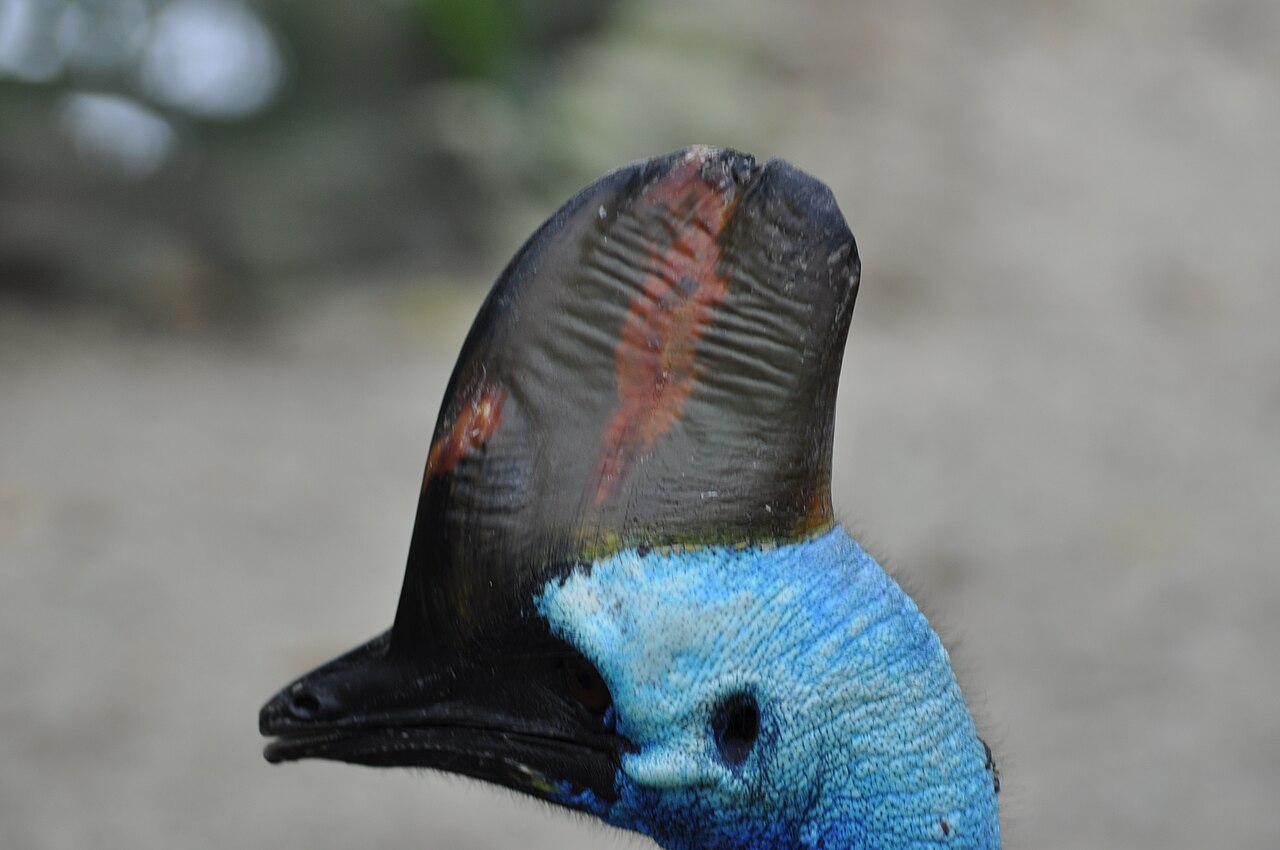
- The Anatomy of a Cassowary Casque
- The "Battering Ram" Myth: The Casque's Real Fragility
- The Acoustic Amplifier: Can the Cassowary Casque "Hear"?
- The Thermal Radiator Hypothesis
- A Billboard of Dominance: The Casque in Sexual Selection
- The Jungle Plow: Headbutting the Rainforest
- ❓ Frequently Asked Questions
The cassowary casque—that strange, blade-like helmet crowning the skull of Earth's most dangerous bird—has sparked everything from Indigenous lore to violent scientific debates for centuries. Standing up to 1.8 meters (5.9 feet) tall and weighing up to 60 kilograms (130 pounds), the southern cassowary already looks like a relic of the Cretaceous period, with a bright blue neck, dangling red wattles, and dagger-like claws on its toes. Yet it is this keratin crown, rising up to 18 centimeters (7 inches) from the top of its head, that remains its most enigmatic feature. Is it a weapon for brutal headbutts, a sonic amplifier for deep jungle booms, a radiator for shedding tropical heat, or simply a status symbol? The surprising truth is that this "helmet" is far more complex—and far more fascinating—than a simple piece of protective armor.
The Anatomy of a Cassowary Casque
To understand what the cassowary casque does, we first have to understand what it is made of. While it looks like a solid, dense horn, it is actually a living, growing structure with a surprisingly complex internal architecture. The outer layer is made of keratin—the same protein that forms your fingernails, hair, and the beaks of birds—providing a tough, slightly flexible, and continuously regenerating surface. But the interior is where things get interesting.
Beneath the keratin sheath lies a core of spongy, honeycombed bone that is highly vascularized, meaning it is packed with blood vessels. In some areas, this bone contains large, air-filled sinuses similar to the pneumatic bones found in a bird's skeleton. This dual structure allows the casque to be relatively lightweight despite its imposing size, while still maintaining enough structural rigidity to withstand the rigors of rainforest life. Because of this internal blood supply and continuous growth, the casque is highly sensitive to pressure and has a rich blood flow, a clue that immediately challenges the idea that it is purely a blunt-force instrument.
Notably, the casque is not identical across all cassowaries. There are three recognized species: the southern cassowary (Casuarius casuarius), the northern cassowary (Casuarius unappendiculatus), and the dwarf cassowary (Casuarius bennetti). The southern species possesses the largest and most prominent casque, which is tall, laterally compressed, and often slightly curved backward like a sweeping blade. The northern cassowary's casque is similar but can be a bit shorter, while the dwarf cassowary has a relatively low, flat, triangular plate that looks more like a geological formation than a helmet. This variation across species might hold vital clues about where these birds live and how they interact with their specific environments, since their habitats range from the dense, lowland rainforests of New Guinea to the tropical scrublands of North Queensland, Australia.
The "Battering Ram" Myth: The Casque's Real Fragility
The most common and intuitive explanation for the cassowary casque is that it is a piece of personal protective equipment, evolved to allow the bird to charge head-first through dense vegetation or systematically headbutt rivals and predators into submission. After all, the cassowary already possesses the most frightening weaponry in the animal kingdom—a 12-centimeter (4.7-inch) blade on its inner toe that can disembowel a dog or human with a single downward kick. It seems logical that such a combative bird would also evolve a helmet.
However, the evidence supporting the headbutting hypothesis is remarkably thin. Let's start with the physics. While the outer keratin shell is durable, the internal structure of the casque is frail and delicate. The spongy bone and air sinus pockets are not designed to absorb massive, concussive impacts in the way that, say, the fused skull of a ram or a bison is. In fact, the cassowary skull itself has large cranial fontanelles (gaps in the bone) that make the braincase more vulnerable to fracture than that of most other birds. If two cassowaries engaged in a violent, head-on collision, the damage to their sinus cavities and braincases could be fatal.
Furthermore, behavioral observations strongly contradict this theory. Cassowaries do not fight for territory or mates by clashing heads, as goats or deer do. When they do fight—which is actually rare, as they are largely solitary, territorial birds—they rely almost exclusively on their feet. Courtship and rivalry fights typically involve high, jumping kicks, not head-to-head shoving matches. The casque is not scarred, chipped, or broken with any frequency, which would be expected if it were regularly used as a battering device.
- Weapon of choice: The lethal, blade-like toe claw is used for fights and defense, not the casque.
- Skull structure: The casque contains air pockets that would compress, not protect, under blunt force.
- Behavioral data: Wild cassowaries rarely make contact with the casque during aggressive confrontations.
If the casque isn't a weapon, then why does it exist at all? This question has driven researchers to look well beyond the simple fight-or-flight narrative, leading to some of the most cutting-edge theories in avian biology, starting with sound.
The Acoustic Amplifier: Can the Cassowary Casque "Hear"?
Anyone who has spent time in the dense, steamy rainforests of North Queensland or New Guinea will tell you that visibility is almost nonexistent. The canopy blocks sunlight, thick vines tangle the undergrowth, and paths often wind through a green wall of vegetation. In this world, sound is king—and cassowaries are auditory monarchs.
Cassowaries produce what naturalists call "booms"—the lowest-frequency calls of any known bird. These booms are emitted at a fundamental frequency of around 23 to 32 Hertz, which is at the edge of, or entirely below, the threshold of human hearing. To us, they sound like a low, rumbling growl or the distant thunder of an approaching storm. But to a cassowary deep in the jungle, this sound can travel for hundreds, if not thousands, of meters, rippling through the thick foliage and even vibrating through the ground itself.
So, how does the cassowary casque play into this? The hypothesis is that the casque acts as a physical amplifier or resonance chamber. Because of its hollow, sinus-filled bone structure, the casque reacts to acoustic vibrations. The theory, proposed by researchers like Darren Naish, suggests that the casque can pick up subtle low-frequency vibrations from the environment and transmit them through the skull to the inner ear. In essence, the casque might function as an external hearing aid, allowing these birds to detect the direction and distance of a prospective mate's booming call from miles away in the dense jungle. It might also act as a transmitter, allowing the bird to direct its own call outward in a specific direction, functioning as a phased array speaker.
While the acoustic theory is highly compelling, assigning a single function to such a complex organ would be a mistake. In evolutionary biology, organs are rarely single-purpose devices, and the casque is proving to be a textbook example of multifaceted adaptation. This brings us to one of the most fascinating and recently proven functions of the casque: temperature control.
The Thermal Radiator Hypothesis
Imagine trying to survive while wearing a warm, thick wool cap during a humid summer heatwave. That is the exact problem a cassowary might face if not for its remarkable nasal and cranial adaptations. Cassowaries inhabit some of the hottest and most humid environments on the planet. In the lowland forests of New Guinea, temperatures can regularly exceed 40°C (104°F) with 100% humidity, making evaporative cooling (panting) less effective.
But thanks to recent studies using advanced thermal imaging, we now know that* the casque is a highly active thermal window. A 2019 study led by Danielle Eastick at the University of Queensland used infrared thermography to analyze the surface temperatures of cassowaries in varying environmental conditions. The results were astonishing.
The researchers found that the casque is covered in a dense network of superficial blood vessels directly beneath the thin outer keratin layer. When the bird gets overheated, blood is shunted into these vessels, carrying excess body heat from the core to the surface of the casque. Because the casque has a relatively large surface area compared to its internal volume, it acts as a perfect radiator, efficiently dissipating that heat into the surrounding air. In simpler terms, the helmet works like the radiator in your car, keeping the bird's "engine" cool while moving through a hot jungle.
- Heat loss: Thermal cameras showed that the casque is consistently cooler than the bird's body temperature, proving it radiates heat.
- Blood flow: The casque has a high-density capillary network that can flush blood to the surface rapidly.
- Behavioral correlation: In extreme heat, cassowaries have been observed tilting their heads to expose the casque to air currents, enhancing cooling.
So, the casque is simultaneously a hearing aid and a heat sink. But if it is used to hear and to cool, what about communication and mating? The answer lies in one of the most overlooked functions of this bizarre appendage: social signaling.
A Billboard of Dominance: The Casque in Sexual Selection
While the casque's internal anatomy explains the acoustic and thermal functions, its external appearance speaks volumes—literally and figuratively—to other cassowaries. Much like the antlers of a deer or the tail feathers of a peacock, the size, shape, symmetry, and general condition of the cassowary casque might be a reliable indicator of an individual's age, genetic fitness, and overall health.
Casques continue to grow slowly throughout a cassowary's life. A larger casque is generally a sign of a mature, experienced adult, whereas a smaller, nubby casque belongs to a juvenile. Because the casque's blood supply provides it with nutrients, periods of extreme stress, poor nutrition, or parasitic infection can result in a dull, brittle, or chipped casque. This makes it a literal "billboard" revealing the quality of the bird's genetics and lifestyle. A shiny, smooth, undamaged casque is a visual declaration of a strong immune system and a secure territory with abundant food resources.
This theory is heavily reinforced by the sexual dynamics of the cassowary species. Female cassowaries are famously larger and more aggressive than males; they dominate the territorial fighting and are the ones who actively court choosy males. Intriguingly, despite this size discrepancy, females do not necessarily possess significantly larger casques than the smaller males. If the casque were a weapon for female-on-female combat, we would expect to see extreme sexual dimorphism in casque size, with females possessing monstrous helmets. Instead, we see similar proportions in both sexes, which suggests that the casque is less about physical combat between females and more about forming pair bonds and transmitting signals to potential mates.
During courtship, males and females engage in a complex and surprisingly delicate ritual that involves lowering their heads, puffing up their necks, and gently rubbing their casques against one another. The dense network of nerves and blood vessels inside the casque suggests that this is a highly sensory, tactile experience. It is essentially a specialized love organ, a way for a mated pair to reinforce their bond in a species where they meet only during the breeding season.
The Jungle Plow: Headbutting the Rainforest
Despite dispelling the "battering ram" myth, we shouldn't fully discount the casque's role in providing literal, physical protection from the environment—just not in the way we might think. The cassowary is a master of rapid transit through inhospitable terrain, capable of sprinting at speeds up to 50 kilometers per hour (31 miles per hour) to escape threats or navigate their home ranges. In pursuit of fruiting trees, they will plunge head-first into
❓ Frequently Asked Questions
💬 What is the helmet on a cassowary's head called?
It's called a casque, a hollow, keratin-covered structure on top of the skull. Unlike horns or antlers, it's made of a tough material similar to human fingernails.
💬 Why do cassowaries actually have a casque?
Recent evidence suggests the casque helps amplify low-frequency sounds, allowing cassowaries to communicate with deep rumbles through dense rainforest. It may also signal a bird's age and dominance, since it keeps growing as the cassowary gets older.
💬 Do cassowaries use their helmets for headbutting?
Surprisingly, the casque is too fragile for serious combat; it's more of a resonance chamber than a battering ram. Cassowaries primarily defend themselves with their powerful clawed feet, delivering a dangerous downward kick.
💬 Is the cassowary casque hollow?
Yes, the casque is essentially hollow, with a thin-walled structure of spongy bone covered in keratin. This air-filled design supports the theory that it functions as an acoustic horn for low-frequency calls.