- What Exactly Is a Cuttlefish? A Quick Primer
- How Cuttlefish Change Color: The Machinery Beneath the Skin
- Innervation and Speed
- Beyond Chromatophores: Iridophores and Leucophores
- The Skin Sees Too
- Why Do Cuttlefish Change Color? Camouflage First
- Matching Texture, Not Just Color
- Ambush and Escape
- When Cuttlefish Change Color to Talk: Signals and Deception
- The Zebra Display and the Passing Cloud
- Courtship and the Giant Aggregation
- Hypnosis and Hunting Tricks
- Do Cuttlefish See Their Own Colors? The Colorblind Paradox
- Famous Examples: From Common Cuttlefish to the Flamboyant Cuttlefish
- Warning Colors and Toxicity
- Captive Observations
- Why Cuttlefish Change Color: The Bigger Picture
- Conclusion: The Shifting Skin Truth
- ❓ Frequently Asked Questions
Cuttlefish change color faster than almost any other animal on Earth, transforming their skin from mottled sand to electric zebra stripes in under a second — and the reasons behind this talent are stranger and more varied than most people imagine. These small, big-brained relatives of the octopus use color for camouflage, communication, courtship, and even deception, running a living light show controlled by millions of tiny organs in their skin. This article unpacks the shifting skin truth: how the system works, what the colors mean, and why a color change is sometimes a bluff, sometimes a whisper, and sometimes a lie.
What Exactly Is a Cuttlefish? A Quick Primer
Cuttlefish are marine molluscs belonging to the cephalopod class, alongside octopuses, squid, and nautilus. Despite the name, they are not fish. There are roughly 120 recognized species, ranging from thumb-sized pygmies to Sepia apama, the Australian giant cuttlefish, which can reach about a meter in total length and weigh several kilograms. Most familiar species, such as the common cuttlefish (Sepia officinalis), grow to around 30–50 centimeters.
They live in coastal and shelf waters across the Atlantic, Mediterranean, Indian, and Pacific oceans, typically from the shallows down to a few hundred meters. The common cuttlefish is a classic example: it favors sandy, seagrass, and reef-edge habitats around Europe and North Africa. Their diet is carnivorous and unfussy — crabs, shrimp, small fish, and other molluscs, ambushed with two lightning-fast tentacles. Lifespans are short, usually one to two years, and most species die shortly after a single breeding season.
What sets cuttlefish apart is their nervous system. They have the largest brain-to-body ratio of any invertebrate, a W-shaped brain wrapped around the esophagus, and sophisticated eyes with pupils shaped like the letter W. That processing power is the engine behind their color-changing feats.
How Cuttlefish Change Color: The Machinery Beneath the Skin
The secret lies in the skin itself, which is packed with millions of elastic pigment sacs called chromatophores. Each chromatophore is a tiny balloon of pigment — yellow, orange, red, brown, or black — surrounded by a star-shaped array of radial muscle fibers. When those muscles contract, the sac stretches open like a flower blooming, and the color floods the skin. When the muscles relax, the sac shrinks to a pinprick and the color vanishes.
Innervation and Speed
Crucially, each chromatophore is wired directly to the brain via motor neurons. This is not a slow hormonal flush; it is a neural command system, which is why a cuttlefish can change color in fractions of a second — estimates suggest a full-body pattern shift can occur in well under a second, and individual chromatophores can cycle faster still. A single cuttlefish may control tens of millions of these units, and the pattern can be different on each side of the body.
Beyond Chromatophores: Iridophores and Leucophores
Pigment alone cannot produce the metallic greens, blues, silvers, and whites cuttlefish display. Beneath the chromatophore layer sit iridophores, stacks of reflective plates that bounce light back at specific wavelengths, and leucophores, which scatter light to create white. By opening and closing chromatophores over these reflective layers, a cuttlefish can effectively mix colors like a painter, producing hues no single pigment cell contains.
The Skin Sees Too
Perhaps the most remarkable discovery in recent years: cuttlefish skin contains light-sensitive proteins, including opsins, similar to those in the eyes. Experiments have shown that cuttlefish can respond to changes in ambient light and background even when blindfolded or when their vision is impaired, suggesting the skin itself contributes to the color-matching process. The full picture is still being worked out, but it means the phrase "shifting skin" is more literal than anyone once thought.
Why Do Cuttlefish Change Color? Camouflage First
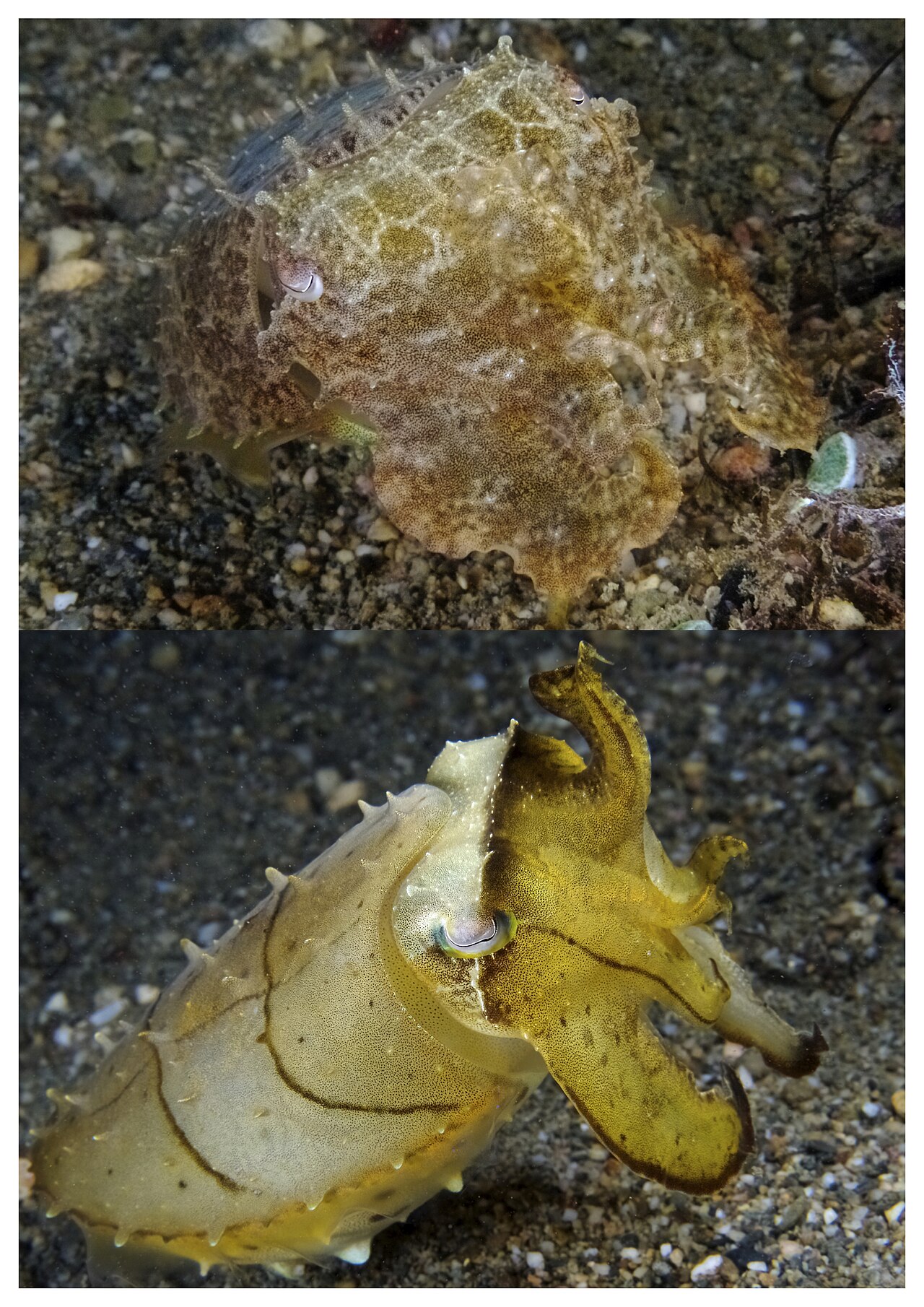
The best-known answer is concealment, and cuttlefish are masters of it. Their skin can mimic sand, gravel, mud, seagrass, coral rubble, and the dappled light of a reef. They can produce uniform tones, fine speckles, bold mottling, and disruptive patterns that break up their outline — the same trick military camouflage uses.
Matching Texture, Not Just Color
Color is only half the story. Cuttlefish also raise and lower small muscular bumps called papillae, sculpting their skin into 3D textures that imitate algae, sponge, or rock. A camouflaged cuttlefish can look less like an animal and more like a lump of the seafloor, complete with fake fronds.
Ambush and Escape
Camouflage serves two survival needs at once. As ambush predators, cuttlefish need to vanish before striking at crabs and shrimp. As prey for dolphins, seals, large fish, and sharks, they need to vanish when threatened. When concealment fails, some species deploy a sudden dark flash or a cloud of ink, then jet away using their siphon.
When Cuttlefish Change Color to Talk: Signals and Deception
Camouflage explains the hiding, but not the flamboyance. Cuttlefish also use color as language, and their signals are among the most sophisticated in the invertebrate world.
The Zebra Display and the Passing Cloud
Many species flash high-contrast zebra stripes — bold black bands across a pale body — to startle predators or signal aggression to rivals. The "passing cloud" is another classic: dark waves ripple along the body from head to tail, often used in disputes or as a warning. Researchers studying the mourning cuttlefish (Sepia plangon) documented something even cleverer: males courting a female while a rival male watches display female-like patterns on the side facing the rival, and male courtship colors on the side facing the female — literal two-faced signaling.
Courtship and the Giant Aggregation
During breeding, males put on intense displays — rippling stripes, dark mantles, and pulsing colors — to attract females and intimidate rivals. The Australian giant cuttlefish gathers each winter in the shallow waters of Spencer Gulf, South Australia, in one of the ocean's great spectacles: thousands of animals crowded together, males fighting and displaying, small "sneaker" males disguising themselves as females to slip past the big males. Color, in that crowded arena, is status, threat, and seduction all at once.
Hypnosis and Hunting Tricks
Some cuttlefish use moving color bands to mesmerize prey. A hunting cuttlefish may send rippling dark waves down its body toward a crab, seemingly holding the prey's attention before the tentacles shoot out. Whether this is true hypnosis or simply distraction is debated, but the behavior is well documented.
Do Cuttlefish See Their Own Colors? The Colorblind Paradox
Here is the twist that makes the shifting skin so fascinating: cuttlefish appear to be colorblind. Their eyes contain only one type of photoreceptor, so they cannot discriminate hues the way humans do. Yet they match colored backgrounds with startling accuracy.
How? Several explanations have been proposed. One is that their W-shaped pupils and unusual optics create chromatic blur, letting them detect color differences through focus rather than hue. Another is the skin's own light sensitivity, which may sample the surrounding light directly. A third is that cuttlefish rely on brightness and texture more than hue, and their chromatophore and iridophore combinations happen to produce convincing matches anyway. The debate is unresolved, but the paradox highlights how little we still know about cephalopod perception.
Famous Examples: From Common Cuttlefish to the Flamboyant Cuttlefish
The common cuttlefish is the textbook camoufleur, settling onto sand and vanishing in seconds. The Australian giant cuttlefish is the showman of the breeding aggregation. But the most dazzling is the flamboyant cuttlefish (Metasepia pfefferi), a small species from the tropical waters of northern Australia, Indonesia, and Malaysia that walks on the seafloor using its arms and flashes warning colors — deep purples, reds, yellows, and whites — in rippling waves.
Warning Colors and Toxicity
The flamboyant cuttlefish's display is thought to be aposematic — a warning. Uniquely among cuttlefish, its flesh is known to be toxic, and its bold coloration advertises that fact rather than hiding it. It is a reminder that color change is not always about disappearing; sometimes it is about being impossible to ignore.
Captive Observations
In aquariums, cuttlefish have shown they can learn to associate patterns with food and adjust their camouflage to new backgrounds over repeated exposure, hinting at flexibility rather than fixed instinct. Keepers report individual animals developing preferred resting patterns and distinct "moods" visible in their skin.
Why Cuttlefish Change Color: The Bigger Picture
The shifting skin is a survival toolkit with several jobs at once. It is armor, hiding the animal from predators. It is a weapon, letting an ambush hunter blend in before striking. It is a voice, broadcasting aggression, courtship, or submission. And it is sometimes a mask, letting a male pretend to be a female or a harmless shape.
All of this runs on a short lifespan of one to two years, which makes the sophistication of cuttlefish signaling even more striking. There is no long apprenticeship; a young cuttlefish must master camouflage and communication quickly, in a dangerous ocean, with a brain the size of a pea and the processing power of a small computer. That combination — short life, big brain, living skin — is why scientists keep returning to them as a model for studying perception, signaling, and the evolution of complex behavior.
Conclusion: The Shifting Skin Truth
Cuttlefish change color for camouflage, communication, courtship, and deception, using millions of neural-controlled chromatophores layered over reflective cells, all coordinated by one of the most complex brains in the invertebrate world. They can vanish into sand, flash zebra stripes at a rival, ripple a passing cloud at a competitor, and — in the case of the flamboyant cuttlefish — advertise their toxicity in neon. They may even be colorblind, matching hues through mechanisms we are still deciphering, with skin that senses light on its own. The shifting skin truth is that cuttlefish color is never just decoration: it is a living language written in pigment, muscle, and light, and we are only beginning to read it.
❓ Frequently Asked Questions
💬 How do cuttlefish change color so quickly?
They use thousands of tiny pigment-filled sacs called chromatophores, controlled by muscles, that can expand or contract in fractions of a second. Layers of reflective cells beneath them (iridophores and leucophores) add shimmering blues, greens, and structural colors. This combination lets cuttlefish shift their appearance almost instantly.
💬 Why do cuttlefish change color?
Color change serves several purposes: camouflage against predators and prey, communication and signaling to other cuttlefish, and sometimes startling or warning displays. It is not driven by a single reason but adapts to the situation.
💬 Are cuttlefish colorblind if they use color so well?
Research suggests cuttlefish may be colorblind, since their eyes lack the cone cells for color vision that humans use. They likely compensate by detecting brightness, polarization, and shape, and by using chromatophore patterns that may be tuned to match their surroundings.
💬 Can cuttlefish change their skin texture as well as color?
Yes. Beyond color, cuttlefish can raise papillae on their skin to mimic the 3D texture of rocks, sand, or seaweed. This physical camouflage works alongside color change to make them blend into complex backgrounds.