- The Basics: What Fireflies Actually Are and Why They Glow
- The Chemistry Behind the Glow
- Why Do Fireflies Glow? The Real Purposes Behind the Signal
- Finding a Mate
- Warning Predators Away
- Larval Glow and Other Uses
- Firefly Anatomy, Size, Diet, and Habitat
- What Fireflies Eat
- Where They Live
- Lifespan
- How Fireflies Control Their Flashes
- Synchrony: When Thousands Flash as One
- Are Fireflies in Trouble?
- How to See and Help Fireflies
- Common Myths, Corrected
- The Shocking Truth About Fireflies Glow
- ❓ Frequently Asked Questions
On a warm summer evening, a backyard in rural Pennsylvania can suddenly fill with tiny, drifting points of light, as if the stars have dropped down to hover among the grass. The reason fireflies glow is one of the most fascinating stories in the natural world — and much of what most people believe about it is either incomplete or flatly wrong. These aren't flies at all, their light isn't hot, and the gentle blinking we find so charming is, in reality, a ruthless conversation about sex, deception, and survival.
The Basics: What Fireflies Actually Are and Why They Glow
Fireflies are beetles, not flies, belonging to the family Lampyridae. That family contains roughly 2,000 described species worldwide, with the greatest diversity in tropical and subtropical regions. In North America, about 170 species have been recorded, concentrated in the eastern and central United States. So the correct name for them is "lightning bugs," and the correct category is Coleoptera — the beetles — not Diptera, the true flies.
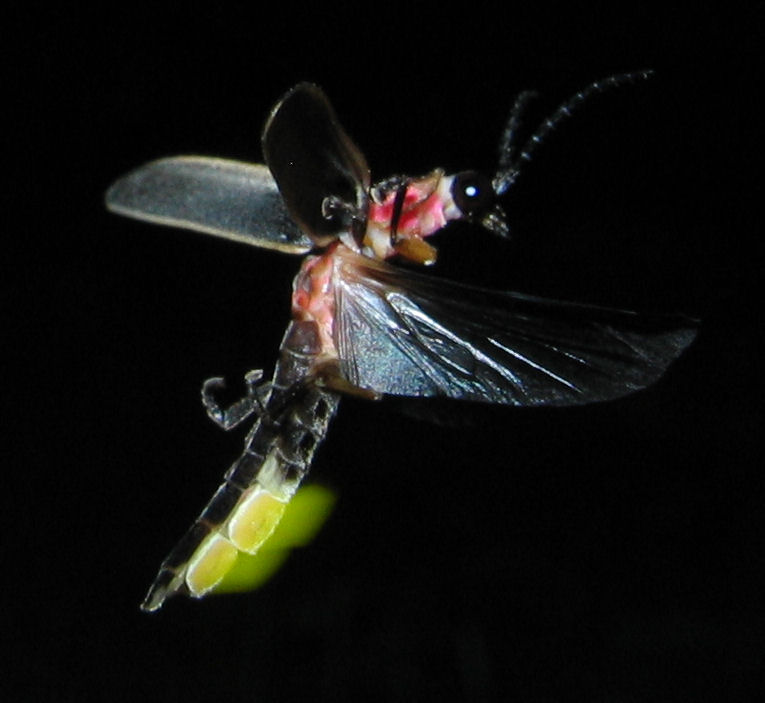
Their glow comes from a chemical reaction inside specialized cells called photocytes, packed into a light-producing organ in the lower abdomen. The reaction is called bioluminescence, and it is one of the most efficient light sources known in biology.
The Chemistry Behind the Glow
Inside the photocytes, a pigment called luciferin reacts with oxygen in the presence of an enzyme called luciferase, plus a molecule of ATP — the same energy currency used by every cell in your body. The result is a photon of light, typically in the yellow-green to pale-orange range, with a wavelength around 510 to 670 nanometers. Crucially, almost none of the energy is wasted as heat. Ordinary incandescent bulbs convert roughly 90 percent of their energy into heat; a firefly converts nearly all of it into light, which is why the glow feels cool to the touch. Researchers estimate the efficiency at 90 to 98 percent.
Fireflies also control the reaction with remarkable precision. They can switch the light on and off by regulating oxygen flow into the photocytes and by using a compound called nitric oxide as a gatekeeper. That's how a single insect produces the crisp, rhythmic flashes we see rather than a constant smudge of light.
Why Do Fireflies Glow? The Real Purposes Behind the Signal
Most people assume the glow exists purely to attract a mate. That's the dominant reason in adult fireflies, but it's far from the only one. Across the firefly life cycle, light serves several distinct jobs.
Finding a Mate
In most North American species, males fly and flash while females sit low in vegetation and answer with a flash of their own after a precise delay. Each species has its own signature: the number of flashes, the duration of each flash, the interval between flashes, and the color. The common eastern firefly, Photinus pyralis, flies in a J-shaped swoop and flashes about every 5.7 seconds at roughly 21 degrees Celsius — and the timing shifts with temperature, because the whole reaction is temperature-dependent.
Females in the genus Photuris take a different approach. They cannot easily be distinguished from Photinus females by sight, but they can mimic the flash responses of Photinus females. When a Photinus male lands beside what he thinks is a receptive mate, he is eaten instead. This behavior has earned these females the nickname "femme fatales." It is not a rare quirk: it's a normal, well-documented part of their biology, and the males they consume supply defensive chemicals called lucibufagins that make the females and their eggs taste bad to predators such as spiders and birds.
Warning Predators Away
Firefly larvae and many adult fireflies are chemically defended. Their bodies contain bitter-tasting compounds, and the glow functions as an honest advertisement: I am toxic, do not eat me. This is called aposematism — a warning signal. Studies have shown that predators such as jumping spiders learn to avoid glowing prey after a single unpleasant encounter, and some frogs and birds spit fireflies out rather than swallowing them.
Some species take this further. Certain fireflies in the Southeast and in tropical regions are mimics of other toxic fireflies, borrowing the protection of a warning signal they haven't paid for.
Larval Glow and Other Uses
Firefly larvae glow too, sometimes continuously rather than in flashes. The larvae live in soil, leaf litter, and near water, where they hunt small prey. Their steady glow likely serves both as a warning and, in some species, as a way to startle or illuminate prey. In a few species, adults also use light for purposes unrelated to mating, and some tropical fireflies synchronize their flashes by the thousands — a phenomenon best known from the mangrove forests of Thailand and Malaysia, where entire trees pulse in unison.
Firefly Anatomy, Size, Diet, and Habitat
Fireflies are modest in size. Most adults measure between 5 and 25 millimeters (roughly 0.2 to 1 inch) in length, with a soft, elongated body and a pronotum — the shield-like plate behind the head — that often carries red or yellow markings. The light organ sits at the tip of the abdomen and is usually visible as a pale, translucent patch.
What Fireflies Eat
Adult fireflies are short-lived and many species feed very little, but those that do eat are often predatory. A well-known example is the Photuris female that hunts other fireflies. Some adults feed on nectar, pollen, or aphid honeydew. Larvae are the real hunters: they are carnivorous and feed on snails, slugs, earthworms, and soft-bodied insects. Some larvae inject digestive enzymes into a snail and then drink the liquefied contents — a process that can take hours.
Where They Live
Fireflies favor warm, humid environments with damp soil, tall grass, forest edges, and standing water nearby. Larvae need moisture to survive; dry, chemically treated lawns are hostile to them. This is one reason sightings have declined in many suburban areas. Species such as the blue ghost firefly (Phausis reticulata) of the southern Appalachians glow steadily rather than flashing and are found only in mature, undisturbed forest. The synchronous firefly (Photinus carolinus) of Great Smoky Mountains National Park draws tens of thousands of visitors each June to watch its coordinated flash patterns.
Lifespan
Fireflies spend the majority of their lives underground or in leaf litter as eggs and larvae — often one to two years in that stage. The adult stage, by contrast, lasts only about one to four weeks. So the glowing beetles we see on a summer night are the brief, final chapter of a long life, which makes their courtship displays all the more urgent.
How Fireflies Control Their Flashes
Watching a firefly blink is watching a metabolic process unfold in real time. The insect doesn't have a switch in the ordinary sense; it regulates oxygen delivery to the light organ and uses nitric oxide to temporarily shut down the reaction. When the signal to flash arrives from the nervous system, oxygen floods the photocytes and light appears. When nitric oxide binds to the enzyme machinery, the reaction halts and the light goes dark.
Temperature matters enormously. Because the whole process is enzymatic, flashes speed up in warm weather and slow down in cool weather. A firefly at 30 degrees Celsius may flash noticeably faster than the same species at 18 degrees Celsius. This is why identical species appear to blink at different rates on different nights, and why researchers must record temperature alongside any flash data they collect.
Synchrony: When Thousands Flash as One
Synchronous flashing is not a single species trick. At least a handful of species in Southeast Asia and North America do it, and the mechanism has been studied for decades. The leading explanation is a form of coupled oscillation: each firefly adjusts its internal flash timer slightly when it sees a neighbor flash, and the local group gradually settles into a shared rhythm. The result is the famous "light show" of the Great Smoky Mountains, where Photinus carolinus produces bursts of roughly six flashes, then a pause of about eight seconds, repeated in near-perfect unison across a hillside.
Are Fireflies in Trouble?
Yes, and the glow is part of why. Fireflies are sensitive to a suite of modern pressures, and many populations are declining.
- Habitat loss: Wetlands drained, meadows mowed, and forests cleared remove the damp, undisturbed places larvae need.
- Light pollution: Artificial light at night disrupts courtship. Females may not see male flashes, or males may be drawn off course toward streetlights and porch lamps.
- Pesticides and herbicides: Chemical lawn treatments kill the snails, slugs, and worms that larvae eat, and can poison the larvae directly.
- Climate change: Shifting rainfall patterns and hotter, drier summers reduce the moisture fireflies depend on.
- Invasive species and development: Introduced predators and paving over of natural areas shrink suitable habitat further.
The International Union for Conservation of Nature has assessed a portion of firefly species and found that a meaningful share are at risk of extinction, with the greatest threats being habitat degradation and light pollution. As of recent assessments, roughly one in three evaluated North American species faces some level of extinction risk. Because fireflies are conspicuous and beloved, they have become a flagship for the broader problem of insect decline.
How to See and Help Fireflies
If you want more fireflies in your yard, the fixes are surprisingly practical.
- Turn off outdoor lights during peak season, or use motion sensors and warm, shielded fixtures that point downward.
- Let the lawn grow in at least part of the yard, and leave leaf litter and brush piles in place over winter.
- Skip chemical pesticides and herbicides, especially broad-spectrum products.
- Add a water feature or a damp, planted corner to give larvae the moisture they need.
- Plant native species that support the small invertebrates fireflies eat.
- Watch, don't catch. Fireflies are fragile, and handling them can shorten their already brief adult lives.
The best viewing conditions are warm, humid nights with little wind and no moonlight, typically from late spring through midsummer depending on your region. Peak activity usually falls in the first hour or two after dusk.
Common Myths, Corrected
Several persistent beliefs about fireflies deserve correction. They are not flies but beetles. Their light is not hot; it is one of the most efficient light sources in nature. They do not all flash in the same pattern — species differ in flash count, duration, interval, and color, and those differences are precisely how they avoid mating with the wrong species. And they are not uniformly harmless: some females eat other fireflies, and some species are toxic enough to sicken a pet that swallows them.
The Shocking Truth About Fireflies Glow
The truth is that a firefly's glow is not decoration and not magic. It is a chemical signal built from luciferin, luciferase, oxygen, and ATP, produced with near-perfect efficiency and controlled by the insect's own nervous system. It exists to find a mate, to warn predators, and in some species to lure prey to their deaths. It burns for only a few weeks at the end of a life that mostly happens in the dark, underground, and unnoticed.
That is what makes fireflies glow so remarkable: a creature barely two centimeters long, using a reaction humans still study for medical imaging and biotechnology, turns a summer field into a conversation of light. Protecting that conversation — by leaving the lights off, the lawn a little wilder, and the chemicals in the shed — is a small effort with an outsized reward.
❓ Frequently Asked Questions
💬 How do fireflies produce light?
Fireflies create light through a chemical reaction called bioluminescence, in which a pigment called luciferin combines with oxygen inside special light-producing cells. An enzyme called luciferase speeds up the reaction, releasing energy almost entirely as light rather than heat.
💬 Why do fireflies glow in the first place?
The main reason is courtship: each species flashes a specific pattern to attract mates, and females often answer with their own signal. The glow also warns predators that fireflies taste bad, since their bodies contain defensive chemicals.
💬 Are fireflies the only animals that glow?
No, bioluminescence has evolved many times, and other glowing animals include certain jellyfish, squid, deep-sea fish, glowworms, and some fungi and bacteria. Fireflies are simply the most familiar land animals that light up.
💬 Do all fireflies glow, and can they control it?
Most adult fireflies glow, but some species are active by day and don't light up, and in many species only the females glow as adults. Fireflies can control their flashes by regulating the oxygen supply to their light organs, which is why the glow can blink on and off.