- The Basics: Meet the World's Tallest Animal
- Why Do Giraffes Have a Long Neck? The Classic Feeding Explanation
- Evidence for the Feeding Hypothesis
- The Giraffe Long Neck as a Weapon: Sexual Selection and "Necking"
- Why Males Are Bigger and Heavier-Necked
- The Fossil Record: When Did the Long Neck Evolve?
- The Hidden Engineering: How a Long Neck Actually Works
- The Cardiovascular System
- Breathing and the Larynx
- More Than Height: Thermoregulation, Predator Detection, and Social Signaling
- Common Myths and Misconceptions About the Giraffe Long Neck
- Conservation: Why Understanding Giraffes Matters
- Conclusion: The Surprising Truth About the Giraffe Long Neck
- ❓ Frequently Asked Questions
The giraffe long neck is one of the most recognizable features in the entire animal kingdom, yet for centuries it puzzled naturalists who assumed such an extreme adaptation must serve a single obvious purpose. Charles Darwin himself invoked giraffes in early discussions of evolution, and later scientists proposed everything from stretching to sexual selection as the explanation. The surprising truth is that there is no single answer: the giraffe's neck evolved through a combination of competing pressures — feeding, fighting, mate competition, thermoregulation, and even predator detection — and the full story is still being refined by researchers today.
The Basics: Meet the World's Tallest Animal
Before diving into the "why," it helps to understand the "what." Giraffes (Giraffa camelopardalis, though recent genetics work suggests several distinct species) are African ungulates found in savannas, grasslands, and open woodlands, primarily in eastern and southern Africa. A mature male can stand up to 5.5 meters (18 feet) tall, with females somewhat shorter at around 4.3 to 4.6 meters. Of that height, the neck alone accounts for roughly 1.8 to 2.4 meters.
Remarkably, a giraffe's neck contains the same number of cervical vertebrae as a human's: seven. Each vertebra, however, can measure over 25 centimeters (10 inches) long, and the joints between them are ball-and-socket style, allowing enormous flexibility. Giraffes weigh between 800 and 1,200 kilograms (1,750 to 2,600 pounds), with males heavier than females. In the wild they live about 20 to 25 years, feeding mainly on leaves — especially acacia — plus shoots, flowers, and occasional fruit, browsing at heights of 4 to 6 meters where few competitors can reach.
They are social but fluid in their groupings, often forming loose herds of females and young, while adult males roam more independently. Giraffes sleep very little — often just a few minutes at a time, totaling perhaps 20 minutes to two hours a day — partly because lying down and rising again is energetically costly and leaves them vulnerable.
Why Do Giraffes Have a Long Neck? The Classic Feeding Explanation
The traditional answer — and the one most people learn — is that the giraffe long neck lets the animal browse high in the canopy, accessing food that other herbivores cannot reach. This is the "competing browsers" hypothesis, and it has real support. In the savanna, giraffes overlap with elephants, kudu, impala, and other browsers, and reaching above the competition reduces dietary conflict.
Evidence for the Feeding Hypothesis
Studies of giraffe feeding behavior show they spend most of their browsing time on leaves at or above their shoulder height, and they preferentially select acacia species, whose thorny defenses they handle with a prehensile, half-meter-long tongue and tough lips. Their height also lets them exploit seasonal leaf flushes at the tops of trees that remain green longer than lower vegetation.
But here is the wrinkle: female giraffes, which are shorter than males, often feed at lower heights — and they do fine. If reaching the highest leaves were the whole story, you would expect females to be under constant competitive pressure. Researchers have noted that giraffes frequently browse at chest or shoulder height rather than stretching to the maximum, suggesting height is not solely about food.
The Giraffe Long Neck as a Weapon: Sexual Selection and "Necking"
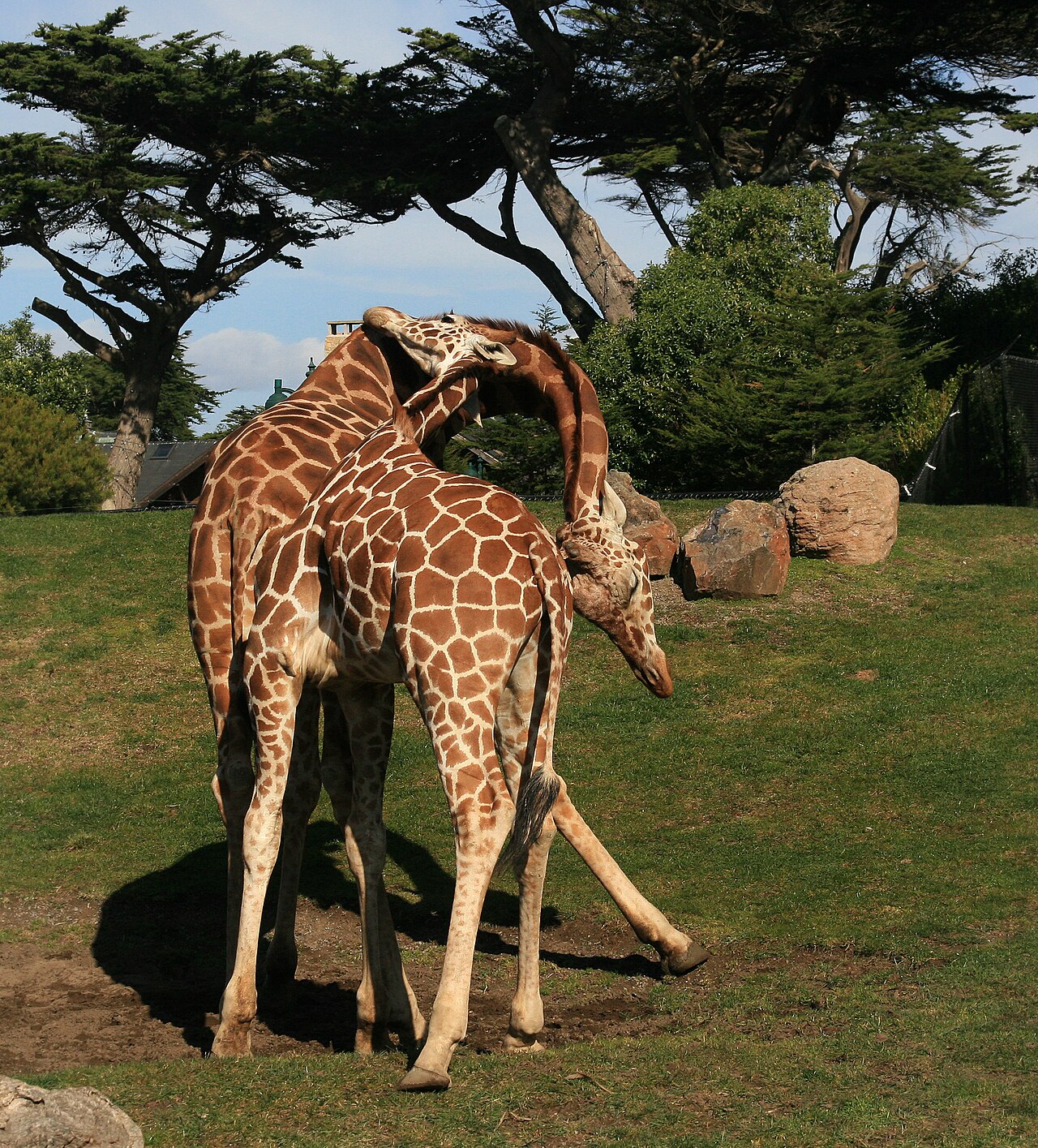
This is where the story gets surprising. Male giraffes use their necks as weapons in ritualized combat called "necking." Two males stand side by side and swing their heads and necks at each other like giant, heavy pendulums, aiming blows at the opponent's body, legs, and neck. These contests can last many minutes and occasionally escalate into serious injury or death, though most are non-lethal displays of strength.
Why Males Are Bigger and Heavier-Necked
Male giraffes are not just taller than females — their necks are proportionally thicker and heavier, and they continue growing well into adulthood, while females' necks stop growing earlier. Males also have a bony lump on the forehead (an ossicone that thickens with age) and heavier skulls. This pattern — where a trait is more exaggerated in the sex that competes for mates — is a hallmark of sexual selection.
Comparative analyses have found that neck length and mass in males scale with body size in ways that look more like a weapon than a feeding tool. In other words, part of the giraffe long neck evolved because longer, heavier necks win fights and therefore win access to females. The feeding advantage likely came along for the ride — or vice versa — but the two pressures reinforced each other over millions of years.
The Fossil Record: When Did the Long Neck Evolve?
Giraffes belong to the family Giraffidae, which today contains only two living species: the giraffe and the okapi (a short-necked, forest-dwelling relative from the Congo). The fossil record shows a rich history of giraffids, including extinct forms with bizarre, moose-like antlers and others with shorter necks.
One key extinct relative, Samotherium, lived roughly 7 to 10 million years ago and had a neck intermediate in length between a modern giraffe and an okapi. Fossils of Samotherium show that the elongation happened gradually, with the middle vertebrae lengthening first — evidence against the idea that the neck appeared suddenly. Genetic studies suggest the giraffe lineage split from the okapi lineage several million years ago, and the extreme elongation we see today likely accumulated over that span through natural and sexual selection acting together.
The Hidden Engineering: How a Long Neck Actually Works
A neck this long creates enormous physiological challenges, and the giraffe's body is packed with extraordinary solutions. These adaptations are some of the strongest evidence that the neck evolved through many small, selected changes.
The Cardiovascular System
To pump blood up a two-meter neck to the brain, a giraffe has an exceptionally powerful heart — weighing up to 11 kilograms (25 pounds) and generating blood pressure roughly twice that of a human. The arteries in the neck have thick, elastic walls to withstand the pressure, and a dense network of blood vessels at the base of the brain (the rete mirabile) helps regulate blood flow.
Equally impressive is what happens when the giraffe lowers its head to drink. Without protection, the sudden rush of blood would be dangerous, so specialized valves and elastic vessel walls buffer the pressure change. Giraffes also have tight skin on their legs that acts like a compression stocking, helping return blood to the heart.
Breathing and the Larynx
The giraffe's long trachea creates a large "dead space" of air that must be moved with each breath, so giraffes breathe more slowly and deeply than similar-sized mammals. Researchers have also found that giraffes have unusually long vocal folds and a unique laryngeal structure, which may explain why they are generally quiet — though they do produce snorts, grunts, coughs, and low-frequency sounds, and there is evidence of humming-like vocalizations at night.
More Than Height: Thermoregulation, Predator Detection, and Social Signaling
Height offers benefits beyond food and fighting. Standing tall gives giraffes an excellent vantage point: a giraffe can spot a lion or other predator from a kilometer or more away, and their own spotted coat — each pattern unique like a fingerprint — provides camouflage in dappled light. Their long legs and neck also help them dissipate heat, since a large body surface area relative to mass helps shed heat in hot savanna climates, and the neck's long, narrow shape may help regulate brain temperature.
Height also plays a role in social life. Giraffes use neck posture and movement in dominance displays, and their ability to see over tall grass and shrubs helps them keep track of herd members and coordinate group movement. When a giraffe stands tall and stares at a predator, it signals to the rest of the herd that danger is near.
Common Myths and Misconceptions About the Giraffe Long Neck
Because giraffes are so familiar, plenty of myths have grown up around them. Here are a few worth correcting.
- Myth: Giraffes have more neck bones than humans. False — they have seven cervical vertebrae, just like us; theirs are simply enormous.
- Myth: Giraffes sleep standing up all the time. They do often rest standing, but they also lie down to sleep, usually in short bouts.
- Myth: Giraffes are silent. They are quiet but not mute; they grunt, snort, and produce low-frequency sounds that are hard for humans to hear.
- Myth: The long neck evolved purely so giraffes could eat treetop leaves. The evidence points to a mix of feeding, sexual selection, and thermoregulation.
- Myth: All giraffes are one species with identical spots. Coat patterns vary by population, and genetic research suggests several distinct species or subspecies.
Conservation: Why Understanding Giraffes Matters
Giraffes are not as numerous as many people assume. The Giraffe Conservation Foundation and IUCN assessments have highlighted a significant decline over recent decades, with some populations — particularly in West and Central Africa — critically endangered. Habitat loss, fragmentation, poaching, and human-wildlife conflict are the main threats. Understanding the giraffe long neck is not just a curiosity: it helps scientists appreciate how specialized these animals are and how vulnerable they become when their savanna habitat shrinks.
Conservation efforts include protected areas, community-based monitoring, and genetic studies that clarify how many distinct giraffe species exist — information that shapes how resources are directed. Because giraffes range widely and reproduce slowly (a single calf after a 15-month gestation), population recovery is gradual.
Conclusion: The Surprising Truth About the Giraffe Long Neck
The giraffe long neck is not the product of one simple cause. The best-supported explanation is a combination of pressures: natural selection for reaching high foliage, sexual selection through male neck-fighting, and secondary benefits like thermoregulation, predator detection, and social signaling. Fossil intermediates like Samotherium show the elongation happened gradually, and the giraffe's extraordinary cardiovascular and respiratory adaptations show how deeply the neck is woven into its biology. So the next time you see a giraffe stretching toward the treetops, remember: that neck is a feeding tool, a weapon, a radiator, and a lookout tower all at once — an evolutionary compromise that turned out to be one of nature's most successful designs.
❓ Frequently Asked Questions
💬 Why do giraffes have long necks?
Giraffes evolved long necks mainly through competition for food, letting them reach leaves other herbivores can't. Sexual selection also played a role, since males use their necks in fights for dominance and females tend to favor larger males.
💬 Do giraffes have seven neck vertebrae like other mammals?
Yes, giraffes have just seven neck vertebrae, the same number as humans and most mammals. Each vertebra is simply enormously elongated, often over 25 centimeters long.
💬 Did giraffes evolve long necks to fight?
Partly, yes. Males swing their heavy necks and heads at rivals in combat called 'necking,' and longer, stronger necks give an advantage in these contests. However, food competition is still considered a major driving force.
💬 How does a long neck help a giraffe survive?
It lets giraffes browse high foliage that most other animals can't reach, reducing competition for food. The long neck also helps them spot predators from a distance and supports powerful neck fighting between males.