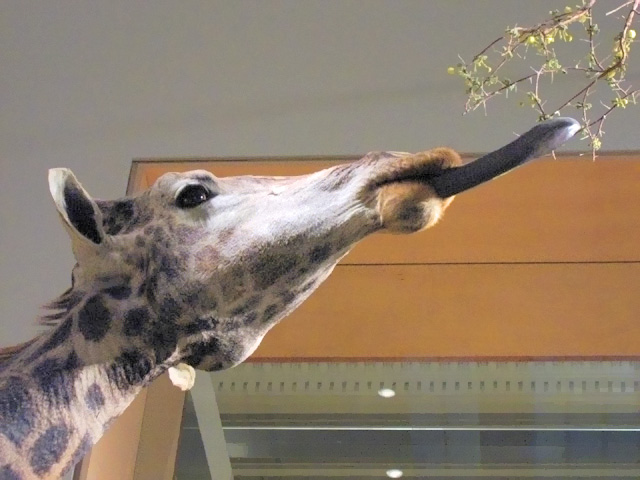
- What Colour Is a Giraffe's Tongue, Really?
- The Anatomy Behind the Colour
- Why Is a Giraffe's Tongue Purple? The Melanin Explanation
- Protection From the African Sun
- Protection From Thorn Scars
- The Real "Dark Truth": Giraffes Eat Trees That Fight Back
- Tannins, Alkaloids, and Cyanogenic Compounds
- Thorns: The Physical Arms Race
- How Acacias Fight Back
- How the Tongue Works: Feeding, Grooming, and More
- The Mechanics of a Giraffe Bite
- Why Giraffes Rarely Get Bitten
- Do All Giraffes Have the Same Tongue Colour?
- Quick Comparison: Giraffe Tongue Facts
- Giraffe Basics: Size, Diet, Habitat, and Lifespan
- Diet and Feeding Habits
- Habitat and Range
- Lifespan and Behaviour
- Predators and Threats
- Common Myths About the Giraffe Purple Tongue
- What the Dark Tongue Tells Us About Evolution
- Conclusion: The Truth Behind the Colour
- ❓ Frequently Asked Questions
The giraffe purple tongue is one of the animal kingdom's most striking curiosities — a muscular, dark bluish-violet organ that can stretch up to 50 centimetres (about 20 inches) out of an animal's mouth and wrap around thorny branches with unnerving precision. Most people who see it for the first time assume the colour must be decorative, or perhaps a trick of the light. It isn't. The dark hue of a giraffe's tongue is a hard-won evolutionary adaptation, shaped by millions of years of feeding on plants that fight back, exposure to relentless ultraviolet radiation, and a daily routine that would leave most mammals bleeding and exhausted. The "dark truth" behind that purple tongue is a story of chemical defences, sun damage, and one of the strangest feeding strategies in the mammal world.
What Colour Is a Giraffe's Tongue, Really?
First, a correction that surprises almost everyone: a giraffe's tongue is not actually purple in the way a grape or an eggplant is purple. The colour is closer to a dark blue-black, deep indigo, or a muted greyish-violet, and it varies between individuals and subspecies. Young giraffes often have tongues that are noticeably paler — sometimes pinkish at the base — and the colour darkens as the animal matures. In some giraffes, the front third of the tongue is almost black, while the base and underside remain a lighter grey-pink.
So why does the "giraffe purple tongue" description stick? Because under bright African sunlight, the dense pigmentation reads as purple to the human eye, especially when the tongue is wet and catching the light. The effect is real, but the cause is biological rather than aesthetic.
The Anatomy Behind the Colour
A giraffe's tongue is roughly 45 to 50 centimetres (18 to 20 inches) long in adults, and it is remarkably prehensile — able to curl, twist, and grip with the dexterity of an elephant's trunk in miniature. The tongue is controlled by a complex set of muscles and is anchored far back in the skull. It is also extremely tough. The surface is covered in thick, keratinised papillae (small hardened bumps) that give it a rasping, sandpaper-like texture, similar in principle to a cat's tongue but far more robust.
That toughness matters, because the tongue's job is brutal. A giraffe uses it to strip leaves from trees that are defended by some of the sharpest thorns in nature.
Why Is a Giraffe's Tongue Purple? The Melanin Explanation
The leading explanation for the dark colour is melanin — the same pigment that darkens human skin and protects it from ultraviolet radiation. Giraffe tongues contain high concentrations of melanin in the outer tissue layers, and this appears to serve two related protective functions.
Protection From the African Sun
A giraffe spends a large part of its day with its tongue extended outside its body, often for hours in total. Unlike most mammals, which keep the tongue safely inside the mouth, a giraffe repeatedly exposes a long, thin, highly vascular organ to direct tropical sunlight. That is a recipe for sun damage, and melanin is nature's sunscreen. The darker the tissue, the more UV radiation it absorbs before that radiation can damage DNA in the tongue's cells.
This is not a fringe theory. Comparative studies of giraffe tongues have found that the pigmentation is concentrated on the upper surface — the side that faces the sun — while the underside is lighter. That asymmetry is exactly what you would expect if UV protection were the driving force.
Protection From Thorn Scars
There is a second, complementary explanation. Giraffes feed heavily on acacia trees, which are armed with thorns up to several centimetres long. Even with careful technique, a giraffe's tongue gets scratched, punctured, and scraped thousands of times over its lifetime. Repeated injury tends to produce scar tissue, and scar tissue in many animals becomes darker and less elastic. Some biologists have suggested that the tongue's dark colour is partly the accumulated result of a lifetime of micro-injuries — a kind of biological callus.
The two explanations are not mutually exclusive. Melanin protects against UV; constant abrasion thickens and darkens the tissue; and the combination produces the near-black tongue we see in mature adults.
The Real "Dark Truth": Giraffes Eat Trees That Fight Back
Here is where the story gets genuinely dark — not because of the tongue's colour, but because of what the tongue has to survive. Giraffes are browsing specialists. They feed on leaves, shoots, flowers, and pods from trees and shrubs, and their favourite targets are acacias and related genera such as Senegalia and Vachellia. Acacias are not passive food. They are chemically armed.
Tannins, Alkaloids, and Cyanogenic Compounds
Acacia leaves contain tannins, alkaloids, and in some species cyanogenic glycosides — compounds that taste bitter, interfere with digestion, and can be toxic in quantity. A giraffe's tongue and digestive system are built to handle them. The tongue's tough surface limits absorption through the mouth, and the giraffe's large liver and specialised saliva help neutralise many of these chemicals.
But the chemical defence is only half the battle.
Thorns: The Physical Arms Race
Acacia thorns can reach 5 to 10 centimetres (2 to 4 inches) in length, and they grow in dense, sometimes hooked clusters. A giraffe cannot simply bite through them. Instead, it uses its tongue like a careful hand: it extends the tongue past the thorns, curls the tip around a bundle of leaves, and pulls them free with a sideways tug. The tongue's tough papillae and thick skin allow it to slide over thorns that would lacerate a softer mouth.
Giraffes also prefer to feed at heights where the thorn density is lower, and they often strip leaves from the tips of branches where the newest growth is least defended. Even so, researchers examining giraffe tongues have documented scarring, nicks, and healed punctures — evidence of a lifetime of thorn contact.
How Acacias Fight Back
Acacias have evolved additional defences that make the giraffe's feeding strategy even more remarkable. When heavily browsed, some acacia species increase tannin production in their leaves within minutes to hours, making themselves less palatable. Others release ethylene gas, which drifts downwind and signals neighbouring trees to ramp up their own chemical defences before the giraffe arrives.
Giraffes respond by browsing into the wind, so they reach trees that have not yet received the warning signal. They also move constantly, feeding in short bursts across many trees rather than stripping one tree bare. This behavioural dance — chemical alarm, wind direction, and a 50-centimetre tongue — is one of the most sophisticated plant-herbivore interactions documented in Africa.
How the Tongue Works: Feeding, Grooming, and More
The giraffe's tongue is not only a feeding tool. It is used for grooming, for exploring objects, and for social interaction. Giraffes have been observed licking their own nostrils, ears, and flanks — an impressive feat given the tongue's length and the animal's body size.
The Mechanics of a Giraffe Bite
When feeding, a giraffe approaches a branch and extends its tongue slowly and deliberately. The tongue wraps around a cluster of leaves, then retracts, dragging the leaves across the lower incisors and canine teeth, which are shaped like pegs and set at the front of the lower jaw. Giraffes have no upper front teeth; instead, they have a hard dental pad. The tongue pulls leaves past this pad, which acts like a cutting edge. The food is then swallowed almost immediately — giraffes do not chew cud in the way cattle do, though they do regurgitate and re-chew food as ruminants.
Why Giraffes Rarely Get Bitten
A common myth claims that a giraffe's dark tongue protects it from being burned by the sun or stung by insects. The sun protection is well supported; the insect protection is more speculative. What is well documented is that giraffes can use their tongues and lips to strip leaves from spiny branches with minimal injury, and that their saliva is unusually thick and sticky, which may help coat and protect the mouth and tongue.
Do All Giraffes Have the Same Tongue Colour?
No. There is natural variation between individuals and between the recognised giraffe subspecies or ecotypes. Giraffes in different parts of Africa — the Masai giraffe of East Africa, the reticulated giraffe of the Horn of Africa, the southern giraffe of southern Africa, and others — show subtle differences in tongue pigmentation, though the overall dark colour is consistent.
Age is the bigger factor. Calves are born with tongues that are relatively pale and soft. As they begin browsing on thorny vegetation, the tongue thickens and darkens. By adulthood, most giraffes have the characteristic near-black tongue that gives rise to the "giraffe purple tongue" description.
Quick Comparison: Giraffe Tongue Facts
- Length: 45–50 cm (18–20 inches) in adults
- Colour: Dark blue-black, indigo, or greyish-violet; paler in young animals
- Texture: Covered in tough, keratinised papillae
- Function: Grasping leaves, grooming, social contact
- Key adaptation: High melanin content for UV protection
- Daily use: A giraffe may spend 16–20 hours a day feeding or ruminating
Giraffe Basics: Size, Diet, Habitat, and Lifespan
To understand why the tongue matters so much, it helps to understand the animal attached to it. Giraffes are the tallest land mammals on Earth. Adult males can reach 5.5 metres (18 feet) in height and weigh up to 1,900 kilograms (4,200 pounds); females are somewhat shorter and lighter. Their long necks allow them to exploit a food source that most herbivores cannot reach — the upper canopy of trees.
Diet and Feeding Habits
Giraffes are browsers rather than grazers. They eat leaves, buds, shoots, flowers, and fruit, and they can consume up to 34 kilograms (75 pounds) of vegetation per day. Acacia is a staple, but they also feed on mimosa, wild apricot, and combretum trees, among many others. Giraffes obtain most of their water from their food, which is a major advantage in arid environments; they can go weeks without drinking if fresh vegetation is available.
Habitat and Range
Giraffes are found across sub-Saharan Africa, from the dry savannas of the Sahel to the woodlands of southern Africa. They prefer open savanna, grassland with scattered trees, and woodland edges where browsing is easy and visibility is good. Their range has shrunk dramatically in the past century. According to the Giraffe Conservation Foundation, wild giraffe numbers have fallen from an estimated 140,000 in the late 1990s to around 117,000 today, and some populations — including the Nubian giraffe — are critically endangered.
Lifespan and Behaviour
Giraffes live about 20 to 25 years in the wild, and up to 28 years in captivity. They live in loose, open herds that change composition frequently. Males engage in "necking" contests — swinging their heads and necks at rivals — to establish dominance. Females form strong bonds and often return to the same calving grounds. Giraffes sleep very little, often just a few minutes at a time, and typically standing up.
Predators and Threats
Adult giraffes have few natural predators, though lions, and occasionally crocodiles at waterholes, will attack them. Calves are far more vulnerable and are preyed on by lions, leopards, hyenas, and wild dogs; roughly half of all calves do not survive their first year. The bigger threat today is human: habitat loss, poaching, and the fragmentation of savanna ecosystems are driving the species' decline.
Common Myths About the Giraffe Purple Tongue
Because the tongue is so distinctive, it has attracted a fair amount of misinformation. Here are the most common claims and what the evidence actually says.
- Myth: The tongue is purple because giraffes eat purple flowers. No. Diet does not determine tongue pigmentation in this way. The colour comes from the animal's own melanin.
- Myth: The tongue is purple to warn predators. There is no evidence for this. Giraffes do not use their tongues as warning signals.
- Myth: The tongue is 60 centimetres long. Measurements generally fall between 45 and 50 centimetres. Some sources exaggerate.
- Myth: Giraffes can pull their tongues all the way into their mouths. They can retract the tongue fully, but the base remains anchored at the back of the mouth.
- Myth: All giraffes have identical tongues. Colour and length vary with age, subspecies, and individual.
What the Dark Tongue Tells Us About Evolution
The giraffe's tongue is a compact case study in adaptation. It shows how a single structure can be shaped simultaneously by multiple pressures: ultraviolet radiation, abrasive food, chemical defences in plants, and the need for precise manipulation of small, defended food items. Each of these pressures favoured a slightly different feature — melanin for UV, keratinised papillae for abrasion, prehensile musculature for dexterity, and a long reach for access.
It also illustrates a principle that biologists call an evolutionary arms race. Acacias evolve thorns and toxins; giraffes evolve tougher tongues, clever feeding behaviour, and a liver that can process plant chemicals. Neither side wins permanently. The relationship is a continuous negotiation, played out over millions of years and observable today in every mouthful a giraffe takes.
And there is a broader point. The giraffe purple tongue is not a quirky fact to file away — it is a visible record of the environment a giraffe lives in. A dark, scarred, 50-centimetre tongue is what it takes to make a living from thorny, chemically defended trees under a punishing sun.
Conclusion: The Truth Behind the Colour
The dark truth about the giraffe purple tongue is that it is not purple for show. It is dark because it has to be. Melanin shields it from intense ultraviolet light during the many hours it spends outside the mouth. Constant contact with acacia thorns thickens and scars it, deepening its colour further. And behind the tongue lies an even darker story: a daily struggle with trees that produce toxins, grow thorns up to 10 centimetres long, and even warn their neighbours when a giraffe is feeding. The giraffe's tongue is a 50-centimetre, near-black, sandpaper-textured survival tool — and one of the clearest examples in nature of anatomy shaped by the specific, unforgiving demands of an animal's diet.
❓ Frequently Asked Questions
💬 Are giraffes' tongues actually purple?
Not truly purple—they're a dark blue-black, mauve, or grayish-purple color, especially toward the tip. The exact shade varies between individual giraffes and can look more purple in certain lighting.
💬 Why do giraffes have dark-colored tongues?
The dark pigment, melanin, likely protects the tongue from sunburn, since giraffes spend hours each day with their tongues exposed while feeding in direct sunlight. It may also help protect against UV damage during those long feeding sessions.
💬 How long is a giraffe's tongue?
A giraffe's tongue can be 45 to 50 centimeters (about 18 to 20 inches) long. That length lets it reach around thorny acacia branches and strip off leaves without getting its face scratched.
💬 Do all giraffes have purple tongues?
Yes, all giraffes have dark-pigmented tongues, though the shade can range from nearly black to a bluish-purple. The color is a normal species trait, not a sign of illness or injury.