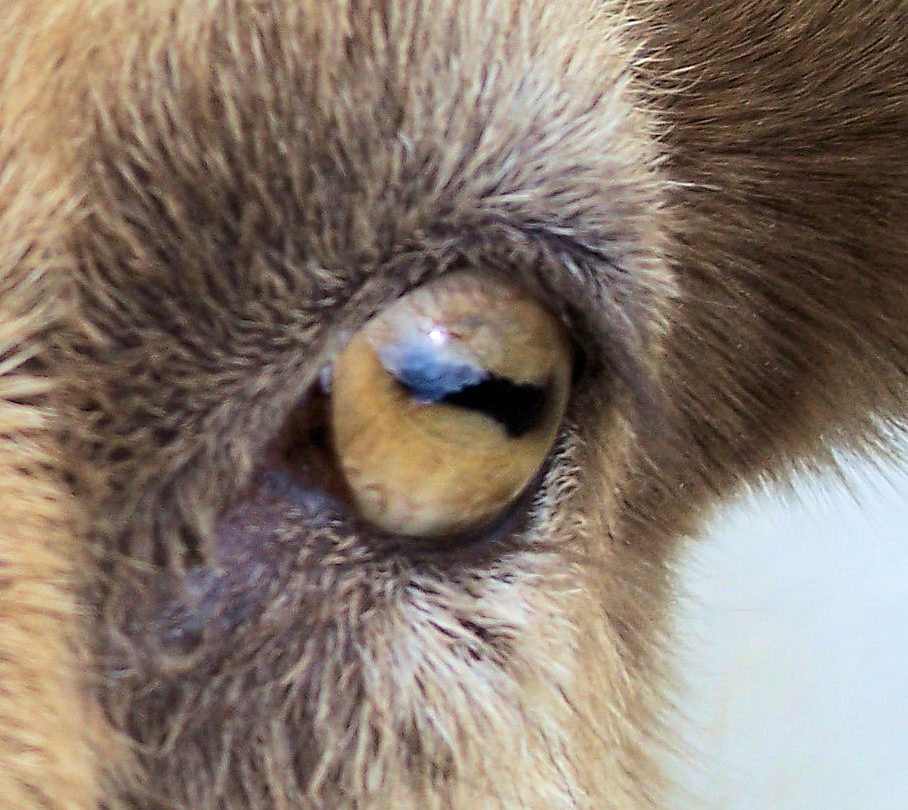
- Goat Rectangular Pupils: A Quick Anatomy Lesson
- Why "Rectangular" Isn't Quite the Whole Story
- Why Do Goat Rectangular Pupils Work So Well? The Optical Advantage
- A Panoramic Field of View
- Sharp Vision Along the Ground
- Reduced Glare in Bright Sunlight
- Goat Rectangular Pupils vs. Other Animal Eyes
- Vertical Slits: Cats and Predators
- Round Pupils: Humans, Primates, and Many Others
- Horizontal Pupils: Goats, Sheep, Deer, and Horses
- The Science Behind the Shape: What Research Shows
- Light, Depth, and the Limits of the Rectangle
- Beyond Vision: How Goat Eyes Fit a Goat's Life
- Diet and Habitat
- Behavior and Social Structure
- Size, Lifespan, and Daily Rhythms
- Common Myths About Goat Rectangular Pupils
- Myth: Rectangular Pupils Let Goats See in the Dark
- Myth: The Shape Is Unique to Goats
- Myth: Goats Are Colorblind
- Myth: The Pupil Shape Means Goats Are "Evil" or Unnatural
- What Goat Eyes Teach Us About Evolution
- Conclusion: The Pasture Truth About Goat Rectangular Pupils
- ❓ Frequently Asked Questions
If you've ever locked eyes with a goat over a fence, you've probably noticed something strange: instead of the round black dots most mammals sport, the goat rectangular pupils stretch sideways across the eye like a letterbox slot. This isn't a quirk of evolution or a random accident of anatomy. The goat rectangular pupils are a precision-engineered optical system, shaped over millions of years to solve a very specific problem: how to eat almost anything, almost anywhere, while staying alive. In this article, we'll unpack the science behind those famous horizontal slits, compare them with other animals, and explain why this odd-looking eye makes goats some of the most adaptable herbivores on the planet.
Goat Rectangular Pupils: A Quick Anatomy Lesson
The pupil is simply the opening in the center of the iris that lets light into the eye. In humans and most primates, it's a circle. In cats, it's a vertical slit. In goats, sheep, deer, and many other grazing animals, it's a wide horizontal rectangle with rounded corners — sometimes described as a "letterbox" or a "loaf of bread" shape.
That shape is created by two opposing sets of muscles in the iris. In a round pupil, a ring of sphincter muscle squeezes the opening closed like a drawstring bag. In a goat's eye, the muscle fibers are arranged in a horizontal band that can contract the pupil into a narrow slit or relax it into a broad rectangle. The result is a pupil that can change its shape dramatically — from a wide horizontal window in dim light to a thin line in bright sun.
Why "Rectangular" Isn't Quite the Whole Story
Strictly speaking, the goat pupil is a horizontally elongated ellipse or a rounded rectangle. When fully dilated in low light, it looks almost like a wide oval. When constricted in bright daylight, the top and bottom edges flatten and the corners sharpen, giving it that unmistakable rectangular appearance. The exact shape varies with lighting, age, and individual animal, which is why photos of goat eyes can look surprisingly different from one another.
Why Do Goat Rectangular Pupils Work So Well? The Optical Advantage
The shape of a pupil isn't just cosmetic. It controls how light enters the eye and, crucially, how much of the surrounding world the animal can see. For a prey animal that spends most of its day with its head down in grass, the horizontal rectangle is a near-perfect solution.
A Panoramic Field of View
Goats are classic prey animals, and their eyes sit on the sides of their heads rather than the front. This gives them an enormous field of view — roughly 320 degrees in many breeds, meaning they can see almost everything around them except a small blind spot directly behind the head and a narrow zone in front of the nose. The horizontal pupil complements this arrangement by widening the vertical and horizontal spread of light entering the eye, effectively stretching the visible panorama even further.
For a goat grazing on a hillside, that wide view is a survival tool. It can keep its head down, cropping grass, while still detecting a predator approaching from the side or from slightly above. Researchers who study pupil shape have found that horizontal pupils consistently belong to animals that are preyed upon and that need to scan the horizon for threats.
Sharp Vision Along the Ground
There's another subtle benefit. Because the goat's pupil is wider than it is tall, light entering from the sides is gathered efficiently, while light from above and below is restricted. This sharpens the image of the horizontal band where the ground meets the sky — exactly the zone where a grazing animal needs to spot both food and danger. The goat's eye is, in effect, tuned to the horizon line.
Reduced Glare in Bright Sunlight
Goats often live in open, sunny environments — rocky Mediterranean hillsides, arid scrublands, high-altitude pastures. A pupil that can close down to a thin horizontal slit cuts glare dramatically while still preserving a wide view. This helps explain why goats, sheep, and other grazing animals thrive in bright, exposed habitats where a round pupil would struggle to balance light intake and image clarity.
Goat Rectangular Pupils vs. Other Animal Eyes
Comparing pupil shapes across species reveals a clear pattern: shape follows lifestyle. The goat's rectangular pupil is one solution among several, and each shape tells a story about how an animal lives.
Vertical Slits: Cats and Predators
Cats, foxes, and many nocturnal predators have vertical slit pupils. These are ideal for ambush hunters that need to judge distance precisely when pouncing. A vertical slit sharpens focus along the vertical axis and allows rapid adjustment to changing light levels, which matters for animals active at dawn and dusk. The trade-off is a narrower horizontal field of view — fine for a predator that can turn its head, less useful for a prey animal that needs constant peripheral awareness.
Round Pupils: Humans, Primates, and Many Others
Round pupils are the most common shape among mammals. They offer a balanced compromise: decent light gathering, reasonable depth of field, and no strong directional bias. Humans, dogs, and most primates have them because their visual needs are different — forward-facing eyes for depth perception, with less emphasis on panoramic scanning.
Horizontal Pupils: Goats, Sheep, Deer, and Horses
The horizontal pupil is the signature of grazing herbivores. Sheep, deer, antelope, horses, and cattle all share some version of this design, though the exact shape varies. Sheep pupils are notably rectangular, similar to goats. Horses have a horizontally oval pupil. Deer pupils are wide and slightly rounded. The common thread is a lifestyle built around grazing in open or semi-open habitats where detecting predators from the side is a matter of life and death.
- Goats and sheep: horizontally rectangular pupils, ~320-degree field of view
- Cats: vertical slit pupils, strong depth perception for pouncing
- Humans and primates: round pupils, forward-facing eyes for binocular vision
- Horses: horizontally oval pupils, wide panoramic vision
- Geckos: vertical slit pupils with multiple pinholes, adapted for nocturnal hunting
The Science Behind the Shape: What Research Shows
The study of pupil shape has become a surprisingly rich field. A widely cited 2015 study published in the journal Science Advances analyzed 214 land species and found a strong statistical link between pupil shape and ecological niche. Species with vertical slit pupils were overwhelmingly ambush predators active at dawn and dusk. Species with horizontal pupils were overwhelmingly prey animals that graze and need to scan the horizon.
The researchers also found something remarkable: when a goat lowers its head to graze, its eyes rotate so that the pupil stays aligned with the horizon. This reflex keeps the horizontal band of sharp vision level with the ground, even as the head tilts down. It's a small detail that reveals how deeply the goat's visual system is tuned to its way of life.
Light, Depth, and the Limits of the Rectangle
The rectangular pupil isn't perfect. It offers less precise depth perception than a round or vertical pupil, which is one reason goats rely heavily on other senses — smell, hearing, and a strong social awareness — to navigate the world. Goats are also known for their climbing ability and curiosity, and their vision is better suited to spotting movement across a wide field than to fine visual detail up close.
Still, the trade-off works. A goat that can see a wolf approaching from 200 degrees to its left while its head is buried in clover has a serious survival advantage over one that can't.
Beyond Vision: How Goat Eyes Fit a Goat's Life
Understanding goat rectangular pupils means understanding goats themselves. Domestic goats (Capra hircus) descend from the wild goat (Capra aegagrus) of the Middle East and Central Asia, and they retain many of the traits that made their ancestors successful in rugged, open terrain.
Diet and Habitat
Goats are browsing herbivores, not pure grazers. They eat grasses, shrubs, leaves, bark, and almost anything else edible — a habit that has earned them a reputation as living lawnmowers. They thrive in rocky, mountainous, and semi-arid environments, from the Alps to the Ethiopian highlands to the American Southwest. Their eyes suit this life: wide horizontal vision for spotting predators across open ground, and the ability to keep scanning while their heads are down in brush.
Behavior and Social Structure
Goats are highly social herd animals, living in groups that provide safety in numbers. A goat that spots a threat will often stare at it, stamp a hoof, and alert the herd. That behavior depends on being able to see threats from many angles at once — exactly what the rectangular pupil provides. Herd living and horizontal vision reinforce each other: many eyes, each with a panoramic view, make a herd very hard to sneak up on.
Size, Lifespan, and Daily Rhythms
Domestic goats typically weigh between 45 and 140 kilograms (100–310 pounds) depending on breed, with some large breeds like the Boer goat reaching higher weights. They live around 10–15 years in captivity, though wild goats often live shorter lives. Goats are crepuscular to diurnal, most active in the morning and evening, and they spend a large portion of their day foraging — which means their eyes are in near-constant use scanning the ground and the horizon.
Common Myths About Goat Rectangular Pupils
Because goat eyes look so unusual, they've attracted plenty of folklore and misinformation. Here are a few of the most common myths, and what's actually true.
Myth: Rectangular Pupils Let Goats See in the Dark
Not really. Goats have decent low-light vision, thanks to a reflective layer called the tapetum lucidum that gives their eyes a greenish glow when light hits them at night. But the rectangular shape itself isn't a night-vision feature. Its main job is panoramic scanning and glare control in daylight.
Myth: The Shape Is Unique to Goats
False. Sheep, deer, antelope, horses, and cattle all have horizontal pupils of some kind. Goats are simply one of the most visible examples, partly because their pupils are so distinctly rectangular and partly because goats are common, charismatic farm animals that people meet up close.
Myth: Goats Are Colorblind
Goats aren't colorblind in the way people once assumed. Research suggests they can distinguish some colors, particularly blues and greens, though their color vision is less rich than a human's. Their vision is optimized for detecting movement and contrast across a wide field rather than for fine color discrimination.
Myth: The Pupil Shape Means Goats Are "Evil" or Unnatural
This is pure superstition. The rectangular pupil is a normal, functional adaptation found across many grazing species. It's no more sinister than a cat's slit or a human's circle — just a different evolutionary answer to a different set of survival pressures.
What Goat Eyes Teach Us About Evolution
The goat rectangular pupil is a small anatomical detail with a large lesson. It shows how evolution solves problems with remarkable precision: a grazing animal that needs to eat constantly, watch for predators, and navigate bright, open terrain ends up with an eye shaped like a letterbox. Change the lifestyle, and the pupil changes too.
That's why comparing pupils across species is so revealing. A vertical slit belongs to a predator that pounces. A round pupil belongs to an animal with forward-facing eyes and strong depth perception. A horizontal rectangle belongs to a prey animal that lives with its head down and its eyes on the horizon. The shape of the pupil is a kind of biological signature — a quick clue to how an animal makes its living.
For anyone who keeps goats, the takeaway is practical as well as fascinating. Understanding how goats see helps explain their behavior: why they startle at movement from the side, why they seem to stare at you from an odd angle, why they're so alert to changes in their surroundings. Their eyes are built to notice things at the edges of vision, and that shapes how they interact with the world — and with us.
Conclusion: The Pasture Truth About Goat Rectangular Pupils
Goat rectangular pupils are one of nature's most elegant design solutions. Far from being a random oddity, the horizontal rectangle is a precision instrument for a grazing, prey-animal lifestyle. It widens the goat's already impressive field of view, sharpens vision along the horizon, cuts glare in bright sunlight, and even stays level with the ground as the goat lowers its head to eat. Compared with the vertical slits of cats and the round pupils of humans, the goat's eye is a reminder that vision evolves to fit an animal's needs — and that a goat's needs are written into every blade of grass it crops and every direction it scans for danger. Next time you meet a goat's gaze through a fence, you'll know exactly what you're looking at: a letterbox-shaped window into millions of years of evolutionary fine-tuning.
❓ Frequently Asked Questions
💬 Do all goats have rectangular pupils?
Yes, domestic goats and most other grazing animals like sheep, deer, and cattle have horizontal rectangular pupils. The shape is a shared trait among prey animals that need a wide field of view to spot predators.
💬 What is the advantage of rectangular pupils in goats?
A horizontal rectangular pupil lets goats see a very wide panoramic view of their surroundings, helping them detect predators approaching from almost any direction. It also improves their ability to spot movement near the horizon while grazing.
💬 Can goats see better than humans?
Goats have a much wider field of view than humans—roughly 320 degrees versus about 210—but their depth perception and detail vision are generally weaker. Their rectangular pupils are optimized for spotting motion and threats, not for sharp focus like ours.
💬 Do goats' pupils change shape in different light?
Yes, the rectangular pupil can narrow into a thin horizontal slit in bright light and widen into a broader rectangle in dim light. This lets goats control how much light enters their eyes across a wide range of conditions.