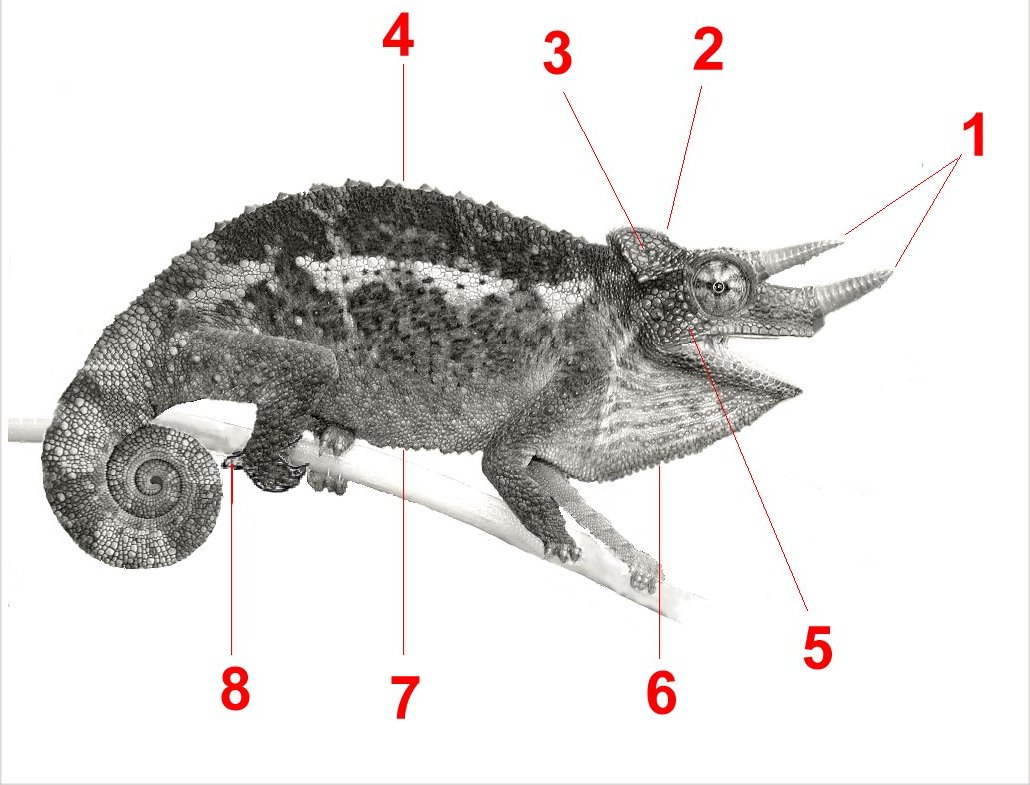
- The Anatomy and Evolution of Jackson's Chameleon Horns
- The Growth Process and Lifespan of the Horns
- The Role of Jackson's Chameleon Horns in Male Combat
- Sexual Selection and Female Choice in Mating
- The Horns as a Misunderstood Defense Mechanism
- Habitat, Diet, and the Daily Life of a Horned Chameleon
- Specific Behavioral Traits and Temperament
- Conservation Status and the Importance of Understanding Horns
- Conclusion: The Horns as a Masterpiece of Evolution
- ❓ Frequently Asked Questions
The three prominent horns adorning the heads of male Jackson's chameleons are more than just bizarre ornamentation; they are the key to understanding the species' entire evolutionary strategy, social structure, and survival. These Jackson's chameleon horns are not weapons for defense against predators, but rather highly specialized tools for communication, combat, and courtship, shaped by millions of years of sexual selection. Understanding the truth behind these fascinating structures reveals a complex story of biological adaptation that goes far beyond the simple "rhinoceros of the reptile world" label they often receive.
The Anatomy and Evolution of Jackson's Chameleon Horns
To truly appreciate the function of these horns, one must first understand their physical composition and evolutionary origins. The horns are not made of bone like those of a rhinoceros, nor are they keratin like the horns of a cow or goat. Instead, they are solid, bony projections covered by a thin layer of skin and scales. They are technically known as "rostral processes" or "nasal horns," and they grow directly from the skull.
In the case of Trioceros jacksonii, the species native to the humid, montane forests of Kenya and Tanzania, the horn arrangement is quite specific. Males possess three distinct horns: a large, prominent horn on the snout (the rostral horn) and two smaller, often slightly curved horns just above the eyes (the preocular horns). This three-horned configuration is unique among chameleons and instantly distinguishes Jackson's chameleons from other species like the veiled chameleon, which has a single casque (a helmet-like crest) and no horns.
Evolutionarily, these structures are a classic example of sexual dimorphism, where males and females of the same species evolve different physical traits. Females of the species are typically hornless, or at most, possess tiny, barely perceptible nubs. This stark difference between the sexes is the first major clue that the horns' primary purpose is tied to male-to-male interaction and reproductive success, rather than general survival. The evolutionary pressure to develop these horns came from competition for mates—females were more likely to choose males with larger, more impressive horns, and males with bigger horns were better able to defeat rivals.
The Growth Process and Lifespan of the Horns
These horns are not present at birth. Baby Jackson's chameleons, which are born live (this species is ovoviviparous, giving birth to live young rather than laying eggs), emerge with smooth heads. The horns begin to develop and become noticeable as the juveniles mature, typically around the age of 4 to 6 months. The growth rate is influenced by the chameleon's health, diet, and environmental conditions, particularly the availability of calcium and UVB lighting, which are crucial for bone development.
The horns will continue to grow throughout the male's life, though the growth rate slows significantly after sexual maturity is reached at around 8 to 12 months. In a healthy adult male, the rostral horn can measure between 1.5 and 2.5 inches in length, which is quite substantial for a reptile that only reaches a total body length of about 12 to 15 inches. The lifespan of a Jackson's chameleon is relatively short—typically 5 to 10 years in captivity, with 8 years being a good average—meaning the horns must serve their purpose effectively during a limited window of reproductive opportunity.
The Role of Jackson's Chameleon Horns in Male Combat
Perhaps the most dramatic and visually striking use of Jackson's chameleon horns is in ritualized combat between rival males. When two males encounter each other in their arboreal territory, the interaction rarely begins with immediate physical contact. Instead, it starts with an elaborate display of color changes and body posturing. The males will brighten their green coloration, sometimes flashing bright blues, yellows, and even reds, and will puff up their bodies to appear larger. They will also curl their tails and sway side-to-side, using their entire bodies to communicate their size and strength.
If this visual intimidation fails to resolve the dispute, the males will escalate to physical combat. This is where the horns become the primary weapons. The two males will lock their horns together, much like deer or antelope, in a test of strength and leverage. They will push and shove, attempting to unbalance the other. The goal is not to gore or injure the opponent fatally, but rather to physically dominate them and force them to submit.
The mechanics of this combat are fascinating. The large rostral horn acts as a grappling hook, while the two smaller preocular horns provide additional points of contact, preventing the opponent from easily disengaging. The chameleons will often lean backwards, using their strong legs and prehensile tails to anchor themselves to branches, creating a powerful tug-of-war. These wrestling matches can last for several minutes and are often decided by sheer physical strength and stamina.
The winner of these contests earns the right to remain in the territory and access the females that reside there. The loser, more often than not, is not severely injured but is chased away, forced to find a less desirable territory. This behavior highlights that the horns are not for defense against predators like birds or snakes, but are exclusively for intraspecific competition—competition within their own species.
Sexual Selection and Female Choice in Mating
While the horns are used in direct combat, their evolutionary significance extends beyond just physical dominance. The theory of sexual selection suggests that females also play an active role in the evolution of these elaborate traits through their choice of mates. In the case of Jackson's chameleons, the size and symmetry of the horns are believed to be indicators of a male's overall health and genetic fitness.
A male with large, symmetrical horns demonstrates that he has had access to sufficient nutrition, has successfully fought off parasites and disease, and possesses strong genes. This is known as the "good genes" hypothesis. When a female selects a mate, she is not just choosing a partner; she is choosing the genetic material for her offspring. By selecting a male with impressive horns, she is increasing the likelihood that her sons will also possess these beneficial traits and be successful in their own battles for dominance.
During courtship, the male performs a specific display for the female. He will approach her with a slow, jerky gait, bobbing his head and displaying his horns prominently. He may also perform a series of color changes to show his vibrant breeding colors. The female observes this display and will either accept the male by remaining stationary and allowing him to approach, or reject him by gaping her mouth, hissing, and swinging her body in an aggressive manner. This female choice adds another layer of selective pressure, ensuring that only the most impressive males get to pass on their genes.
The Horns as a Misunderstood Defense Mechanism
A common misconception is that these horns are used for defense against predators. This is largely untrue. When a Jackson's chameleon feels threatened by a bird, snake, or human, its first and primary defense is crypsis—the ability to blend in with its surroundings. They are masters of camouflage, able to change their skin color to match the leaves and bark of their environment, and they will often freeze in place, swaying gently to mimic a leaf blowing in the wind.
If camouflage fails, their next line of defense is to puff up their bodies, open their mouths wide to display the bright pink or orange interior, and hiss loudly. This bluff display is often enough to startle a predator. They may also bite, and a large Jackson's chameleon can deliver a painful bite, but this is a last resort, not a primary strategy.
The horns are too short and blunt to be effective weapons against a predator's thick feathers or fur, and they are positioned on the head in a way that makes it difficult to strike downwards. They are simply not designed for this purpose. The horns are purely for intraspecific communication and combat, and understanding this distinction is crucial to understanding the animal's true ecology.
Habitat, Diet, and the Daily Life of a Horned Chameleon
The environment in which these chameleons live has shaped their behavior and the evolution of their horns. Jackson's chameleons are arboreal, spending nearly their entire lives in the branches of trees and bushes. They are native to the montane forests of East Africa, where the climate is cool and humid, with frequent mist and rain. In this dense, three-dimensional environment, visual communication is paramount. The ability to display bright colors and prominent horns is much more effective than auditory or chemical signals, which can be easily blocked by dense foliage.
Their diet consists primarily of insects. They are ambush predators, using their unique, independently-moving eyes to scan for prey. Once they spot a cricket, roach, or worm, they will slowly creep towards it and then launch their long, ballistic tongue, which can extend up to 1.5 times their body length, to capture it in a fraction of a second. In captivity, they are often fed a diet of gut-loaded crickets, mealworms, and waxworms, dusted with calcium and vitamin D3 supplements to maintain bone health, which is critical for their horn growth.
The daily life of a Jackson's chameleon is one of slow, deliberate movement. They are solitary creatures, coming together only to mate. They spend their days basking in patches of sunlight to regulate their body temperature, hunting for passing insects, and carefully navigating their territory. The need to defend a prime hunting territory with good sun exposure and abundant prey is what drives the male-to-male combat described earlier, making the horns a daily-used tool in their survival.
Specific Behavioral Traits and Temperament
These chameleons are known for their relatively calm but highly stressed temperament. They are not social animals and do not enjoy being handled. In captivity, they are considered "display animals" rather than pets that can be held. Handling them can cause significant stress, leading to health problems like mouth rot or respiratory infections. They are also notorious for their slow, deliberate movements, which can be mistaken for lethargy, but is actually a sophisticated hunting and predator-avoidance strategy.
Interestingly, they are also known for their live births. Unlike many other chameleons that lay eggs, female Jackson's chameleons carry their young internally for 5 to 6 months before giving birth to 8 to 30 live babies. This adaptation is thought to have evolved in response to the cool, unpredictable climate of their montane habitat, where egg incubation in the soil would be risky. The babies are born fully formed and independent, ready to start their own lives in the trees, although they will not develop their full horns for many months.
Conservation Status and the Importance of Understanding Horns
Understanding the function of the horns is not just an academic exercise; it is vital for conservation efforts. In their native habitat, Jackson's chameleons face threats from habitat destruction due to deforestation for agriculture and logging. They are also heavily collected for the international pet trade, although many countries now regulate this trade. The species is listed under CITES (Convention on International Trade in Endangered Species of Wild Fauna and Flora) Appendix II, which means that trade is regulated to ensure it does not threaten their survival.
Conservationists who understand the social dynamics and reproductive needs of these animals, including the critical role of the horns, are better equipped to manage captive breeding programs and protect wild populations. For example, knowing that males fight using their horns means that captive facilities must provide enough space and visual barriers to prevent constant, stressful battles. Understanding that females choose mates based on horn size means that breeding programs should prioritize the genetic diversity that maintains these traits.
Conclusion: The Horns as a Masterpiece of Evolution
The three horns of the Jackson's chameleon are a testament to the power of natural and sexual selection. They are not simple appendages but rather complex biological structures that dictate the social hierarchy, mating success, and evolutionary path of the species. From the delicate growth process influenced by nutrition and UVB light, to the brutal, ritualized wrestling matches between males, and the subtle cues they provide to discerning females, the horns are integral to every aspect of the male's life.
They are a clear example of how a physical trait can be honed over millennia to serve a very specific purpose. While they may look like weapons, they are more accurately described as social tools and status symbols. The truth is that these horns are a brilliant evolutionary solution to the problem of competition, allowing males to establish dominance and secure reproductive rights without resorting to fatal violence. By looking beyond the bizarre appearance and understanding the true function of these horns, we gain a deeper appreciation for the intricate and often surprising ways in which life adapts and thrives in the natural world.
❓ Frequently Asked Questions
💬 Do female Jackson's chameleons have horns?
No, female Jackson's chameleons typically have no horns or only tiny, barely visible bumps. The three prominent horns are a male-only trait, used for combat and display during mating rituals.
💬 What are the three horns used for?
Male Jackson's chameleons use their three horns primarily to fight rival males for territory and access to females. They lock horns and push, trying to flip each other over, much like deer antlers in combat.
💬 Do Jackson's chameleons horns grow back if broken?
No, once a Jackson's chameleon breaks a horn, it does not regrow. Horns are made of keratin-covered bone, and damage is permanent, though minor chips may smooth over with shed cycles.
💬 Are the horns sharp or dangerous to humans?
The horns are blunt and not sharp, so they rarely cause injury to humans, but they can scratch if the chameleon thrashes. They are more for wrestling than piercing, so handling with care is still recommended.