- The Biological Imperative Behind Monarch Butterflies Migration
- Why They Cannot Stay in Northern Habitats
- The Unique Physiology of the Migratory Generation
- Navigating the Epic Journey: How Monarch Butterflies Migration Works
- Navigation Without a Map
- Staging and Roosting Behavior
- The Specific Overwintering Habitats That Make Monarch Butterflies Migration Worthwhile
- Why Mexico and Not Elsewhere?
- California's Coastal Groves
- The Role of Milkweed and Life Cycle in Driving Migration
- Seasonal Milkweed Availability
- A Multi-Generational Round Trip
- Threats to Monarch Butterflies Migration and Conservation Efforts
- Habitat Loss
- Climate Change
- Conservation Actions
- Real Examples and Record-Breaking Journeys
- Western Monarchs: A Separate Population
- Conclusion: The Fragile Future of Monarch Butterflies Migration
- ❓ Frequently Asked Questions
The annual monarch butterflies migration is one of the most extraordinary phenomena in the natural world, a journey that spans thousands of miles and multiple generations. Every year, millions of these delicate orange-and-black insects embark on a perilous trek from their summer breeding grounds in the United States and Canada to specific overwintering sites in central Mexico and along the California coast. But why do monarch butterflies migrate so far? The answer lies in a complex interplay of biology, climate, and survival strategies that have evolved over millennia.
The Biological Imperative Behind Monarch Butterflies Migration
Monarch butterflies (Danaus plexippus) are cold-blooded insects that cannot tolerate freezing temperatures. Unlike birds or mammals, they lack the internal mechanisms to generate body heat. When temperatures drop below 55°F (13°C), their flight muscles become stiff, and they enter a state of torpor. Prolonged exposure to freezing conditions is lethal. The primary driver of the monarch butterflies migration is the search for a suitable microclimate that ensures their survival through the winter.
Why They Cannot Stay in Northern Habitats
During the summer, monarchs thrive across North America, feeding on milkweed (Asclepias species) and other nectar plants. However, as autumn approaches, the northern regions become inhospitable. Daylength shortens, temperatures plummet, and frost kills the milkweed plants that caterpillars depend on. If monarchs remained in Canada or the northern United States, they would face starvation and freezing death. The migration is essentially a life-or-death escape to a stable, cool but frost-free environment.
The Unique Physiology of the Migratory Generation
Not all monarchs migrate. The generation that emerges in late summer and early autumn is physiologically distinct. Known as the "Methuselah generation," these butterflies live up to eight or nine months, compared to the typical two to six weeks of summer generations. They enter a reproductive diapause—a state of suspended sexual maturity—which allows them to conserve energy for the long flight. Their bodies store fat reserves, and their wings become more durable for endurance flying. This specialized life stage is what makes the monarch butterflies migration possible.
Navigating the Epic Journey: How Monarch Butterflies Migration Works
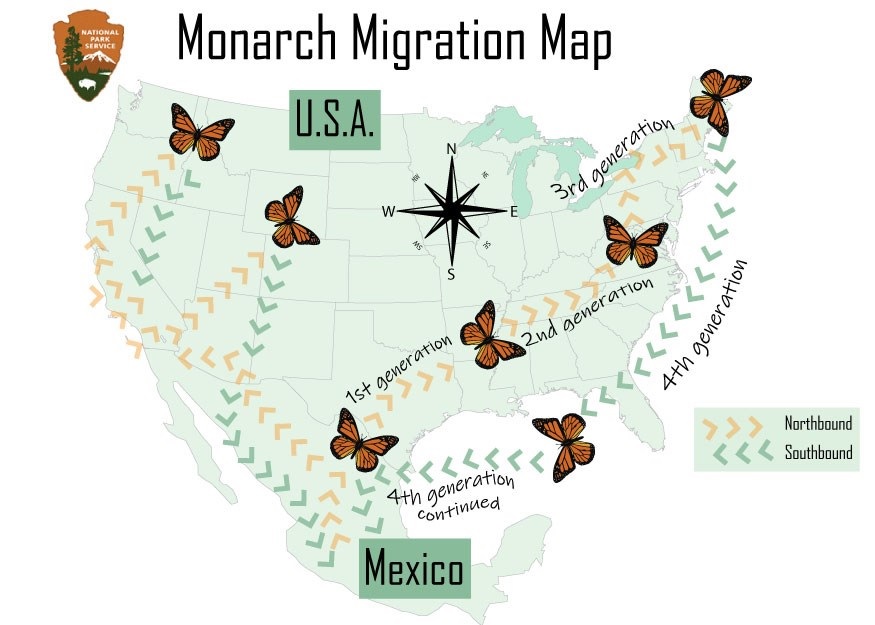
The monarch butterflies migration is not a single continuous flight but a multi-stage journey involving millions of individuals moving in a southwesterly direction. Eastern monarchs travel up to 3,000 miles to the oyamel fir forests of Michoacán and the State of Mexico, while western monarchs migrate to groves along the California coast, such as those in Pacific Grove and Santa Cruz.
Navigation Without a Map
How do monarchs find their way to specific overwintering sites they have never visited? Research shows they use a combination of a sun compass and an internal circadian clock. Their compound eyes detect the sun's position, and their brain adjusts for the time of day, allowing them to maintain a consistent southern heading. Recent studies also suggest they may sense the Earth's magnetic field, providing a backup navigation system on cloudy days. This innate ability is encoded in their genes, passed down from previous generations that made the same journey.
Staging and Roosting Behavior
During migration, monarchs do not fly non-stop. They travel during the day, riding thermals and tailwinds to conserve energy, and they roost at night in large clusters on trees. These overnight aggregations, sometimes numbering in the thousands, provide warmth and protection from predators. Along the way, they stop to feed on nectar from flowers like goldenrod, asters, and blazing stars, building up the fat reserves needed to survive the winter. The entire journey can take two to three months, with individuals covering 50 to 100 miles per day under favorable conditions.
The Specific Overwintering Habitats That Make Monarch Butterflies Migration Worthwhile
The monarch butterflies migration ends in highly specific, fragile habitats that offer the perfect winter conditions. For the eastern population, this is the oyamel fir forests of central Mexico, located at elevations between 9,000 and 11,000 feet. These forests create a unique microclimate: cool enough to slow the butterflies' metabolism but not so cold that they freeze. The dense tree canopy moderates temperature fluctuations, protects from rain and snow, and maintains high humidity, preventing the butterflies from drying out.
Why Mexico and Not Elsewhere?
The oyamel forest provides a "sweet spot" of temperature and moisture that is rarely found elsewhere. Studies show that the ideal temperature for overwintering monarchs is between 32°F and 59°F (0°C to 15°C). At these temperatures, they remain in a state of low metabolic activity, conserving fat stores. If the forest were warmer, they would burn through their fat reserves too quickly; if colder, they would freeze. This delicate balance is why the monarch butterflies migration targets such a narrow geographic zone.
California's Coastal Groves
The western monarch population relies on groves of eucalyptus, Monterey pines, and cypress trees along the California coast. These coastal sites offer similar benefits: moderate temperatures moderated by the Pacific Ocean, protection from wind, and access to nectar plants during occasional warm spells. However, these habitats are increasingly threatened by development, disease (such as eucalyptus dieback), and climate change, making the monarch butterflies migration even more precarious.
The Role of Milkweed and Life Cycle in Driving Migration
Understanding the monarch butterflies migration requires examining the butterfly's complete life cycle. Monarchs are obligate specialists on milkweed plants. Female monarchs lay eggs exclusively on milkweed, and the caterpillars feed only on milkweed leaves, which contain toxic cardiac glycosides that make them unpalatable to predators. This specialized diet ties the butterfly's distribution directly to the availability of milkweed.
Seasonal Milkweed Availability
In spring and summer, milkweed is abundant across North America, from the southern United States to southern Canada. As monarchs move northward, they colonize new areas, laying eggs and producing multiple generations. But by late summer, milkweed begins to senesce and die back in northern regions. The migrating generation must leave these areas because there is no food for their offspring. The monarch butterflies migration is thus a response to the seasonal collapse of their larval host plant.
A Multi-Generational Round Trip
The entire migration is a multi-generational cycle. The monarchs that leave Mexico in March fly to the southern United States, where they lay eggs and die. Their offspring continue northward, and it takes three to four generations to reach Canada by summer. The final generation, born in late summer, makes the return journey to Mexico. No single butterfly completes the entire round trip; instead, the migration is a relay race of generations, guided by inherited instinct.
Threats to Monarch Butterflies Migration and Conservation Efforts
The monarch butterflies migration is considered an endangered biological phenomenon by the International Union for Conservation of Nature (IUCN). The eastern population has declined by over 80% in the past two decades, and the western population has plummeted by more than 95% since the 1980s. Several factors contribute to this decline.
Habitat Loss
The primary threat is the loss of both milkweed breeding habitat and overwintering forest habitat. In the United States, widespread use of glyphosate-based herbicides on genetically modified crops has eliminated milkweed from vast agricultural landscapes. In Mexico, illegal logging and forest degradation have shrunk the oyamel forests, reducing the area available for overwintering monarchs. In California, coastal development has destroyed many groves.
Climate Change
Climate change poses a growing danger. Extreme weather events, such as droughts, late spring freezes, and unseasonal storms, can kill migrating monarchs or disrupt their timing. Warmer autumns may delay the onset of diapause, causing butterflies to migrate too late. Changes in precipitation patterns in Mexico could make the overwintering microclimate unsuitable. Scientists project that suitable overwintering habitat could shift northward, but monarchs may not be able to adapt quickly enough.
Conservation Actions
Conservation efforts are underway at multiple levels. In the United States, initiatives like the Monarch Butterfly Conservation Fund and the Million Pollinator Garden Challenge aim to restore milkweed along migration corridors. In Mexico, the Monarch Butterfly Biosphere Reserve was established to protect the core overwintering sites, and community-based monitoring programs help combat illegal logging. Citizens can help by planting native milkweed and nectar plants, avoiding pesticides, and supporting conservation organizations.
Real Examples and Record-Breaking Journeys
The scale of the monarch butterflies migration is best appreciated through specific examples. The longest recorded individual flight was a monarch tagged in Ontario, Canada, and recovered in Mexico, a distance of 2,800 miles. Some monarchs have been tracked flying from the Great Lakes to the Gulf of Mexico in just a few weeks. The largest overwintering colonies in Mexico can contain tens of millions of butterflies, clustering so densely that tree branches bend under their weight. In the 1996-1997 season, an estimated 200 million monarchs overwintered in Mexico, but recent counts have fallen to fewer than 30 million.
Western Monarchs: A Separate Population
The western monarch population, while smaller, is equally remarkable. Their migration is shorter, usually 200 to 500 miles, from the Pacific Northwest and inland California to coastal groves. The largest known overwintering site is in the Monarch Grove Sanctuary in Pacific Grove, California, where up to 25,000 butterflies have been counted in a single season. However, the western population has faced catastrophic declines, with counts dropping from over 200,000 in 2017 to fewer than 2,000 in 2020—a 99% decline. Conservationists are urgently working to restore coastal habitats.
Conclusion: The Fragile Future of Monarch Butterflies Migration
The monarch butterflies migration is a testament to the resilience and adaptability of life, yet it hangs in a delicate balance. The journey of thousands of miles is driven by an ancient instinct to survive winter, find milkweed, and perpetuate the species. But this remarkable phenomenon is now under threat from habitat destruction, pesticide use, and climate change. Without concerted conservation action, the monarchs' epic migration could become a memory. Protecting this natural wonder requires preserving milkweed along their route, safeguarding the oyamel forests of Mexico, and mitigating the impacts of a warming world. The fate of the monarch butterflies migration rests on our collective ability to act—before these fragile travelers vanish from our skies.
❓ Frequently Asked Questions
💬 Why do monarch butterflies migrate thousands of miles?
Monarchs migrate to escape freezing winter temperatures in North America; they travel to warmer regions in Mexico and California where they can survive the cold and find food.
💬 How do monarch butterflies know where to migrate?
They use a combination of environmental cues, including the sun's position, Earth's magnetic field, and genetic instincts, to navigate to specific overwintering sites they have never visited before.
💬 Do all monarch butterflies migrate?
No, only the eastern and western North American populations migrate long distances; monarchs in other regions, like those in tropical areas, may stay in one place year-round.
💬 How far can a single monarch butterfly travel during migration?
A single monarch can travel up to 3,000 miles during its multi-generational migration, with some individuals covering over 80 miles in a day.