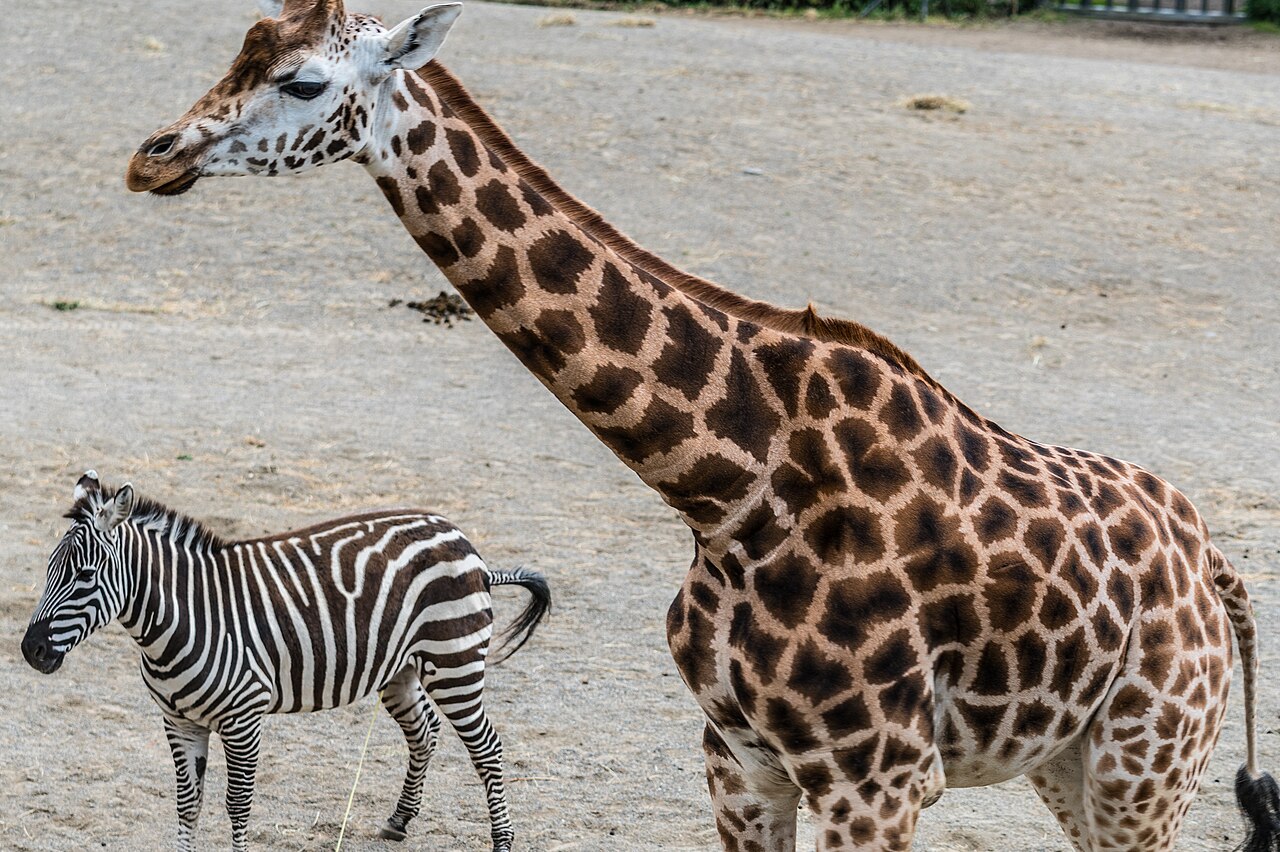
- Meet the Okapi: The Forest Giraffe Behind the Okapi Zebra Stripes
- Where Okapis Live
- Why Do Okapis Have Okapi Zebra Stripes? The Leading Hypotheses
- 1. Disruptive Coloration in Dappled Forest Light
- 2. A Visual Confusion Effect on Predators
- 3. Insect Deterrence
- 4. Social Signaling and Individual Recognition
- The Okapi Zebra Stripes Are Not Actually Zebra Stripes
- What the Stripes Look Like Up Close
- Behavior, Diet, and the Stripes in Context
- Reproduction and Lifespan
- Conservation: A Hidden Animal Under Hidden Threats
- Conclusion: The Hidden Truth About Okapi Zebra Stripes
- ❓ Frequently Asked Questions
The okapi zebra stripes are one of the most striking—and most misunderstood—features in the animal kingdom: bold black-and-white bands wrapped around the hindquarters and upper legs of a creature that otherwise looks like a shy, velvet-brown forest antelope. For decades, visitors to zoos have asked the same question: why would a rain-forest animal that never sets foot on the savanna evolve a pattern so strongly associated with open-country zebras? The answer turns out to be far richer than simple camouflage, touching on insect repellent, visual confusion for predators, social signaling, and the peculiar evolutionary history of one of the least-known large mammals on Earth.
Meet the Okapi: The Forest Giraffe Behind the Okapi Zebra Stripes
Before unpacking the stripes, it helps to know exactly what an okapi is—and what it is not. The okapi (Okapia johnstoni) is the only living close relative of the giraffe. Both animals belong to the family Giraffidae, and despite the okapi's zebra-like legs and deer-like body, its nearest evolutionary kin is the towering giraffe of the African savanna. The two lineages split roughly 11 to 16 million years ago, and the okapi has been evolving quietly in the dense forests of Central Africa ever since.
Physically, an okapi stands about 1.5 meters (4.9 feet) at the shoulder, with a body length of around 2.5 meters (8.2 feet) including the tail. Females are noticeably larger than males. Adults typically weigh between 200 and 350 kilograms (440–770 pounds). Males carry short, skin-covered ossicones—the same horn-like structures found on giraffes—while females have small hair whorls in their place. Their coat is a deep, oily chocolate brown, and the skin feels almost velvety thanks to a dense, water-repellent layer of fur that sheds rain in a forest that receives well over 1,500 millimeters (60 inches) of precipitation annually.
Where Okapis Live
Okapis are endemic to the Democratic Republic of the Congo, found only in the lowland and mid-altitude rainforests of the Ituri Forest and surrounding regions. They occupy a relatively small range and are classified as Endangered by the IUCN, with a wild population estimated at somewhere between 10,000 and 20,000 individuals—figures that remain uncertain because the animals are famously elusive. They are so secretive that they were not formally described by Western science until 1901, and for years the "African unicorn" was known only from tracks and skin fragments.
- Habitat: Dense, humid tropical rainforest with thick understory
- Diet: Leaves, buds, shoots, fruits, and fungi—over 100 plant species recorded
- Lifespan: Around 20–30 years in captivity; wild longevity is less well documented
- Activity: Largely diurnal but highly cryptic, freezing motionless when disturbed
- Social structure: Mostly solitary; adult males maintain territories and rarely tolerate one another
Why Do Okapis Have Okapi Zebra Stripes? The Leading Hypotheses
Scientists have proposed several overlapping explanations for the okapi zebra stripes, and most researchers now believe the pattern serves multiple functions at once rather than a single purpose. Evolution rarely produces a feature as conspicuous as high-contrast banding without it earning its keep in more than one way.
1. Disruptive Coloration in Dappled Forest Light
The most widely accepted explanation is disruptive coloration. The Ituri Forest is a cathedral of shifting light: shafts of sun break through the canopy and scatter bright patches across the forest floor. Against that flickering, high-contrast background, the okapi's striped legs and rump break up the animal's outline. A predator—chiefly the leopard—does not see a solid, recognizable body but a jumble of light and dark shapes that fails to resolve into a single target. This is the same principle behind military camouflage patterns, which use contrasting patches to fragment the wearer's silhouette.
Importantly, the stripes are concentrated on the hindquarters and upper legs—the parts of the body most likely to be visible as an okapi crashes away through undergrowth. The animal's dark brown torso blends into shadow, and the striped rear becomes a confusing, flickering blur rather than a clear flight path.
2. A Visual Confusion Effect on Predators
Related to disruptive coloration is the idea that the stripes create motion dazzle. When an okapi bolts, the alternating black and white bands on its legs and rump may make it difficult for a predator to judge speed and direction. Experiments on other striped and patterned animals have shown that high-contrast patterns can genuinely impair a predator's ability to track movement, and the okapi's rear-heavy striping fits this model well. Because an okapi flees through dense vegetation, even a fraction of a second of confusion can mean the difference between escape and capture.
3. Insect Deterrence
A newer and increasingly influential hypothesis comes from studies of zebras and other striped mammals: stripes may reduce attacks by biting flies. Researchers have found that the polarization of light reflected from dark and white stripes can confuse tsetse flies and tabanid horseflies as they attempt to land. The Ituri Forest is home to abundant biting insects, and an okapi's thin, sparsely haired legs are especially vulnerable. The fine striping on the lower limbs may therefore act as a modest but meaningful insect repellent—one that would have been favored by natural selection over countless generations.
4. Social Signaling and Individual Recognition
Okapis are largely solitary, and in a dim, cluttered forest, visual signals need to be bold to be useful. The striped rump may help individuals recognize one another at close range, or allow a mother and calf to stay in visual contact through the undergrowth. The pattern could also serve as a warning or submission signal during the rare encounters between adults, though direct evidence for this is limited and largely observational.
- Camouflage: Fragments the body outline in dappled light
- Motion dazzle: Confuses predators tracking a fleeing animal
- Insect defense: Stripes may disrupt fly landing behavior
- Communication: Aids recognition between mother and calf
The Okapi Zebra Stripes Are Not Actually Zebra Stripes
Here is where the "hidden truth" of the title really begins. The okapi's stripes are often described as zebra-like, but they are not the same phenomenon, and they did not evolve for the same reasons. Zebra stripes run across the entire body—neck, torso, and legs—and are thought to function primarily as protection against biting flies and as a means of confusing predators on open ground. Okapi stripes are confined to the rump, thighs, and upper forelegs, with a distinctive pattern of horizontal white bands on a dark background that continues down the legs but fades toward the hooves.
The two animals are also only distant relatives. Zebras are equids, members of the horse family; okapis are giraffids. Their shared black-and-white banding is a textbook case of convergent evolution—similar solutions arising independently in different lineages facing comparable pressures. In other words, the okapi did not inherit its stripes from a zebra ancestor, nor vice versa. Each evolved its pattern on its own evolutionary path, shaped by the specific demands of its environment.
What the Stripes Look Like Up Close
The okapi's stripes are typically creamy white against a very dark brown or near-black background. They begin as broad bands across the rump and upper thighs, then narrow and become more numerous as they descend the legs, often ending in crisp horizontal bars just above the hooves. The front legs are also striped, though the pattern is usually less extensive than on the hindquarters. A distinctive feature is the okapi's ankle bands—dark rings encircling the lower legs—which add to the visual fragmentation of the animal's outline.
Behavior, Diet, and the Stripes in Context
Understanding okapi behavior helps explain why the stripes are arranged the way they are. Okapis are browsers, feeding on leaves, buds, shoots, fruits, and fungi at heights between ground level and about three meters. They use their long, flexible blue-gray tongues—which can reach roughly 30 centimeters (12 inches)—to strip foliage and even to groom their own ears and eyes. They are known to eat clay and charcoal from forest soils, likely to obtain minerals and to neutralize toxins in certain plants.
Okapis are mostly solitary and strongly territorial, particularly the males, which mark their ranges with scent from glands on their feet and by urinating and defecating along trails. They are also famously quiet, communicating with infrasonic calls that may travel through dense vegetation better than higher-pitched sounds. When threatened, an okapi's first defense is to freeze; its dark body vanishes into shadow, and the striped rear stays motionless. If that fails, it flees—and that is when the stripes earn their keep, fragmenting a moving target in a maze of light and leaves.
Reproduction and Lifespan
Females give birth after a gestation of approximately 14 to 16 months, typically to a single calf. Newborn calves are famously able to stand within about half an hour and are born with their stripes already visible—suggesting the pattern is important from the very start of life, whether for camouflage, insect defense, or mother-calf recognition. Calves are weaned at around six months and reach sexual maturity at roughly two to three years. In captivity, okapis have lived into their early thirties, though wild lifespans are harder to establish given how rarely they are observed.
Conservation: A Hidden Animal Under Hidden Threats
The okapi's elusiveness once protected it, but it is now classified as Endangered. The primary threats are habitat loss from logging and agricultural expansion, and—most seriously—poaching. Okapi meat is traded in some local bushmeat markets, and the animal's remote range overlaps with areas affected by armed conflict and illegal mining, which complicates conservation efforts. The Okapi Wildlife Reserve, a UNESCO World Heritage Site in the Ituri Forest, is the species' most important stronghold, but it has faced repeated pressures from illegal activity.
Conservation groups, including the Okapi Conservation Project and the Wildlife Conservation Society, work with local communities, rangers, and authorities to protect the reserve and monitor populations. Because okapis are so difficult to survey, researchers increasingly rely on camera traps and genetic analysis of dung samples to estimate numbers. For a species this cryptic, the stripes that make it so recognizable in photographs are almost never seen in the wild by human eyes—a reminder that the okapi's greatest defense is also its greatest mystery.
Conclusion: The Hidden Truth About Okapi Zebra Stripes
The okapi zebra stripes are not a borrowed costume from the savanna, nor a simple accident of pattern. They are a multi-purpose adaptation forged in the dappled light of the Congo Basin: a camouflage that fragments the body, a dazzle that confuses predators, a possible shield against biting flies, and perhaps a quiet signal between mother and calf. The fact that the same basic pattern appears in zebras and okapis—two animals separated by millions of years of evolution—is a vivid demonstration of how nature arrives at similar solutions from entirely different starting points. The next time you see an okapi's striped hindquarters, you are looking at one of evolution's most elegant and hard-won tricks, hidden in plain sight.
❓ Frequently Asked Questions
💬 Why do okapis have zebra-like stripes on their legs?
The stripes are thought to help with camouflage in the dense, dappled light of the Congo rainforest, breaking up the animal's outline so it blends into shadows and vegetation. They may also help okapis recognize each other and follow family members through thick cover. Importantly, okapis are not closely related to zebras—the stripes evolved independently.
💬 Are okapis related to zebras?
No. Okapis are the closest living relative of the giraffe, and both belong to the family Giraffidae. Zebras are equids, related to horses and donkeys, so the striped pattern is an example of convergent evolution rather than shared ancestry.
💬 Do okapi stripes actually work as camouflage?
Field observations and their habitat support the idea: the stripes mimic the vertical streaks of light and shadow in the understory, making the animal hard to spot from a distance. The striped legs are also the most visible part when an okapi stands in cover, so disruptive patterning helps there too.
💬 What other purpose might okapi stripes serve?
Some researchers suggest the bold leg stripes help okapis identify and track each other, especially mothers and calves, in dim forest light. Others propose a role in signaling or mate recognition, though direct evidence for these functions is still limited.