- Why Do Penguins Waddle? A Skeleton Built for a Double Life
- Land Legs, Sea Wings
- The Center of Mass Challenge
- Why Do Penguins Waddle? The Surprising Energy Economy
- The Pendulum Effect
- Short Legs, Big Payoff
- From Sea to Shore: How Evolution Shaped the Waddle
- The Avian Family Tree: Every Penguin Waddles Its Own Way
- Emperor Penguins: The Giants of the Ice
- ❓ Frequently Asked Questions
Penguins waddle with a side-to-side grace that has made them the internet's favorite birds—but this iconic shuffle is far more than a cute party trick. Beneath the sway lies a masterpiece of evolutionary engineering, a walking style fine-tuned over millions of years to help these flightless birds survive in some of the most extreme environments on Earth. Every step, every teeter, and every comic pause is actually a carefully calibrated act of physics, anatomy, and energy conservation.
Why Do Penguins Waddle? A Skeleton Built for a Double Life
To understand why penguins waddle, you have to look past the feathers and into the bones. Unlike most birds, penguins are not built for the air. They are built for the sea, and every part of their skeleton reflects that aquatic ambition. Their bones are dense and heavy rather than hollow and airy, a trait called osteosclerosis that helps them sink effortlessly beneath the waves. While a flying bird of similar size might weigh a few hundred grams, the skeleton of an emperor penguin is solid, acting like a diver's weight belt.
Land Legs, Sea Wings
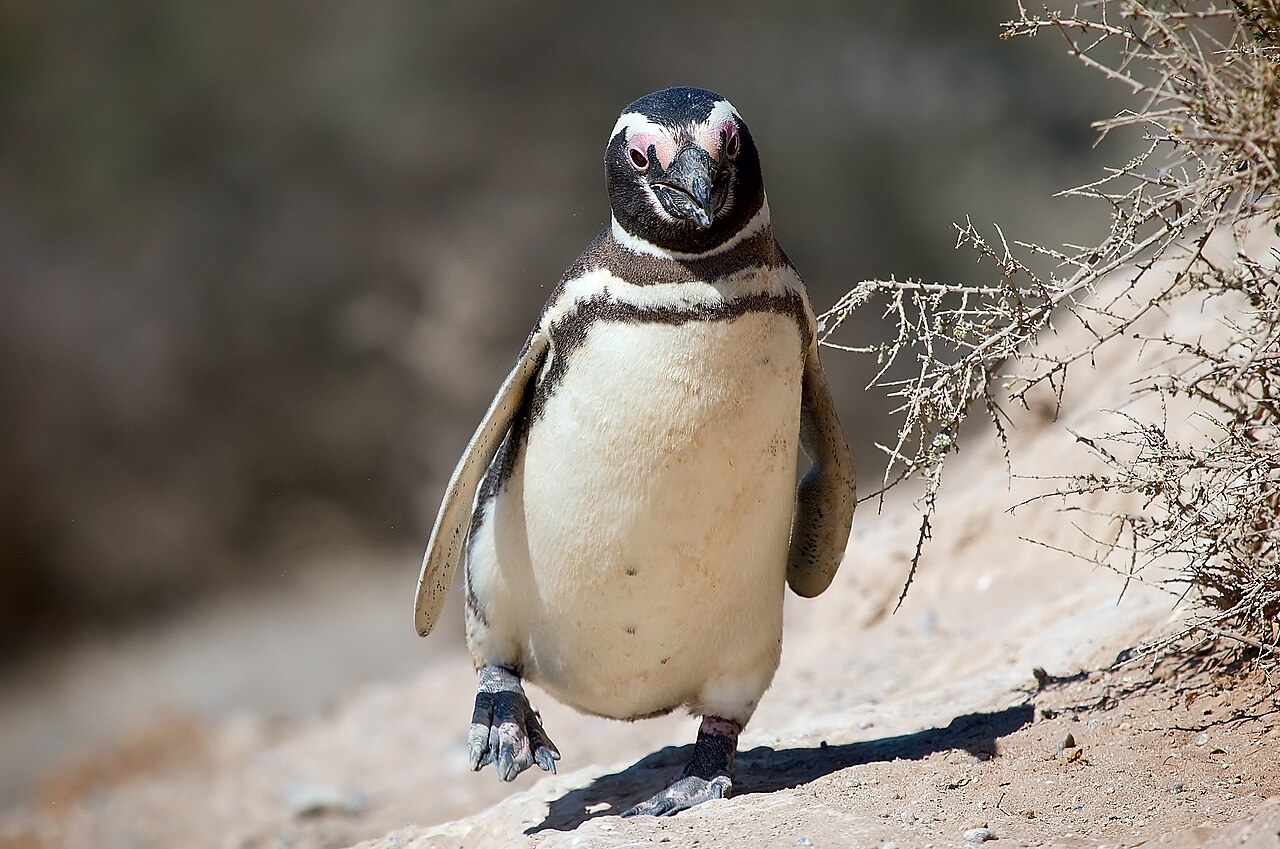
Most birds walk on their toes with a straight, efficient stride. Penguins, however, have short legs set far back on their bodies, with femurs that sit almost horizontally. This arrangement is perfect for steering under water, but it makes walking on land genuinely awkward. Because their legs are splayed outward and their knees are slightly bent, each wobble is the penguin shifting its entire body weight over one foot before committing to the next step. That exaggerated, rolling motion we call the waddle is simply the most stable way to move two stubby, sea-adapted legs across ice, rock, or sand.
The Center of Mass Challenge
Penguins also carry their center of mass unusually close to the ground. With a thick, torpedo-shaped body, a heavy beak, and no neck to speak of, they resemble a feathered bowling ball on stilts. To avoid tipping over, they must physically lean side to side far more than a slender bird like a heron or a pigeon. The wider the stance, the more the body rocks—and the more charmingly clumsy the result. It is not a flaw in their design; it is a deliberate compromise between flightlessness and speed in water.
- Dense, heavy bones allow deep diving but reduce agility on land.
- Short, rear-placed legs act like rudders in the sea but force a swaying stride ashore.
- A heavy, upright torso needs constant balance corrections, producing the signature teeter.
Why Do Penguins Waddle? The Surprising Energy Economy
For years, scientists assumed the waddle was a wasteful, inefficient way to travel. It looks exhausting. Yet when researchers at the University of California and the University of British Columbia tested penguin metabolism on a treadmill in the early 2000s, they discovered something astonishing: penguins waddle not despite the cost, but because of the savings. The famous 2000 study published in Nature, titled "Penguin waddling is not wasteful," measured the oxygen consumption of walking penguins and found their waddling gait is just as efficient as a typical bird's straight-legged stride.
The Pendulum Effect
Think of a child on a swing. Each pump stores energy that returns on the backswing. Penguins do something similar with their bodies. Every time they sway sideways, they lift their center of mass slightly, storing elastic energy in their tendons and muscles. As they tip over the supporting foot, that stored energy is released, propelling them forward without extra muscular effort. The waddle is essentially a controlled bounce, a pendulum motion that recovers energy with every sway. What appears to be wasted motion is actually a finely tuned energy-recovery system, one that lets a penguin march for miles across the frozen shelf of Antarctica on a single, reliable fuel supply.
Short Legs, Big Payoff
For a bird with such short limbs, walking straight is impossible—and physically unnecessary. The waddle allows penguins to move at a steady pace of roughly 1 to 2 miles per hour without overheating or exhausting their limited fat reserves. In a habitat where temperatures plummet below -60°F and storms can last for days, burning fewer calories during travel can be the difference between life and death. So the next time you watch a penguin wobble across the ice, remember: you're watching a creature that has evolved to make every step count.
From Sea to Shore: How Evolution Shaped the Waddle
Penguins evolved from flying seabirds around 60 million years ago, shortly after the extinction of the dinosaurs. The earliest known proto-penguin, Waimanu, was discovered in New Zealand and still had wings capable of flight. But as these birds moved into the southern oceans, natural selection favored those with stronger flippers, heavier bones, and shorter legs—all traits that made them superior swimmers. Over millions of years, they traded the sky for the sea, and their bodies became increasingly engineered for a life of diving, chasing fish, and escaping seals and orcas.
But the ocean cannot be their only home. Penguins must return to land to breed, lay eggs, and raise their young. The waddle is what happens when an animal is born to swim but forced to walk. It is a compromise written in bone and muscle, the price of being the fastest, most agile diver in the bird world. Rather than evolving a second, more graceful set of legs, penguins simply made the most of what they had—and turned a biological quirk into a cultural icon.
The Avian Family Tree: Every Penguin Waddles Its Own Way
Not all waddles are created equal. There are 18 species of penguins, each with its own gait, habitat, and personality. From the 12-inch fairy penguin to the 4-foot emperor, the waddle adapts to the landscape, the climate, and the lifestyle of each species.
Emperor Penguins: The Giants of the Ice
The emperor penguin is the undisputed heavyweight champion, standing nearly 4 feet tall and weighing up to 100 pounds. These birds endure the harshest winter on Earth, breeding on Antarctic sea ice while temperatures drop to -76°F and winds exceed 120 miles per hour. They waddle more slowly and deliberately than any other species, often sliding onto their bellies—a behavior called tobogganing—to travel faster across flat ice. A male emperor will waddle up to 80 miles from the colony to the sea, fasting for up to 115 days while incubating a single egg on his feet.
Little Blues and
❓ Frequently Asked Questions
💬 Why do penguins waddle instead of walking normally?
Penguins have short legs positioned far back on their bodies, an adaptation for efficient swimming, which makes upright walking on land awkward. Their wide stance and webbed feet force them to rock side to side, producing the familiar waddle.
💬 Is waddling inefficient for penguins?
Surprisingly, no. Research shows that at a penguin's preferred walking speed, the energy saved by using pendulum-like motions outweighs the cost of side-to-side rocking, making waddling an efficient gait for their body shape.
💬 Do all penguin species waddle?
Most penguin species waddle, but some, like rockhopper penguins, are known to hop over rocky terrain using both feet together. Even the hopping species rely on a side-to-side motion when moving on flat ground.
💬 Why do penguins slide on their bellies instead of walking?
Penguins toboggan—sliding on their bellies—to move quickly across snow and ice while conserving energy. This tactic is also safer on thin ice than pushing down with their feet, and it helps them reach the open water faster.
❓ Frequently Asked Questions
💬 Why do penguins waddle instead of walking normally?
Penguins have short legs positioned far back on their bodies, an adaptation for efficient swimming, which makes upright walking on land awkward. Their wide stance and webbed feet force them to rock side to side, producing the familiar waddle.
💬 Is waddling inefficient for penguins?
Surprisingly, no. Research shows that at a penguin's preferred walking speed, the energy saved by using pendulum-like motions outweighs the cost of side-to-side rocking, making waddling an efficient gait for their body shape.
💬 Do all penguin species waddle?
Most penguin species waddle, but some, like rockhopper penguins, are known to hop over rocky terrain using both feet together. Even the hopping species rely on a side-to-side motion when moving on flat ground.
💬 Why do penguins slide on their bellies instead of walking?
Penguins toboggan—sliding on their bellies—to move quickly across snow and ice while conserving energy. This tactic is also safer on thin ice than pushing down with their feet, and it helps them reach the open water faster.