- What Is a Praying Mantis? A Quick Primer
- Diet and Hunting Behavior
- Lifespan and Life Cycle
- Why Does Praying Mantis Cannibalism Happen?
- Nutritional Benefit: A Meal That Helps the Eggs
- Opportunity and Reflex: The Predator's Instinct
- The "Head Off, Keep Going" Effect
- How Common Is Praying Mantis Cannibalism in the Wild?
- Captivity vs. Natural Habitat
- Species Differences Matter
- Male Strategies to Avoid Being Eaten
- The Science Behind the Behavior: What Studies Show
- Evolutionary Perspectives
- Common Myths and Misconceptions
- Myth: The Female Always Eats the Male
- Myth: The Male "Sacrifices" Himself
- Myth: Mantises Are Dangerous to Humans
- Myth: Mantises Are Protected by Law
- How to Observe Mantis Mating Without Causing Cannibalism
- Ethical Considerations for Keepers
- Conclusion: A Complex Behavior, Not Just a Horror Story
- ❓ Frequently Asked Questions
Few moments in the insect world capture the human imagination quite like praying mantis cannibalism, in which a female sometimes devours the male during or shortly after mating. It is a scene that shows up in nature documentaries, cartoons, and dinner-party conversations — the elegant female calmly chewing on her partner's head while he continues to mate. But how common is this behavior really, why does it happen at all, and does it occur in every mantis species? The answers are more surprising and more nuanced than the popular image suggests.
What Is a Praying Mantis? A Quick Primer
Praying mantises are insects in the order Mantodea, which contains roughly 2,400 described species worldwide. They are most diverse in tropical and subtropical regions, but they can be found almost everywhere except the coldest polar zones. In North America, the most familiar species is the European mantis (Mantis religiosa), introduced in the late 1800s, along with the Chinese mantis (Tenodera sinensis) and the native Carolina mantis (Stagmomantis carolina).
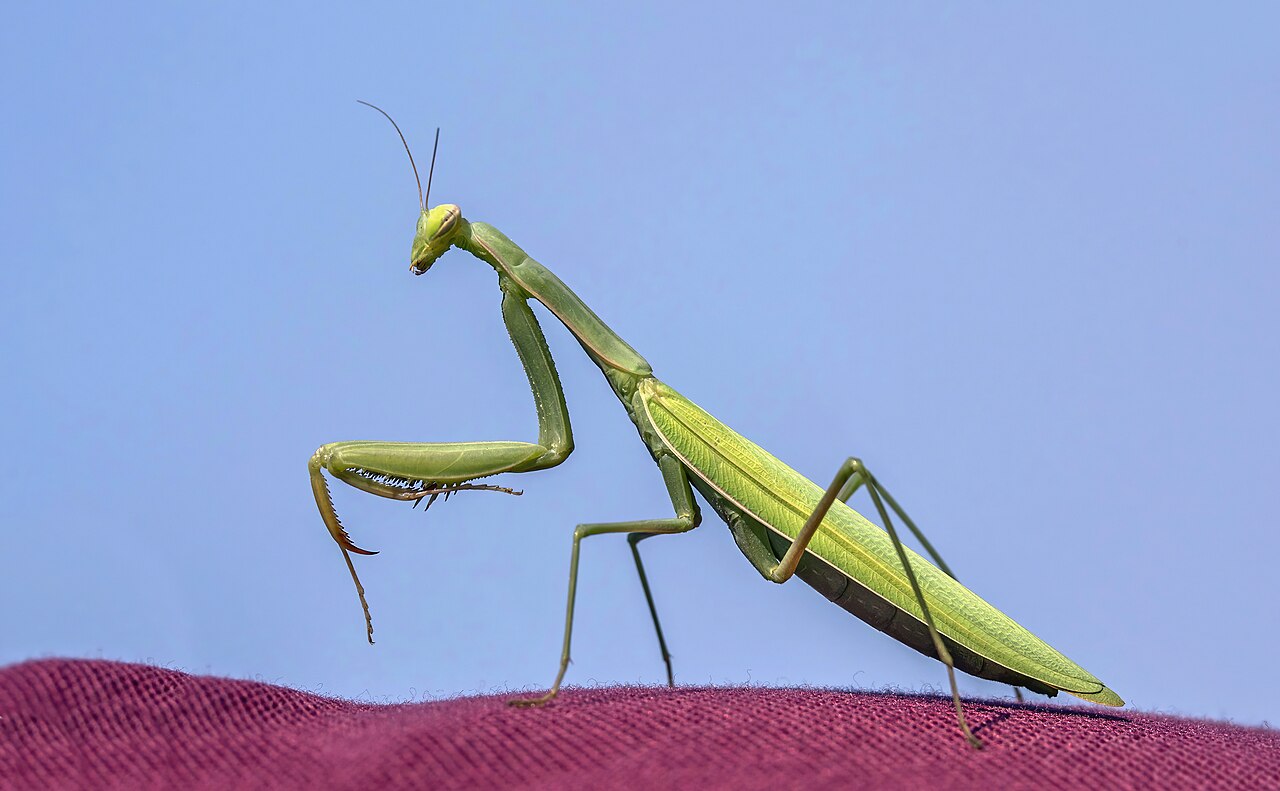
Mantises are defined by their raptorial front legs — powerful, spined limbs folded in a pose that resembles prayer. These legs are not for praying; they are for grabbing and holding prey. A mantis is a sit-and-wait ambush predator, often camouflaged as a leaf, twig, flower, or bark, and it will strike at anything within reach that seems edible.
Size varies widely. Small species may measure less than 2 centimeters, while the giant Asian mantis (Hierodula membranacea) and the African mantis (Sphodromantis species) can exceed 10 centimeters. The largest species, such as Toxodera and Tenodera, can approach 15 centimeters in length.
Diet and Hunting Behavior
Mantises are generalist carnivores. Their diet includes flies, moths, crickets, grasshoppers, beetles, spiders, and even small vertebrates such as frogs, lizards, hummingbirds, and small snakes. They are not venomous; instead, they rely on speed, strong forelimbs, and serrated mandibles to subdue prey. A strike can occur in as little as 50 to 70 milliseconds.
Because they eat almost anything they can catch, mantises are often considered beneficial garden predators — though they are indiscriminate and will happily eat other beneficial insects, including pollinators and even other mantises.
Lifespan and Life Cycle
Most mantises live for about one year. They hatch from eggs in a foamy case called an ootheca, which can contain anywhere from a few dozen to several hundred eggs. The nymphs molt six to nine times before reaching adulthood. Males typically mature faster and live shorter lives than females, and adults generally die with the arrival of cold weather in temperate regions. In captivity, females can live several months as adults, sometimes longer if they continue to be fed.
Why Does Praying Mantis Cannibalism Happen?
Sexual cannibalism — where one sex, usually the female, eats the other before, during, or after mating — is not unique to mantises. It occurs in spiders, scorpions, some flies, and a few other insects. But mantises are the most famous example, and the reasons behind it are a mix of nutrition, opportunity, and biology.
Nutritional Benefit: A Meal That Helps the Eggs
The leading explanation is straightforward: a male is a large, protein-rich meal. A female mantis that is producing eggs needs enormous amounts of energy and nutrients. In many insects, egg production is limited by protein availability. Eating her mate can directly fuel the development of her ootheca, potentially increasing the number of eggs she lays or improving their quality.
Studies on Chinese mantises have shown that females who cannibalize their mates produce more eggs and heavier oothecae than those who do not. In a species where females typically mate once or twice and then die within weeks, that nutritional boost can meaningfully increase reproductive output.
Opportunity and Reflex: The Predator's Instinct
Mantises are wired to attack moving prey. During mating, the male is right in front of her, close, and often moving. For a hungry female, the distinction between "mate" and "meal" may be blurry. In many cases, cannibalism appears to be opportunistic rather than a deliberate strategy — she simply grabs what is in front of her.
This is especially true in captive settings, where females are often underfed or confined in small spaces with no escape route. In the wild, males have more room to approach cautiously and retreat quickly.
The "Head Off, Keep Going" Effect
One of the most repeated facts about praying mantis cannibalism is that the male can continue mating after losing his head. This is partly true and has a physiological basis. In insects, much of the mating behavior is controlled by nerve centers in the abdominal ganglia rather than the brain. Removing the head can actually reduce inhibition, causing the male's mating movements to become more vigorous and prolonged.
The female, meanwhile, may begin eating from the head down, which is one reason the behavior is so memorable. But this does not mean the male survives — he will die from the injury, though his reproductive contribution may already be secured.
How Common Is Praying Mantis Cannibalism in the Wild?
Here is where the popular image diverges from reality. In the wild, sexual cannibalism in mantises is relatively rare — estimates vary, but many field studies suggest it occurs in fewer than 20 percent of matings, and in some species it is much rarer or has never been observed. The dramatic, near-guaranteed cannibalism seen in documentaries and pet forums is often a product of captivity.
Captivity vs. Natural Habitat
In captivity, females are often kept in small enclosures, fed irregularly, and unable to hunt freely. Males are introduced into the female's territory with no escape. Under these conditions, cannibalism rates rise dramatically. In the wild, a male can approach from behind, keep his distance, and flee immediately after mating.
Some species, such as the European mantis, show low rates of cannibalism in the wild. Others, particularly larger species like the Chinese mantis, may show higher rates, especially when food is scarce.
Species Differences Matter
Not all mantises behave the same way. Some species are more aggressive and more likely to cannibalize than others. In some, males are smaller and more vulnerable; in others, males and females are closer in size, and the male has a better chance of escaping. There is also evidence that males of some species have evolved specific behaviors to reduce risk, such as approaching cautiously, jumping onto the female's back from a distance, or mating quickly and then dropping away.
Male Strategies to Avoid Being Eaten
Male mantises are not passive victims. They have evolved several tactics to survive mating:
- Approach from behind: Many males approach the female from the rear, avoiding her striking range.
- Freeze and wait: Males may remain motionless for long periods until the female is distracted or feeding.
- Quick mating: Some males complete mating in a matter of minutes and then flee.
- Jump and retreat: In some species, the male leaps onto the female's back, mates, and then drops off and runs.
- Mate while she eats: If the female is busy consuming prey, the male can mate with less risk.
These behaviors suggest that cannibalism is a real risk — but one that males have evolved to manage, not an inevitable fate.
The Science Behind the Behavior: What Studies Show
Scientific research on mantis cannibalism dates back to the early 20th century, but it gained widespread attention through studies in the 1980s and 1990s. Researchers like Kenneth Roeder and later scientists such as Linton and colleagues examined mating behavior in species including Mantis religiosa and Tenodera aridifolia sinensis.
Key findings include:
- Cannibalism is more likely when the female is hungry.
- Females that eat their mates lay more eggs and produce larger oothecae.
- Males can mate successfully even when cannibalized during the process.
- Cannibalism rates vary widely by species, population, and environment.
- In some species, cannibalism is rare or has never been observed in the wild.
One important nuance: eating the male does not always benefit the female in the long run. If she eats her mate before mating is complete, she may lose the chance to fertilize her eggs. In some cases, cannibalism is a mistake, not a strategy.
Evolutionary Perspectives
From an evolutionary standpoint, sexual cannibalism is puzzling. The male dies, which seems bad for his fitness. But if his body nourishes the female and she produces more of his offspring, his genes may still propagate. This is sometimes called the "paternal investment" hypothesis.
An alternative view is that cannibalism is not adaptive at all — it is simply a byproduct of a predatory lifestyle. Females are hungry, males are nearby, and the female's attack reflex does the rest. In this view, cannibalism is not a strategy but an accident.
Most researchers now accept that both factors play a role. Cannibalism can be adaptive in some contexts and incidental in others, depending on species, environment, and the female's nutritional state.
Common Myths and Misconceptions
The praying mantis has attracted more than its share of myths. Here are some of the most common:
Myth: The Female Always Eats the Male
This is false. In many species and in most wild matings, the male survives. Cannibalism is a possibility, not a certainty. The image of the female always devouring her mate comes largely from captive observations and dramatic media portrayals.
Myth: The Male "Sacrifices" Himself
Males do not deliberately offer themselves as food. They approach cautiously and try to escape. There is no evidence that male mantises willingly sacrifice themselves for the female's benefit.
Myth: Mantises Are Dangerous to Humans
Mantises are harmless to humans. They can pinch with their forelegs if handled roughly, but they are not venomous and do not bite humans in any dangerous way. They are also not pests; they are predators of pests.
Myth: Mantises Are Protected by Law
In some places, such as Germany, it is illegal to keep or harm certain native mantis species. In most of the world, however, mantises are not legally protected, though collecting wild specimens is discouraged in some areas.
How to Observe Mantis Mating Without Causing Cannibalism
If you keep mantises as pets or are simply curious about their behavior, there are ways to reduce the risk of cannibalism during mating:
- Feed the female well before introducing the male. A full female is less likely to attack.
- Provide a large enclosure with plenty of hiding spots and vertical space.
- Introduce the male carefully, ideally from behind and at a distance.
- Watch closely and be ready to separate them if the female becomes aggressive.
- Do not disturb them during mating, but be prepared to intervene if needed.
Even with precautions, cannibalism can happen. It is part of the biology of these insects, and in captivity it is often unavoidable.
Ethical Considerations for Keepers
Some keepers deliberately allow cannibalism because it mimics natural behavior and benefits the female's egg production. Others prefer to separate the pair after mating to preserve the male for future matings. Both approaches are common in the hobby, and there is no single "correct" way — but understanding the biology helps keepers make informed choices.
Conclusion: A Complex Behavior, Not Just a Horror Story
Praying mantis cannibalism is real, but it is not the inevitable, universal behavior that pop culture suggests. It happens most often when the female is hungry, when the male cannot escape, and in species where the size difference is large. It can benefit the female by providing nutrients for her eggs, and it may even benefit the male's genes if his offspring survive. But in the wild, many males mate and escape unharmed, using cautious approaches and quick retreats to avoid becoming a meal.
Understanding this behavior reveals a lot about mantis biology: their predatory instincts, their reproductive strategies, and the delicate balance between mating and survival. The next time you see a mantis in your garden, remember that behind the serene, prayer-like pose is one of nature's most efficient and opportunistic predators — and sometimes, that includes its own mate.
❓ Frequently Asked Questions
💬 Do all praying mantises eat their mates?
No—mate cannibalism is not universal. It's been documented most often in a few species, especially the European mantis (Mantis religiosa), and even then it typically happens in captivity or when the female is very hungry, not in every encounter.
💬 Why does the female praying mantis bite the male's head off?
In some cases, removing the male's head may actually help mating succeed: the head contains inhibitory nerve centers, and decapitation can trigger more vigorous mating movements while the body continues the transfer of sperm. It also gives the female a large meal that may support egg production.
💬 Does the male praying mantis survive mating?
Often, yes—many males mate and walk (or fly) away unharmed, especially in the wild where they can approach cautiously and escape quickly. In captivity, where escape is impossible and the female may be underfed, the male's chances of being eaten are much higher.
💬 Is it true the male offers himself to be eaten on purpose?
There's no solid evidence that males deliberately sacrifice themselves. It's better explained as a risk of approaching a larger, predatory female—if he can't get away in time, he becomes a meal, which incidentally may boost the female's nutrition for producing offspring.