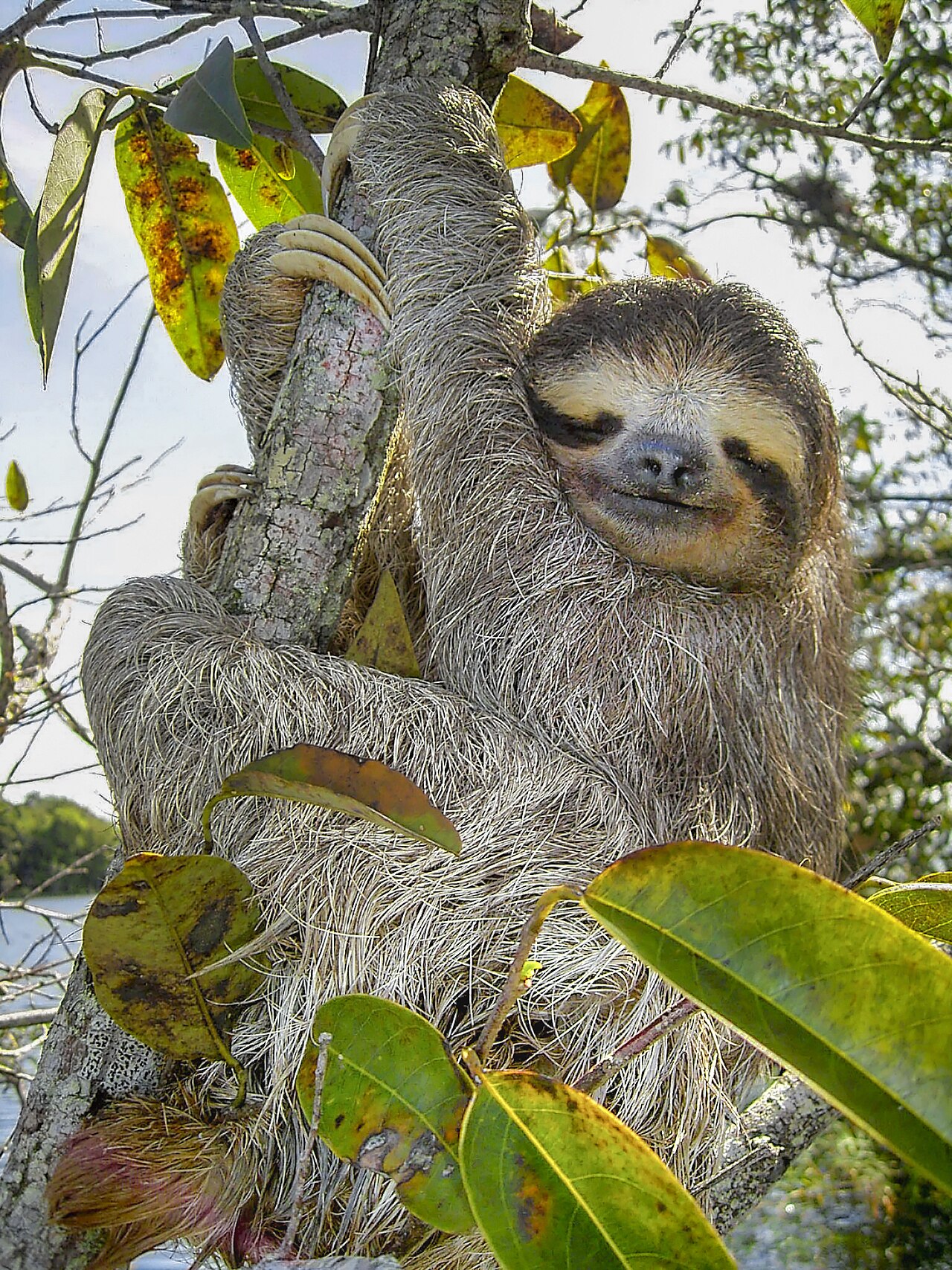
- Why Sloths Move Slowly: The Energy Economy
- The Folivore's Dilemma
- A Metabolic Rate on Vacations
- The Predator Strategy: How Moving Slowly Protects Sloths
- The Art of Invisibility
- Teeth, Claws, and Camouflage
- The Physiology of Slow: Muscles, Neck Vertebrae, and Hanging Upside Down
- The Upside-Down Skeleton
- Grip Versus Movement
- The Slowest Digestive System in the Animal Kingdom
- A Stomach Like a Fermentation Vat
- The Perilous Weekly Descent
- ❓ Frequently Asked Questions
Few animals in the natural world carry a reputation as iconic as the sloth's. The phrase sloths move slowly has become a global shorthand for leisure, laziness, and unhurried living, but the reality behind that deliberate pace is far more extraordinary than any meme suggests. Sloths are not sluggish because they lack motivation; they are sluggish because their entire bodies, diets, and survival strategies are built around an extremely low-energy lifestyle. To understand why sloths move so slowly, we must look at their metabolism, their rainforest habitat, their bizarre anatomy, and the ancient evolutionary pressures that shaped them into masters of stillness.
Why Sloths Move Slowly: The Energy Economy
At the core of the sloth's slow-motion existence is a brutal biological reality: sloths simply do not have enough energy to burn. They are folivores, meaning their diet consists almost exclusively of leaves, and leaves are one of the most nutritionally poor foods a mammal can eat. A single mouthful of leaf is packed with cellulose, a tough, fibrous compound that most animals cannot digest at all. Even for the animals that can process it, leaves deliver a pitifully small yield of calories for the effort required to obtain and chew them.
Unlike monkeys living in the same canopy, which snack on sugary fruits, protein-rich insects, and nutrient-dense seeds, sloths make do with buds, tender shoots, flowers, and young leaves. A three-toed sloth may spend most of its waking hours eating, yet it consumes only about as many calories as a small apple provides in a day. When your fuel tank is that empty, every movement becomes a costly decision.
The Folivore's Dilemma
The most famous example of this dietary trade-off is the three-toed sloth's relationship with the Cecropia tree, a fast-growing pioneer species found throughout Central and South America. These leaves are especially low in nutrients and contain toxic compounds that deter most herbivores. Sloths have evolved an enormous, multi-chambered stomach, similar in structure to a cow's rumen, to slowly ferment these leaves. The fermentation process releases the nutrients locked in the cellulose, but it takes time, sometimes up to a month or more to pass a single meal through the entire digestive tract. In fact, a sloth's stomach can account for anywhere from 20 to 30 percent of its total body weight, a staggering proportion that would be unthinkable in a fast-moving mammal.
A Metabolic Rate on Vacations
To match this low-energy diet, sloths run their internal engines at a fraction of the speed of other mammals. Their basal metabolic rate is roughly 40 to 50 percent lower than what scientists would predict for a mammal of their size. For comparison, a similar-sized mammal like a wild cat or a small monkey burns energy at a furious pace, maintaining a constant high body temperature and powering rapid movement. A sloth's body temperature, by contrast, fluctuates with the environment, often dropping from about 34°C (93°F) during the day to as low as 24°C (75°F) at night. This partial reliance on external heat, a trait more common in reptiles than in mammals, allows sloths to cut their energy bill dramatically.
This physiological economy means that a top speed of roughly 0.17 miles per hour (0.27 kilometers per hour) is not a failure of design but a carefully calibrated survival strategy. When you are moving that slowly, you are also burning energy slowly. A sloth climbing through the canopy at a pace that looks painfully slow to human eyes may actually be moving as fast as its energy budget will ever allow.
The Predator Strategy: How Moving Slowly Protects Sloths
If you were being hunted by harpy eagles, jaguars, and ocelots, you might think that speed would be your best defense. But sloths have found a different answer: become so slow and so still that predators never notice you at all. Most rainforest predators are not searching for a specific silhouette; they are searching for movement. A stealthy predator like the jaguar relies on capturing prey that flees, while the harpy eagle, one of the largest eagles in the world, hunts by scanning the canopy for anything that twitches or breaks the pattern of the leaves. An animal that moves only a few meters each minute, and sometimes not at all for hours, simply falls out of the predator's visual field.
The Art of Invisibility
Sloths take this camouflage strategy to an astonishing level. Their fur is an extraordinary ecosystem in itself. Because a sloth's coat grows in the opposite direction from most mammals—away from the limbs rather than toward the ground—it allows rainwater to run off the animal easily while the sloth hangs upside down. More importantly, a sloth's fur is often tinged green. This is not natural coloring but a living colony of algae that grows in the grooves of each hair strand. These green algae, along with fungal communities discovered only in recent years, give the sloth mossy, leafy tones that blend perfectly with the canopy. Some researchers even believe the algae provide a secondary benefit: they may be partially absorbed through the skin or licked off the fur, supplementing the sloth's meager diet with nutrients.
Even the sloth's face is designed for concealment. The dark patches around the eyes, often called a "mask," break up the outline of the head and make it far harder for an eagle to recognize the shape of a face. Some species, such as the maned three-toed sloth, have darker fur around the throat and shoulders that resembles a shadow. In the dappled light of the rainforest canopy, a still sloth does not look like a meal at all; it looks like a knot in the wood, a clump of moss, or an ordinary part of the tree itself.
Teeth, Claws, and Camouflage
When camouflage fails, sloths do have one final, if rarely used, defense. Their arms are exceptionally long and powerful, and they are armed with curved, sickle-like claws that can measure up to 4 inches (10 centimeters) in length. While sloths rarely engage in fights, these claws can inflict serious wounds on a predator. However, the sloth's greatest protection may simply be the fact that it is not worth the effort. Many predators will pass over a sloth in favor of faster-moving, more nutritious prey, and this is precisely the point. By moving slowly, sloths signal that they are not an easy meal, even if they are an available one.
The Physiology of Slow: Muscles, Neck Vertebrae, and Hanging Upside Down
Beyond their diet and behavior, sloths are physically built for slowness in ways that surprise even experienced zoologists. The average sloth has roughly 30 percent less skeletal muscle mass than a similarly sized mammal, and its muscle fibers are dominated by a "slow-twitch" type that contracts gradually and resists fatigue. This means a sloth can hold its grip on a branch for hours without tiring, but it simply does not have the fast-twitch muscle fibers necessary to sprint, jump, or quickly change direction. This is not an impairment; it is an adaptation to an arboreal life where the ability to hang on is far more important than the ability to leap away.
The Upside-Down Skeleton
Perhaps the strangest anatomical feature is found in the neck. Almost all mammals, including giraffes and humans, possess exactly seven cervical vertebrae. Three-toed sloths, however, have between eight and nine. This extra flexibility gives them a remarkable ability to rotate their heads up to 270 degrees, allowing a sloth to scan the canopy for predators without moving the rest of its body. In the world of the sloth, being able to watch an approaching threat without breaking cover is an evolutionary advantage that outweighs the awkwardness of extra neck bones, which can also make breathing and swallowing slightly more difficult for the animal.
The sloth's limbs are another masterpiece of upside-down engineering. The three-toed sloth's front and rear limbs each end in three long, hooked claws, while the two-toed species have three claws on their hind feet but only two on their front limbs. Those claws are attached directly to bones that lock into the tendon, meaning a sloth can hang from a branch using pure passive anatomy, with no muscular effort at all. This is why sloths can sleep suspended in a tree for hours without falling. It takes energy to release the grip, not to hold it, which perfectly suits a creature that wants to conserve energy at all times.
Grip Versus Movement
This remarkable gripping power comes at a cost. The muscles in a sloth's forelimbs are strong enough to defend itself or haul its body across a wide branch, but they are not built for precision or speed. Even when a sloth decides to move, it does so by reaching out with one claw, latching on, dragging its body forward, and then repeating the sequence with the next limb. On the ground, where a sloth has no branches to hang from, this movement becomes even more laborious. The sloth must drag itself along using its front claws, its rear limbs almost useless for propulsion. Watching a three-toed sloth cross a forest road is a true test of patience, and it is also one of the most dangerous moments of the animal's life.
The Slowest Digestive System in the Animal Kingdom
If the sloth's body is built around saving energy, the digestive system is the engine room where all of that saving takes place. A sloth's stomach is not a simple bag but a complex, multi-chambered fermentation vat filled with bacteria that slowly break down the tough plant material. The entire process, from the first bite to the final elimination, can take anywhere from two weeks to more than a month. That is an extraordinarily long time for a mammal, and it demands that the animal keep its body temperature stable enough for the gut bacteria to work, even when the surrounding rainforest cools at night.
A Stomach Like a Fermentation Vat
Sloths rarely drink water because they obtain most of the moisture they need from the moist leaves they eat and from licking dew off the foliage. This water-conserving lifestyle is another reason they can remain high in the canopy for days on end without descending to the forest floor. However, the sheer weight of the food digesting in their stomachs creates a constant physical burden. A sloth with a full stomach is heavier and more cumbersome, which makes its deliberate pace even more pronounced. It is a loop of cause and effect: the poor diet demands a huge digestive system, the huge digestive system demands more energy to carry, and the energy shortage demands slower movement.
The Perilous Weekly Descent
This brings us to one of the most fascinating and dangerous behaviors in all of zo
❓ Frequently Asked Questions
💬 Why do sloths move so slowly?
Sloths move slowly as a survival strategy tied to their extremely low-calorie diet of leaves. They have one of the slowest metabolisms of any mammal and must conserve every bit of energy to survive on food that is tough to digest and provides very little nutrition.
💬 Can sloths move fast when they are in danger?
No, sloths cannot speed up even when threatened. Their entire body is adapted for slow, energy-saving movement, so their main defenses are camouflage, stillness, and using their sharp claws to swipe if attacked.
💬 Are sloths faster in water than on land?
Yes, sloths are surprisingly faster in water than on land. They can swim about three times faster than they move across the ground, using a long stroke similar to a doggy paddle to cross rivers or flooded areas.
💬 How does a sloth's diet affect its slowness?
Sloths eat toxic, tough leaves that are incredibly hard to digest and provide very few calories. Their multi-chambered stomach takes days or even weeks to break down a single meal, leaving them with minimal energy for any fast movements.