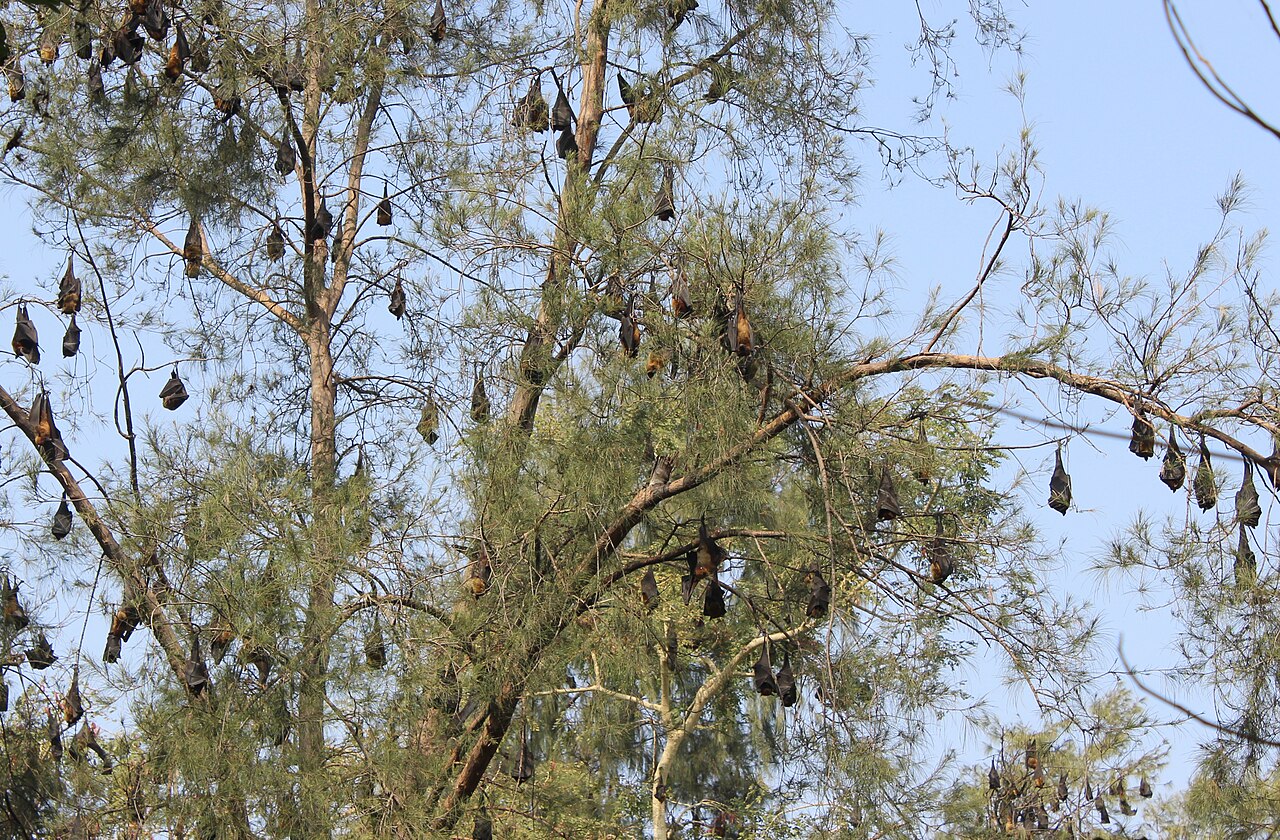
- Why Do Bats Hang Upside Down? The Core Reasons
- Their Legs Are Built for Hanging, Not Standing
- Launching Is Easier from Above
- Wings Are Not Built for Folding Underneath
- Why Do Bats Hang Upside Down Instead of Lying Down?
- Predator Avoidance
- Space and Temperature Control
- Ready for Escape
- How Bats Hang Upside Down: The Anatomy Behind It
- Specialized Feet and Claws
- Wing Thumbs and Wrist Claws
- Blood Flow and Gravity
- What Do Bats Do While Hanging Upside Down?
- Sleep and Torpor
- Giving Birth and Nursing
- Social Interaction
- Which Bats Hang Upside Down — and Which Do Not?
- How Bats Get Into Hanging Position
- Common Myths About Bats Hanging Upside Down
- Myth: Bats Cannot Take Off from the Ground
- Myth: Hanging Causes Blood to Rush to the Head
- Myth: Bats Are Blind and Bump Into Things
- The Hanging Truth: Why This Behavior Matters
- Final Thoughts
- ❓ Frequently Asked Questions
Bats are the only mammals capable of true powered flight, and they are also the only mammals that routinely spend a large part of their lives hanging by their feet. If you have ever watched a colony of bats settle in for the day, you have probably wondered why they do it. The short answer is that bats hang upside down because their bodies are built for flight first and everything else second — and hanging is the most efficient, safest way for a flying mammal to rest, sleep, and launch itself back into the air.
Why Do Bats Hang Upside Down? The Core Reasons
Hanging upside down looks awkward to us, but for a bat it solves several problems at once. Their hind limbs are rotated relative to other mammals, their feet are adapted to lock onto a surface without muscular effort, and their wings are far too large and fragile to fold neatly beneath the body while resting on a branch.
Their Legs Are Built for Hanging, Not Standing
Bat hind limbs are rotated about 180 degrees compared with those of most mammals. The knee bends backward and the foot points forward in a way that makes walking clumsy but makes hanging almost effortless. In most species, the tendons of the toes tighten automatically when the body's weight pulls down on the leg, so the foot clamps shut like a ratchet. A sleeping bat does not have to grip — gravity does the gripping for it. This is why bats can hang for hours, and even sleep deeply, without falling.
This same adaptation explains why bats are so hard to dislodge. A roosting bat can hang from a rough ceiling with only a few toes in contact, and many species use both feet plus a thumb claw on the wing to steady themselves.
Launching Is Easier from Above
Flying animals need to get airborne quickly. A bird can run, hop, or leap into the air. A bat on the ground is slow and vulnerable. By hanging from a high point, a bat simply lets go and drops — gravity gives it the initial speed it needs, and it opens its wings after a short fall. This drop-launch is far more efficient than trying to take off from flat ground, which many bats can do only clumsily, and some cannot do at all.
Wings Are Not Built for Folding Underneath
A bat's wing is a modified hand: the fingers are enormously elongated and the membrane, called the patagium, stretches between them and down to the legs. That membrane is delicate and easily damaged. Resting upright on a branch would mean folding the wings awkwardly against the body and risking tears. Hanging keeps the wings free to wrap around the body like a cloak, which also provides insulation and protection from rain.
Why Do Bats Hang Upside Down Instead of Lying Down?
The question is really about trade-offs. Lying down would be comfortable for a bat, but it would be dangerous and inefficient. A bat on the ground or on a flat surface is exposed to predators, cannot launch quickly, and struggles to move. Hanging solves all three problems at once.
Predator Avoidance
Most bats roost high up — in caves, tree hollows, under bridges, in attics, or on cliff faces — where terrestrial predators cannot easily reach them. Hanging from a ceiling or branch keeps them out of reach of snakes, cats, and rats on the ground. The upside-down posture also means a bat's back faces the open air, so a predator approaching from below is easier to detect.
Space and Temperature Control
Caves and tree hollows offer limited usable surface area. Hanging allows bats to pack tightly into a small space, sometimes thousands to a single cave. In Mexican free-tailed bat colonies, densities can reach hundreds of animals per square meter. Clustering like this traps body heat, which is vital for small mammals with a high surface-area-to-volume ratio. Many bats also allow their body temperature to drop during rest, entering a state called torpor, which saves enormous amounts of energy.
Ready for Escape
A hanging bat is always one release away from flight. If a predator or disturbance arrives, the bat drops and is airborne within a fraction of a second. A bat lying on the ground would need precious seconds to right itself and climb.
How Bats Hang Upside Down: The Anatomy Behind It
The ability to hang is not just a behavior — it is written into bat anatomy. Several features work together to make hanging secure and low-effort.
Specialized Feet and Claws
Bat feet have sharp, curved claws that hook onto rough surfaces. The toes are long and the joints are arranged so that the weight of the hanging body pulls the claws into a gripping position. In many species, the tendons lock automatically, so the grip is passive. Even a dead bat can remain hanging from a ceiling until something dislodges it.
Wing Thumbs and Wrist Claws
Most bats also have a claw on the thumb of each wing, and some have a small claw near the wrist. These help the animal climb into position, shuffle along a cave ceiling, and grip the substrate while settling. Fruit bats, or megabats, retain a second claw on the wing that most microbats lack.
Blood Flow and Gravity
Hanging head-down for long periods raises an obvious question: does blood pool in the head? Research on bats has found adaptations in their circulatory systems, including valves in the veins of the neck and legs that help regulate blood flow. Bats also have relatively small, lightweight brains and skulls, and their posture is not a true vertical headstand — the body is angled, which reduces pressure on the head. Studies of bats hanging for long periods have not found the kinds of problems that would affect a human in the same position.
What Do Bats Do While Hanging Upside Down?
Hanging is not just a resting posture. Bats sleep, groom, give birth, nurse young, mate, and even socialize while upside down.
Sleep and Torpor
Bats are nocturnal and typically sleep 12 to 20 hours a day. During sleep, many species enter torpor, dropping their body temperature and metabolic rate to conserve energy. Hanging in a cluster helps them rewarm more efficiently. In cold climates, some bats hibernate for months in this position, surviving on stored fat.
Giving Birth and Nursing
Female bats give birth while hanging, usually catching the newborn in the wing membrane or a pouch formed by the tail membrane. The pup clings to the mother's nipple and travels with her in flight. Some species, such as the Mexican free-tailed bat, leave pups in dense nursery clusters while mothers forage, and the mothers recognize their own pup by voice and scent among thousands.
Social Interaction
Hanging colonies are highly social. Bats groom each other, share warmth, and communicate with a range of calls. Some species, like the greater horseshoe bat, use complex vocalizations, and vampire bats are famous for regurgitating blood meals to share with roost-mates that failed to feed.
Which Bats Hang Upside Down — and Which Do Not?
Almost all bats hang, but there are exceptions and variations worth knowing.
- Microbats — the vast majority of bat species, including most insect-eaters — roost hanging in caves, crevices, tree hollows, and buildings.
- Megabats, such as flying foxes and fruit bats, often hang in open tree canopies in large camps, wrapping their wings around themselves in heat.
- Vampire bats hang in dark roosts and are among the few bats that can move effectively on the ground, using their thumbs and strong forelimbs to crawl and even hop.
- Some species, like the lesser short-tailed bat of New Zealand, spend much time on the ground and are unusual among bats in their terrestrial habits.
Flying foxes can have wingspans of up to about 1.5 meters (5 feet), while the smallest bats, such as Kitti's hog-nosed bat, weigh only around 2 grams and have a wingspan of about 15 centimeters. Both extremes hang upside down, but the largest bats tend to hang in open trees, while small bats favor tight crevices.
How Bats Get Into Hanging Position
Landing upside down is a skill. A bat approaching a roost flies to the surface, grabs it with its feet, and flips its body around in a fraction of a second. The wings act as brakes, and the thumb claws help with grip. Once attached, the bat shuffles into place, often turning to face the colony or to tuck its head under a wing.
Getting down is simpler: the bat releases its grip and drops. Most species need only a short fall to gain enough speed to fly. Some bats can take off from the ground, but it costs more energy and leaves them exposed.
Common Myths About Bats Hanging Upside Down
Several myths surround this behavior, and most are easy to correct.
Myth: Bats Cannot Take Off from the Ground
Many bats can take off from the ground, though it is awkward. The idea that all bats are helpless on the ground is a simplification. Some species, like the pallid bat, can walk and even run short distances.
Myth: Hanging Causes Blood to Rush to the Head
As noted, bats have circulatory adaptations that manage blood flow, and their posture is not a true headstand. There is no evidence that hanging harms them.
Myth: Bats Are Blind and Bump Into Things
Bats are not blind. Most microbats use echolocation to navigate and hunt, while megabats rely more on vision and smell. Hanging has nothing to do with eyesight.
The Hanging Truth: Why This Behavior Matters
Understanding why bats hang upside down helps explain why they are so vulnerable to disturbance. A roosting colony depends on specific conditions: the right temperature, the right height, and a surface their feet can grip. When a cave is disturbed, or a roost is destroyed, the bats cannot simply relocate overnight — they need suitable alternatives.
Bats also provide enormous ecological value. Insect-eating bats consume vast numbers of pests; a single colony of Mexican free-tailed bats can eat tons of insects in a night. Fruit bats pollinate and disperse seeds for hundreds of plant species. Their unusual posture is part of what makes these services possible, because it allows them to rest safely and launch quickly in the dark.
So the next time you see a bat hanging by its feet, remember that it is not stuck or helpless. It is resting in the most efficient position its body allows, ready to drop into flight at a moment's notice. The upside-down life is not a quirk — it is a brilliant solution to the challenges of being a flying mammal.
Final Thoughts
Bats hang upside down because their anatomy, their need for quick escape, and their roosting environments all favor it. Passive toe-locking, rotated hind limbs, drop-launching, and the protection of high, enclosed roosts make hanging the safest and most energy-efficient way for a bat to rest. Far from being a strange habit, it is one of the most elegant adaptations in the animal kingdom — a posture that lets a small mammal sleep, raise young, and take to the night sky with a single release of its grip.
❓ Frequently Asked Questions
💬 Why do bats hang upside down instead of standing upright?
Bat legs are short and their knees point backward, making it hard for them to stand or take off from the ground. Hanging upside down lets them simply drop into flight, which is far more efficient than launching from a flat surface. It also gives them a safe, predator-reduced resting position high off the ground.
💬 How do bats hang upside down without falling while they sleep?
Their feet have special tendons that lock closed when their body weight pulls down, so hanging actually requires almost no muscle effort. This grip stays locked even while the bat is asleep or dead, and the bat simply flexes to release it when it wants to fly.
💬 Can bats take off if they land on the ground?
Many bats struggle to launch from flat ground because their wings and legs aren't built for it, though some species can crawl to a height or do a clumsy hop-launch. This is why you should never place a grounded bat on the ground—gently move it to a tree or ledge so it can drop into flight.
💬 Do bats ever hang right-side up?
Yes, some bats, especially certain fruit bats and flying foxes, sometimes hang upright or wrap themselves in their wings while roosting in hot weather. But the upside-down posture remains the standard resting position for the vast majority of bat species.