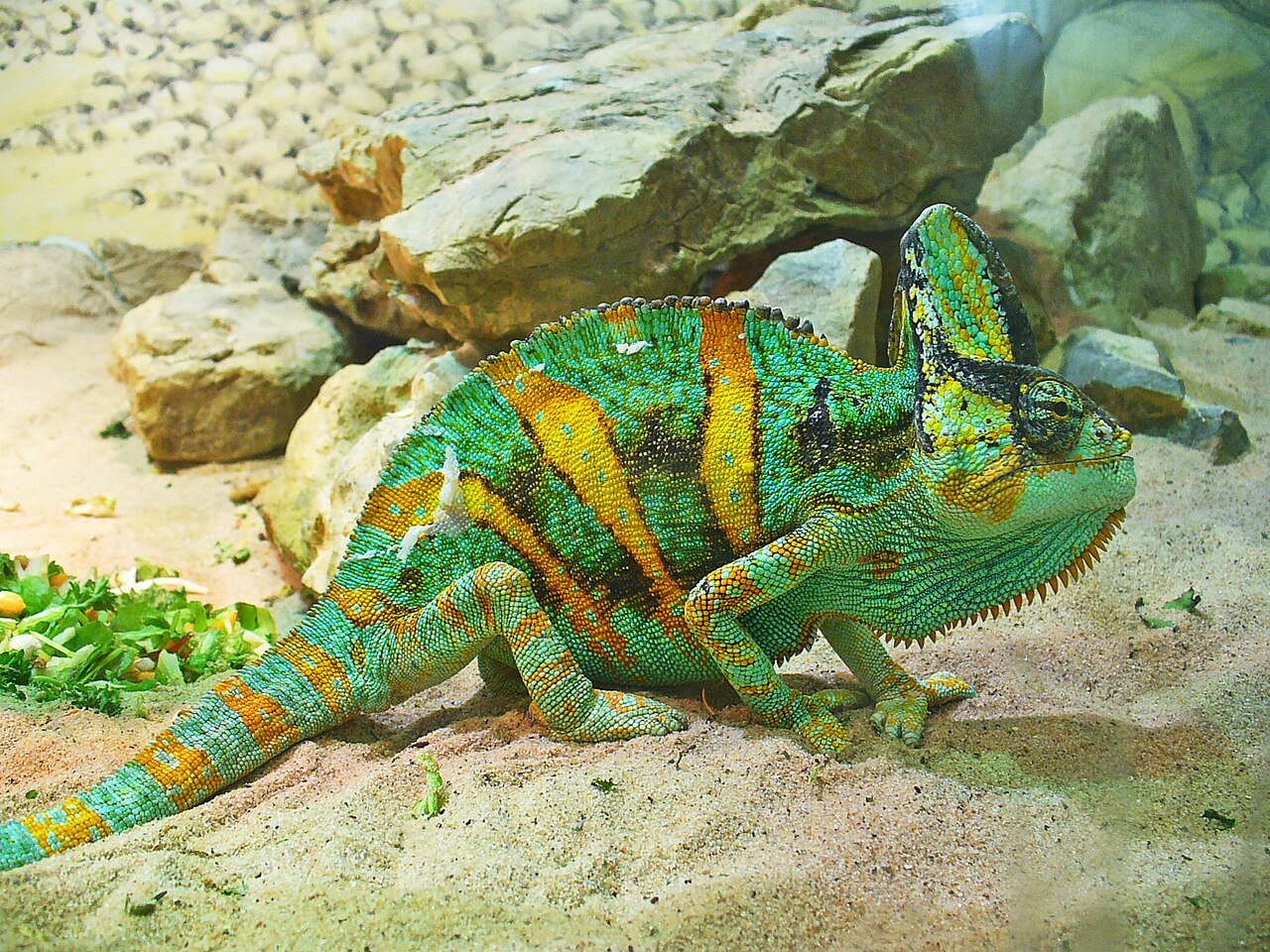
- What Exactly Is a Chameleon Head Crest?
- Bone, Skin, and Scales
- Not Every Chameleon Has One
- Why the Chameleon Head Crest Matters: Five Core Functions
- 1. Defense Against Predators
- 2. Species Recognition and Mate Choice
- 3. Thermoregulation
- 4. Water Collection
- 5. Intraspecific Combat and Display
- Which Chameleons Have the Most Prominent Head Crests?
- The Veiled Chameleon (Chamaeleo calyptratus)
- The Panther Chameleon (Furcifer pardalis)
- The Jackson's Chameleon (Trioceros jacksonii)
- Other Notable Crested Species
- How the Crest Fits Into Chameleon Anatomy and Behavior
- Eyes, Tongue, and the Head That Houses Them
- Arboreal Life and Balance
- Color Change and the Crest
- Do Female Chameleons Have Crests?
- Common Myths and Misconceptions About the Chameleon Head Crest
- Myth: The Crest Is a Weapon
- Myth: A Bigger Crest Means a Healthier Chameleon
- Myth: All Chameleons Have Crests
- What the Crest Tells Us About Chameleon Evolution
- Conclusion: The Bony Truth About the Chameleon Head Crest
- ❓ Frequently Asked Questions
The chameleon head crest is one of the most striking features of these already extraordinary reptiles — a bony, helmet-like structure that rises from the back of the skull and gives species like the veiled chameleon their unmistakable silhouette. But what looks like pure decoration is actually a multipurpose piece of biological engineering, shaped by millions of years of selection for defense, display, water collection, and species recognition. In this article, we'll dig into the anatomy, evolution, and day-to-day function of the chameleon head crest, and explain why not every chameleon has one.
What Exactly Is a Chameleon Head Crest?
A chameleon head crest is a projection of bone — usually of the skull bones known as the parietal and squamosal — covered in skin and, in many species, scales. Unlike a horn, which typically grows from a separate keratin sheath, a crest is structural: it is part of the skull itself, and in some species it is reinforced by ridges, ridges-with-spines, or a raised "casque" (the French word for helmet) at the back of the head.
There are two broad forms. The first is the casque, a tall, often blade-like or helmet-shaped rise at the rear of the skull, best known in the veiled chameleon (Chamaeleo calyptratus). The second is a crest of spines or scales, such as the serrated dorsal crest running down the back and neck of species like the panther chameleon (Furcifer pardalis), which is softer tissue and scale rather than solid bone. Many species combine both features.
Bone, Skin, and Scales
Underneath the skin, the casque is mostly bone with a lightweight, honeycombed internal structure — strong but not heavy, which matters for an animal that spends much of its life climbing thin branches. The outer surface is covered in small, overlapping scales, and in males of some species the casque is taller and more angular than in females, a clue to its role in sexual selection.
Not Every Chameleon Has One
Crests are far from universal. The roughly 200 recognized chameleon species vary enormously: some, like the tiny stump-tailed chameleons of the genus Brookesia (some under 3 cm/1.2 in in total length), have almost no casque at all, while the veiled chameleon's casque can reach several centimeters tall in adult males. This variation is itself informative — it tells us the crest is not essential to being a chameleon, but rather an adaptation tuned to particular habitats and social systems.
Why the Chameleon Head Crest Matters: Five Core Functions
The crest is not a single-purpose structure. Across species, researchers have identified several overlapping roles, and any given chameleon's crest may serve more than one of them.
1. Defense Against Predators
A tall casque makes a chameleon look larger than it is — a classic anti-predator tactic. When threatened, many chameleons turn side-on, puff up their bodies, gape their brightly colored mouths, and tilt the head so the casque is presented edge-on. The result is a visually confusing, larger, and more angular target. The bony crest also provides some physical protection to the back of the skull, though it is not armor in any serious sense; birds, snakes, and small carnivores remain significant predators throughout a chameleon's range.
2. Species Recognition and Mate Choice
Because crest shape and height differ so consistently between species — and often between males and females of the same species — the crest functions as a visual identity badge. In Madagascar, where dozens of chameleon species can occur in overlapping ranges, getting the species right matters: hybridization wastes reproductive effort. Males of many species also use casque size and head tilt in courtship displays, and females appear to assess these signals. In veiled chameleons, males have noticeably taller casques than females, a pattern consistent with sexual selection.
3. Thermoregulation
Chameleons are ectotherms, and their flattened bodies are already well adapted to basking: by turning broadside to the sun, a chameleon can absorb heat quickly. The casque adds surface area to the head, and its position means it can be angled toward or away from the sun. Some keepers and researchers have noted that chameleons with prominent casques often bask with the head raised, exposing the crest to direct light. The effect is modest compared with body flattening, but it contributes.
4. Water Collection
This is one of the most elegant explanations for the casque, particularly in the veiled chameleon. In the arid coastal and mountain habitats of Yemen and Saudi Arabia where veiled chameleons live, rain and dew can be scarce. The tall, ridged casque appears to help channel condensation and rainwater toward the mouth — a form of fog-basking or dew-harvesting. The idea has been discussed in the herpetological literature and is widely cited by keepers, though direct experimental confirmation remains limited. Even so, the link between tall casques and relatively dry habitats is suggestive.
5. Intraspecific Combat and Display
Male chameleons are famously territorial. Two males of similar size will often engage in elaborate displays — color changes, gaping, swaying, and head-to-head pushing — before or instead of physical fighting. The casque exaggerates the apparent size of the head during these contests, and in species with prominent crests, males may use them in shoving matches. Fights can escalate to biting, and injuries do occur, but most encounters are settled by display.
Which Chameleons Have the Most Prominent Head Crests?
If you want to see a chameleon head crest at its most dramatic, these are the species to know.
The Veiled Chameleon (Chamaeleo calyptratus)
Native to the southwestern Arabian Peninsula, including Yemen and Saudi Arabia, the veiled chameleon has the tallest casque relative to body size of any common species. Adult males reach roughly 45–60 cm (18–24 in) in total length, with females smaller at around 30–45 cm (12–18 in). The male's casque can be several centimeters tall and is often marked with bold green, yellow, and orange bands. Veiled chameleons are primarily insectivorous, though adults will take some plant material. In captivity, with correct care, they commonly live 5–8 years, with males typically outliving females. They are also one of the few chameleons with a well-documented, if localized, invasive population — notably in Florida.
The Panther Chameleon (Furcifer pardalis)
From Madagascar's northern and eastern lowlands, the panther chameleon is famous for its color morphs, which vary by locality — "Ambilobe," "Nosy Be," "Diego Suarez," and others. It has a modest casque but a pronounced dorsal crest of small spines. Males reach about 40–50 cm (16–20 in), females around 25–35 cm (10–14 in). Lifespan is roughly 3–5 years, shorter for females, which produce large clutches of 15–50 eggs after mating.
The Jackson's Chameleon (Trioceros jacksonii)
Native to the mountain forests of Kenya and Tanzania, Jackson's chameleon is known for three horns rather than a tall casque, though it does have a low helmet ridge. It is unusual among chameleons in giving birth to live young — litters of 8–30 after a gestation of roughly five to six months. Adults are around 25–30 cm (10–12 in). Introduced populations exist in Hawaii and California.
Other Notable Crested Species
- Meller's chameleon (Trioceros melleri): one of the largest chameleons, up to 60 cm (24 in), with a small casque and a pronounced gular crest.
- Flap-necked chameleon (Chamaeleo dilepis): widespread in sub-Saharan Africa, with a low casque and large occipital flaps.
- Senegal chameleon (Chamaeleo senegalensis): a smaller West African species with a modest, rounded casque.
- Stump-tailed chameleons (Brookesia spp.): leaf-litter dwellers with essentially no crest, showing the other end of the spectrum.
How the Crest Fits Into Chameleon Anatomy and Behavior
The crest does not exist in isolation. Chameleons are built around a set of extreme specializations, and the casque interacts with several of them.
Eyes, Tongue, and the Head That Houses Them
Chameleons have some of the most unusual eyes in the animal kingdom: each eye moves independently, mounted in a conical turret, giving nearly 360-degree coverage. The tongue is a ballistic weapon, capable of extending up to twice the body length in some species and striking prey in a fraction of a second. All of this equipment is packed into the head — and the casque adds volume at the rear without interfering with the eyes or jaw. In a sense, the crest is "free real estate" at the back of the skull.
Arboreal Life and Balance
Chameleons are slow, deliberate climbers with specialized grasping feet — fused toes in opposing bundles — and prehensile tails in many species. A tall casque does not appear to hinder balance; the animal's center of gravity remains low in the body, and the head is kept relatively level while moving. The crest's lightweight, honeycombed bone keeps the added mass minimal.
Color Change and the Crest
Chameleon color change is driven by chromatophores — pigment cells in the skin — and is used for camouflage, thermoregulation, and social signaling. The casque is often a canvas for these signals: in veiled chameleons, males display bright vertical bars on the casque during courtship and aggression, while stressed or subordinate animals show duller, darker tones. The crest thus amplifies visual communication simply by providing more surface area for color.
Do Female Chameleons Have Crests?
Yes — but usually smaller ones. In most crested species, both sexes have a casque, but males tend to have taller, more angular, and more heavily ornamented crests. This sexual dimorphism is strongest in veiled chameleons, where the difference is obvious even to a beginner. In panther chameleons, the difference is subtler; the dorsal crest is present in both sexes, but males are larger and more brightly colored overall.
The pattern fits the general rule in sexual selection: ornaments that are costly to produce and that signal condition tend to be exaggerated in the sex that competes for mates — here, males. Females, which invest heavily in egg production (panther chameleon clutches can exceed 40 eggs), benefit less from a large display structure and more from efficient body shape and camouflage.
Common Myths and Misconceptions About the Chameleon Head Crest
The crest attracts a lot of folklore, some of it harmless and some of it misleading for keepers.
Myth: The Crest Is a Weapon
It is not a horn or a battering ram. While males may use the casque in shoving contests, it is primarily a display structure. Chameleons do not headbutt predators, and the crest offers only limited physical protection.
Myth: A Bigger Crest Means a Healthier Chameleon
In adult males of crested species, a well-formed casque is generally a good sign, but casque size is heavily influenced by species, sex, and age. A small casque on a female veiled chameleon is completely normal. Conversely, a soft or deformed casque can indicate metabolic bone disease, a serious husbandry problem caused by calcium or UVB deficiency.
Myth: All Chameleons Have Crests
As noted, many species — especially the small leaf-litter Brookesia chameleons — have little or no casque. The crest is a feature of certain lineages and habitats, not a defining trait of the family Chamaeleonidae.
What the Crest Tells Us About Chameleon Evolution
Chameleons are an ancient lineage; their family has been around for tens of millions of years, with fossils and molecular evidence placing their origins well back in the Mesozoic or early Cenozoic depending on the analysis. The diversity of crest forms — from the towering casque of the veiled chameleon to the spiny dorsal crest of the panther chameleon to the near-absence of a crest in stump-tailed species — reflects adaptation to different pressures: predator regimes, climate, habitat structure, and mating systems.
The fact that the crest appears in multiple forms across the family suggests it has been modified repeatedly by evolution rather than invented once. In dry habitats, water-harvesting and thermoregulatory benefits may dominate; in dense chameleon communities, species recognition and sexual selection may be more important; in predator-rich environments, display and size exaggeration matter most. The chameleon head crest is, in other words, a flexible evolutionary tool — repurposed again and again.
Conclusion: The Bony Truth About the Chameleon Head Crest
The chameleon head crest is far more than a helmet-shaped ornament. It is a bony, lightweight structure that helps chameleons look bigger to predators, signal species identity and mate quality, manage heat, possibly collect drinking water, and bluff their way through territorial disputes. Its size and shape vary enormously across the roughly 200 species — from the towering casque of the veiled chameleon to the modest ridges of Jackson's chameleon and the near-total absence of a crest in the tiny stump-tailed species.
Understanding the crest also has practical value. For keepers, it is a useful indicator of species, sex, and sometimes health — a soft or misshapen casque can be an early warning of metabolic bone disease. For anyone lucky enough to see a chameleon in the wild, from the mountains of Yemen to the forests of Madagascar, the crest is a reminder that every bizarre feature in nature usually earns its keep. The bony truth is that the chameleon head crest is a multipurpose adaptation, shaped by predators, partners, and the weather — and it is one of the reasons chameleons remain among the most fascinating reptiles on Earth.
❓ Frequently Asked Questions
💬 What is the crest on a chameleon's head made of?
The crest is formed from bone, specifically extensions of the skull's parietal and squamosal bones, covered in skin and often scales. In some species, like veiled chameleons, it is a tall casque, while in others it is a lower ridge.
💬 Do all chameleons have head crests?
No. Crests and casques vary widely by species: veiled and Jackson's chameleons have prominent structures, while many pygmy and leaf chameleons have only slight ridges or none at all. The crest's size generally reflects the species' habitat and display needs.
💬 What is the purpose of a chameleon's head crest?
The crest serves several functions: it provides surface area for thermoregulation, offers some protection from predators, and acts as a visual display in courtship and territorial signaling. Its shape and size also help distinguish species and sexes.
💬 Does the crest make a chameleon's head heavier or affect its movement?
The crest is lightweight, hollow or spongy bone in many species, so it adds little weight. It does not noticeably hinder movement, though very large casques can slightly affect balance and head positioning when climbing.