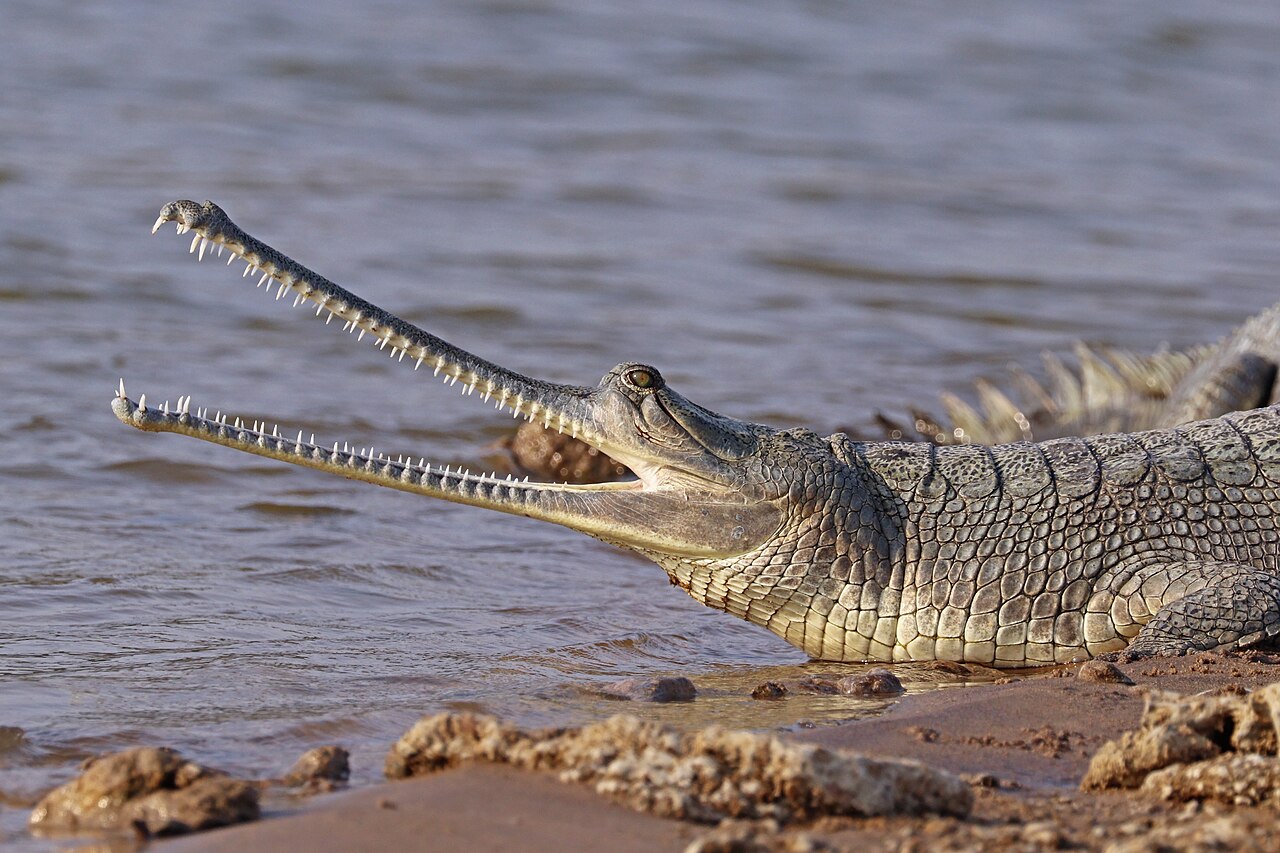
- Meet the Gharial: A Crocodilian Unlike Any Other
- How the Gharial Got Its Name
- Anatomy of the Gharial Snout: Built Like a Pair of Tweezers
- Why Do Gharials Have Such Long Thin Snouts? The Fish-Hunting Truth
- A Snout Shaped by Physics, Not Just Diet
- The Gharial Diet: What Exactly Goes Down That Snout?
- How Gharials Actually Catch Fish
- Gharial Snout vs. Other Crocodilian Snouts: A Comparative Look
- Behavior, Breeding, and the Ghara: Life Beyond the Snout
- The Ghara and Male Courtship
- Conservation: Why the Gharial Snout Is Now a Symbol of Survival
- Conclusion: The Gharial Snout Is Evolution's Fishing Rod
- ❓ Frequently Asked Questions
The gharial snout is one of the most distinctive features in the entire reptile world: a long, narrow, almost needle-like muzzle that looks less like a crocodilian jaw and more like a pair of specialized forceps. Stretching across the rivers of the Indian subcontinent, the gharial (Gavialis gangeticus) uses this remarkable adaptation to hunt fish in fast-flowing water, and every ridge, tooth, and nostril on that slender snout tells a story about evolution, ecology, and survival.
Meet the Gharial: A Crocodilian Unlike Any Other
The gharial is one of the largest living crocodilians and arguably the most unusual. Adult males can reach lengths of 5 to 6 meters (16 to 20 feet), while females typically top out around 3.5 to 4.5 meters (11 to 15 feet). Despite their impressive size, gharials are among the least aggressive crocodilians toward humans, largely because their anatomy and diet are geared entirely toward catching fish rather than tackling large prey.
Gharials are native to the river systems of India, Nepal, and Bangladesh, with historical populations also recorded in Pakistan, Bhutan, and Myanmar. They favor deep, fast-flowing rivers with sandy banks and calm eddies — habitats that support the fish populations they depend on. Today, the species is classified as Critically Endangered by the IUCN, with wild populations estimated at fewer than 1,000 breeding adults, concentrated in a handful of strongholds such as the Chambal River in India and the Narayani River in Nepal.
How the Gharial Got Its Name
The name "gharial" (sometimes spelled "gavial") comes from the Hindi word ghara, meaning "pot" or "mud pot." This refers to the bulbous, hollow growth at the tip of mature males' snouts, which resembles a traditional clay pot. This structure, called a ghara, acts as a resonator that amplifies hissing and buzzing sounds during courtship and territorial displays. It is one of the few external features that distinguishes adult males from females, alongside overall size.
Anatomy of the Gharial Snout: Built Like a Pair of Tweezers
The gharial snout is extraordinarily elongated — in adults, the muzzle can account for roughly one-fifth of total body length — and remarkably thin, with a width-to-length ratio unmatched among living crocodilians. The jaws are lined with around 100 to 110 interlocking teeth, many of them needle-sharp and slightly curved. These teeth are perfectly spaced to snap shut around slippery, fast-moving fish.
Several structural details make the snout a precision fishing tool:
- Low water resistance: The narrow profile slices through moving water with minimal drag, allowing the gharial to sweep its head sideways in a rapid, scything motion.
- Interlocking teeth: The upper and lower teeth mesh together like the tines of a fork, creating a cage that prevents fish from wriggling free.
- Raised nostrils: The nasal openings sit at the very tip of the snout, letting the animal breathe while nearly submerged.
- Reinforced bone: Despite its slender appearance, the snout is heavily ossified and supported by strong jaw muscles near the base, delivering a fast, snapping bite.
- Laterally compressed shape: The snout is taller than it is wide, a shape that cuts cleanly through currents when swung from side to side.
The overall effect is a jaw built for speed and precision rather than brute force. Where a saltwater crocodile has a broad, powerful skull designed to crush bone, the gharial has a delicate, rapid-strike instrument designed to snare fish.
Why Do Gharials Have Such Long Thin Snouts? The Fish-Hunting Truth
The short answer is that the gharial snout is a specialized fish-catching device shaped by millions of years of natural selection in flowing rivers. The long, thin jaws minimize drag in water, and their low profile lets the gharial approach schools of fish without creating the pressure waves that a bulkier head would generate. When the animal strikes, it swings its head laterally through the water, and the interlocking teeth trap whatever fish happen to be in the path.
This feeding strategy is sometimes called "lateral snap feeding." Gharials do not typically grab individual fish with a direct forward lunge the way many other predators do. Instead, they use a sweeping, side-to-side motion that maximizes the chance of contact with schooling fish in murky, fast-moving water. The elongated snout increases the effective sweep radius, covering more water with each strike.
A Snout Shaped by Physics, Not Just Diet
Researchers studying crocodilian skull mechanics have found that long, narrow snouts experience lower bending stresses during rapid lateral strikes than short, broad snouts of comparable strength. In other words, the gharial's snout is not just a fish-catching tool — it is a structurally efficient one. The shape distributes force along the jaw in a way that allows fast, repeated strikes without fracturing bone.
This has led scientists to describe the gharial as an extreme example of "form follows function" in predator evolution. The snout is long because the animal hunts in water, hunts fish, and needs to strike quickly and repeatedly. Change any of those conditions — slower water, larger prey, ambush hunting from cover — and the long, thin snout would become a liability rather than an advantage.
The Gharial Diet: What Exactly Goes Down That Snout?
Gharials are almost exclusively piscivorous. Their diet is dominated by fish, and studies of stomach contents and stable isotopes confirm that fish make up the overwhelming majority of their intake throughout life. Common prey includes species such as Tor mahseer, catfish, carp, and various riverine cyprinids, depending on the local river system.
Juveniles eat smaller fish and aquatic invertebrates, gradually shifting to larger fish as they grow. Unlike many other crocodilians, gharials rarely take mammals, birds, or large reptiles, though opportunistic feeding on carrion or small vertebrates has occasionally been recorded. Their thin jaws simply are not built to subdue large, struggling prey — a fact that also makes them far less dangerous to humans than their size might suggest.
How Gharials Actually Catch Fish
Gharials are ambush-and-sweep hunters. They typically lie motionless in deeper water or near the edge of a current, waiting for fish to gather. When a school moves within range, the gharial strikes with a rapid sideways snap of its head, then adjusts the fish in its jaws and swallows it whole, usually head-first. Because their teeth are thin and interlocking rather than robust and tearing, gharials cannot chew or dismember prey — they must swallow it intact.
This feeding method explains why gharials are so dependent on healthy, fish-rich rivers. A single adult may consume several kilograms of fish per week, and populations need consistent prey density to thrive. When rivers are overfished, dammed, or polluted, gharials starve or fail to reproduce.
Gharial Snout vs. Other Crocodilian Snouts: A Comparative Look
Comparing the gharial snout to those of other crocodilians reveals just how specialized it is. Crocodilians as a group show a remarkable range of snout shapes, each tied to a particular hunting strategy and habitat.
- Gharial: Extremely long and thin; fish specialist; fast-flowing rivers.
- Saltwater crocodile: Broad and heavy; generalist predator; estuaries, coastal waters, and rivers.
- American alligator: Moderately broad, robust; takes fish, turtles, birds, and mammals.
- Freshwater crocodile (Australia): Slender but far shorter than the gharial's; fish and small vertebrates.
- False gharial (Tomistoma schlegelii): Long, narrow snout similar to the gharial's but less extreme; found in Southeast Asian swamps and peat forests.
The false gharial is a particularly interesting comparison. It shares the long, narrow snout shape but is not closely related to the true gharial, and its diet is broader, including fish, birds, and mammals. This suggests that a long snout can evolve for different reasons in different lineages, and that the true gharial's snout is an extreme version of a shape that has appeared more than once in crocodilian evolution.
Behavior, Breeding, and the Ghara: Life Beyond the Snout
Gharials are highly aquatic and rarely venture far from water. Their legs are relatively weak compared to those of other crocodilians, and they "belly-slide" rather than walk high on their limbs when on land. They bask on sandy banks in the morning and retreat to deeper water during the heat of the day.
Breeding season typically coincides with the dry months, when rivers recede and expose sandbanks suitable for nesting. Females dig nests in the sand and lay clutches of roughly 30 to 50 eggs, which incubate for about 60 to 80 days. Hatchlings are small and vulnerable, and mortality in the first year is high. In the wild, gharials can live for several decades — estimates suggest 40 to 60 years or more, though precise lifespan data are limited.
The Ghara and Male Courtship
The male's ghara plays a central role in reproduction. During courtship, males produce a buzzing, hissing vocalization amplified by the ghara, and they defend territories and harems. The structure becomes more prominent as males mature, and its size may signal fitness to females. This makes the snout not just a feeding tool but also a sexual ornament — a rare dual role among reptiles.
Conservation: Why the Gharial Snout Is Now a Symbol of Survival
The gharial's specialized snout is both its greatest strength and its greatest vulnerability. Because the species depends on healthy, free-flowing rivers with abundant fish, it is acutely sensitive to habitat change. Dams and barrages fragment populations and alter flow regimes. Sand mining destroys nesting banks. Fishing nets drown adults and juveniles alike. Pollution and overfishing reduce prey availability.
Conservation efforts have had measurable success in some areas. The Chambal River population, shared between Rajasthan, Madhya Pradesh, and Uttar Pradesh in India, is considered one of the most important strongholds, with several hundred individuals. In Nepal, the Chitwan National Park area supports a breeding population sustained by release programs. Captive breeding and head-starting — raising hatchlings in captivity before release — have become key tools, alongside nest protection and community-based river stewardship.
Despite these efforts, the species remains Critically Endangered, and its long-term survival depends on protecting entire river ecosystems, not just individual animals. The gharial snout, evolved over millions of years to catch fish in living rivers, is a reminder that specialized anatomy is only as secure as the habitat that supports it.
Conclusion: The Gharial Snout Is Evolution's Fishing Rod
The gharial snout is a masterpiece of evolutionary engineering — long, thin, toothy, and perfectly tuned to the physics of catching fish in moving water. It minimizes drag, maximizes sweep, and traps slippery prey with interlocking precision. It also doubles as a courtship instrument in males and stands as one of the clearest examples of dietary specialization among living reptiles. But the same specialization that makes the gharial so remarkable also makes it fragile. Protecting this extraordinary animal means protecting the rivers it depends on — and ensuring that its fish-hunting truth continues to play out in the wild for generations to come.
❓ Frequently Asked Questions
💬 Why do gharials have long, thin snouts?
A gharial's long, narrow snout is a specialized fish-catching tool. Its slim shape cuts through water with little resistance and lets the jaws snap shut fast on quick, slippery fish, while the many sharp, interlocking teeth grip prey that would otherwise wriggle free.
💬 Is a gharial's snout too weak to be dangerous to humans?
Gharials are fish specialists, and their thin jaws are not built for grabbing large prey like people. They are generally shy and not considered a significant threat to humans, though any large wild animal should still be given space and respect.
💬 How is a gharial's snout different from a crocodile's or alligator's?
A gharial's snout is far longer and thinner than those of most crocodiles and alligators, which have broader, more robust jaws suited to taking a wider range of prey. The gharial's narrow snout reflects its near-exclusive focus on catching fish.
💬 Does the gharial's long snout help it breathe or hunt underwater?
The snout is mainly a feeding adaptation for snatching fish, not a breathing device. Gharials do use their raised nostrils and eyes to watch for prey at the surface, but the elongated shape itself is about efficient, fast fish capture.