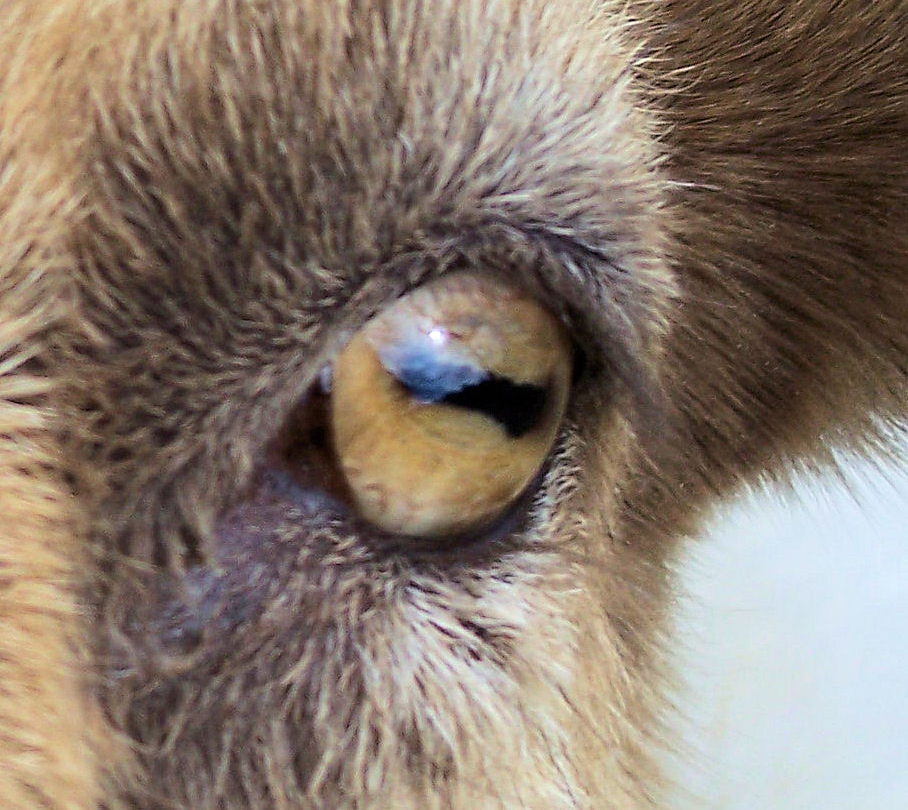
- What Goat Pupils Actually Look Like
- Why Do Goat Pupils Have a Rectangular Shape? The Science
- The "Horizontal Panorama" Advantage
- Better Depth Perception on the Ground
- Reduced Glare and Better Light Control
- How Goat Pupils Compare to Other Animals
- Goats vs. Cats and Other Vertical-Slit Animals
- Goats vs. Humans and Other Round-Pupil Animals
- Goats vs. Sheep, Cattle, and Horses
- Goats vs. Geckos and Toads
- The Goat Eye in Action: Behavior and Survival
- Grazing Posture and the "Predator Scan"
- Climbing, Jumping, and Depth Judgment
- Social Communication
- Common Myths and Misconceptions About Goat Pupils
- Frequently Asked Questions About Goat Eyes
- Do all goats have rectangular pupils?
- Can goats see color?
- How good is a goat's eyesight?
- Do goats see the same way at night?
- Quick Facts: Goats and Their Remarkable Eyes
- Why This Design Matters Beyond the Barnyard
- The Truth About Goat Pupils
- ❓ Frequently Asked Questions
If you have ever locked eyes with a goat and noticed its strange, horizontally stretched pupils, you have witnessed one of the most distinctive eyes in the animal kingdom — and the reason behind those goat pupils is far more fascinating than most people expect. That odd rectangular slit is not a quirk or a defect. It is a precision-engineered optical adaptation that helps goats survive in some of the most predator-rich landscapes on Earth. In this article, we will explore exactly why goats have rectangular pupils, how they work, how they compare with the eyes of other animals, and what the science says about one of nature's strangest-looking — and smartest — designs.
What Goat Pupils Actually Look Like
A goat's pupil is a horizontal rectangle with rounded corners, sometimes described as a "band" or "slit" that stretches almost the full width of the iris. When the light is bright, the pupil narrows into a thin horizontal line. In dim light, it widens into a broad rectangle or even a rough oval, letting in as much light as possible.
This shape is technically called a horizontal rectangular pupil, and it is found in a group of animals biologists call "horizontal-slit-pupil" species. Goats share this trait with sheep, cattle, deer, antelope, horses, and toads. Domestic goats (Capra hircus) are the classic example most people encounter, but their wild relatives — including the bezoar ibex (Capra aegagrus), the wild ancestor of the domestic goat — have the same eye design.
What makes the goat eye especially striking is the combination of the pupil shape with the position of the eyes. Goats have eyes set on the sides of their head, giving them a field of view of roughly 320 to 340 degrees. Only a narrow blind spot sits directly behind them and a small one in front of their nose. When you combine a nearly panoramic field of view with a horizontally stretched pupil, you get an eye built for scanning a wide horizon for danger.
Why Do Goat Pupils Have a Rectangular Shape? The Science
For decades, the rectangular pupil was treated as a curious oddity. Then, in 2015, a team of researchers led by Martin Banks at the University of California, Berkeley, published a study in the journal Science Advances that finally explained the geometry behind it. Their findings are the foundation of almost everything we now know about goat pupils.
The "Horizontal Panorama" Advantage
The key insight is that pupil shape affects how much light enters the eye from different directions. A vertical slit pupil, like a cat's, blocks light coming from the sides but admits light from above and below. A horizontal rectangular pupil does the opposite: it blocks light from above and below while admitting light from a wide horizontal arc.
For a grazing animal like a goat, that is exactly what you want. Goats spend most of their waking hours with their heads down, eating grass, shrubs, and browse. In that posture, the most important visual information is not what is directly above them — it is what is happening along the horizon. A predator approaching from the side or the distance is the real threat. The rectangular pupil maximizes light capture along that horizontal band, sharpening the goat's ability to detect movement across a wide, flat landscape.
Better Depth Perception on the Ground
The horizontal pupil also improves something called stereopsis — the brain's ability to judge distance using the slightly different images from each eye. Because the pupil is wider horizontally than vertically, the eye collects more visual information from left to right. This gives goats a sharper sense of depth along the ground plane, which helps them judge the distance to a ledge, a gap, or a predator.
This matters enormously for an animal that climbs cliffs, balances on rocky outcrops, and lives in mountainous terrain. Feral goats in places like the Scottish Highlands or the Hawaiian islands regularly navigate near-vertical rock faces. Accurate depth perception is not a luxury for them; it is a survival requirement.
Reduced Glare and Better Light Control
Anyone who has watched a goat on a sunny day has seen its pupil snap into a thin horizontal line. That narrowing is not just about comfort. By closing down to a slit, the pupil reduces the amount of light hitting the retina and cuts down on glare from bright skies and pale rocks. In low light, the same pupil opens into a wide rectangle, gathering far more photons than a round pupil of similar area would allow. The result is an eye that performs well at dawn, dusk, and under cloud — the exact times when predators are most active.
How Goat Pupils Compare to Other Animals
Pupil shape is not random. Across the animal kingdom, it tracks an animal's lifestyle, body size, and position in the food chain. Comparing goat pupils with those of other species makes the goat's design look even more deliberate.
Goats vs. Cats and Other Vertical-Slit Animals
Cats, foxes, and many snakes have vertical slit pupils. These are common in small predators that ambush prey and need to judge distance to a target directly ahead. Vertical slits also allow a very large range of light adjustment, which is useful for nocturnal hunters. But vertical slits sacrifice horizontal awareness, which is a poor trade for a prey animal that needs to watch a wide horizon.
Goats vs. Humans and Other Round-Pupil Animals
Humans, dogs, and most primates have round pupils. Round pupils are flexible and work well for animals that move their eyes frequently and rely on sharp central vision. But a round pupil does not specialize in any one direction, so it does not offer the panoramic sensitivity of a horizontal rectangle.
Goats vs. Sheep, Cattle, and Horses
Goats are not alone. Sheep, cattle, deer, antelope, and horses all have horizontal rectangular pupils, and all are grazing or browsing animals that evolved as prey. This shared design is a textbook example of convergent evolution: unrelated lineages arriving at the same solution because they face the same problem — spotting predators across open ground while keeping their heads down to eat.
Goats vs. Geckos and Toads
Horizontal pupils are not limited to mammals. Some geckos and many toads have them too, and the same logic applies: they need to watch the horizon while staying alert in open habitats. The goat is simply the most familiar and most studied example of this pattern.
The Goat Eye in Action: Behavior and Survival
Understanding the anatomy is one thing; seeing how goats actually use those eyes is another. Goats are famously alert animals, and their behavior reflects the strengths of their visual system.
Grazing Posture and the "Predator Scan"
When a goat grazes, its head is low and its pupils sit horizontally across the visual field. Even while chewing, a goat will lift its head every few seconds to scan. This "predator scan" is a built-in behavior that takes advantage of the wide horizontal pupil. Feral goats in Australia, New Zealand, and the Mediterranean islands are known for this constant vigilance, and it is one reason they are so hard to approach in the wild.
Climbing, Jumping, and Depth Judgment
Goats are exceptional climbers. Domestic goats have been recorded standing on branches barely thicker than a broom handle, and feral goats in places like the Italian Alps and the Rocky Mountains scale rock faces that would stop most animals. Their horizontal pupils give them the depth perception needed to judge gaps and landing spots. Anyone who has watched a goat leap from one rock to another knows how precise that judgment can be.
Social Communication
Goat eyes also play a role in social life. Goats are highly social herd animals, and they use eye contact and head position to communicate. A goat that raises its head and stares is signaling alertness. Because the pupil is horizontal, the direction of the stare is easy for other goats to read, which helps the herd coordinate its reaction to a threat.
Common Myths and Misconceptions About Goat Pupils
Because goat pupils look so unusual, they have attracted plenty of folklore. It is worth separating fact from fiction.
- Myth: Rectangular pupils mean goats are demonic or unnatural. This idea comes from old European folklore, where unusual eyes were associated with supernatural creatures. In reality, the shape is a straightforward optical adaptation shared by dozens of species.
- Myth: Goats can see perfectly in total darkness. Goats have good low-light vision, but they are not nocturnal. Their eyes are optimized for dawn, dusk, and daytime — not pitch-black caves.
- Myth: The pupil shape is fixed. In fact, goat pupils change size constantly, narrowing in bright sun and widening in shade or at night.
- Myth: Rectangular pupils are unique to goats. Sheep, cattle, deer, horses, and even toads have them. Goats are simply the most famous example.
- Myth: Goats rely only on vision. Goats also use excellent hearing and a strong sense of smell. Their eyes are one tool among several.
Frequently Asked Questions About Goat Eyes
Do all goats have rectangular pupils?
Yes. All domestic goats, and all wild species in the genus Capra, have horizontal rectangular pupils. The trait is consistent across the group.
Can goats see color?
Goats are not colorblind, but their color vision is different from ours. Like many ungulates, they have two types of cone cells rather than three, which means they see blues and yellows well but have trouble distinguishing red from green. This is typical of grazing animals.
How good is a goat's eyesight?
Goats have sharp vision for movement and a very wide field of view, but their visual acuity — the ability to see fine detail — is lower than a human's. They excel at detecting motion and judging distance, which is what matters for a prey animal.
Do goats see the same way at night?
Goats have a reflective layer behind the retina called the tapetum lucidum, which boosts night vision by reflecting light back through the retina. This is why goat eyes appear to glow when light hits them in the dark. Combined with a wide pupil, it gives goats reasonable night vision, though not the equal of a cat or an owl.
Quick Facts: Goats and Their Remarkable Eyes
- Scientific name: Capra hircus (domestic goat)
- Field of view: roughly 320–340 degrees
- Pupil shape: horizontal rectangle with rounded corners
- Color vision: dichromatic (blue and yellow, limited red-green)
- Lifespan: typically 10–15 years for domestic goats, sometimes up to 18 with good care
- Diet: grazers and browsers — grasses, shrubs, leaves, bark, and browse
- Habitat: originally rocky mountains of the Middle East and Central Asia; now worldwide as domestic animals
- Body size: 40–100 kg (88–220 lb) depending on breed
- Social structure: highly social, living in herds with clear dominance hierarchies
Why This Design Matters Beyond the Barnyard
The goat eye is more than a curiosity. It is a case study in how evolution solves practical problems with elegant geometry. A grazing animal that lives in open, predator-rich terrain needs three things from its eyes: a wide field of view, strong motion detection along the horizon, and good depth perception near the ground. The rectangular pupil delivers all three.
That is why the same design appears again and again across unrelated species — from sheep and deer to horses and toads. Nature, it turns out, is a remarkably efficient engineer. When a shape works, it gets reused.
For farmers and goat owners, understanding goat pupils also has practical value. A goat that is constantly scanning is not being paranoid; it is behaving exactly as its visual system evolved to behave. A goat that seems to startle easily at movement in its peripheral vision is simply using the wide, horizontal awareness its eyes were built for. Recognizing this can make handling and housing goats easier and less stressful for both animal and owner.
The Truth About Goat Pupils
So why do goats have rectangular pupils? The truth is that this strange-looking shape is a highly specialized survival tool. It gives goats an almost panoramic view of their surroundings, sharpens their ability to spot movement along the horizon, improves depth perception for climbing and jumping, and helps them manage light across the bright, open landscapes where they evolved. Far from being an oddity, the rectangular pupil is one of the most elegant adaptations in the animal kingdom.
The next time you look a goat in the eye, you are not seeing something weird or unsettling. You are seeing millions of years of evolution, fine-tuned for a life of grazing, climbing, and staying one step ahead of predators. The goat's rectangular pupil is not a mystery — it is a masterpiece of natural engineering, hiding in plain sight.
❓ Frequently Asked Questions
💬 Why do goats have rectangular pupils?
Their horizontal rectangular pupils give goats a wide, panoramic field of view—roughly 320 degrees—so they can spot predators approaching from almost any direction while grazing. The shape also improves their ability to detect movement, especially along the horizon.
💬 Do all goats have rectangular pupils?
Yes, goats are among the animals with horizontal, rectangular pupils, a trait shared with sheep, cattle, deer, and other grazing prey species. The pupil still narrows and widens with light, but it keeps its horizontal slit shape.
💬 What is the advantage of a rectangular pupil over a round one?
A horizontal rectangular pupil lets in more light across a wide horizontal band, matching the wide horizon line of open grazing land. It also sharpens detection of predators moving sideways across their field of vision, which is the most common direction of attack.
💬 Can goats see in color, and does the pupil shape affect it?
Goats have dichromatic vision, meaning they see mainly blues and yellows and cannot distinguish red well. Their pupil shape mainly affects light gathering and the width of their visual field rather than color perception itself.