- The Basics: What Exactly Is a Pufferfish?
- Why Do Pufferfish Inflate? The Core Reasons
- How Do Pufferfish Inflate? The Anatomy Behind the Balloon
- The Water Versus Air Decision
- The Muscular Pump
- Why It Is Not a Free Trick
- The Backup Defences: Toxins, Spines, and Warning Colours
- Pufferfish Inflation in the Wild: Real Examples
- Does Inflating Hurt the Pufferfish?
- Common Myths and Misconceptions
- "Pufferfish inflate to float."
- "All pufferfish are deadly."
- "Pufferfish can inflate forever."
- "Blowfish and pufferfish are different animals."
- Why Pufferfish Inflate: A Final Word
- ❓ Frequently Asked Questions
Few sights in the ocean are as instantly recognisable as a pufferfish blowing up like a spiky balloon. It is the behaviour that gave these fish their name, inspired cartoons, and made them a favourite in aquariums worldwide. But why do pufferfish inflate, and how does a relatively slow, clumsy swimmer transform itself into a defensive balloon in a matter of seconds? The answer involves a remarkable piece of anatomy, a carefully calibrated set of instincts, and a surprising amount of strategy. This article takes a deep dive into the bloated truth behind one of nature's strangest defence mechanisms.
The Basics: What Exactly Is a Pufferfish?
Pufferfish belong to the order Tetraodontiformes, a group whose name literally means "four-toothed." Instead of ordinary teeth, most species have their jawbones fused into a beak-like structure divided into four plates, which they use to crack open hard-shelled prey. There are roughly 190 known species, found in tropical and subtropical waters around the world, with a handful living in brackish or even freshwater habitats.
They go by many names depending on region and species: pufferfish, blowfish, balloonfish, toadfish, and globefish. The family Tetraodontidae contains the "true" pufferfish, while the closely related Diodontidae are known as porcupinefish and carry permanent, prominent spines. Sizes vary enormously. The dwarf pufferfish (Carinotetraodon travancoricus) of freshwater rivers in India reaches barely 2.5 centimetres, while the giant freshwater pufferfish (Tetraodon mbu) of the Congo Basin can grow to around 67 centimetres. In the sea, the starry pufferfish (Arothron stellatus) can exceed 1 metre in length, making it one of the largest of all.
Their diet is just as varied. Many species are generalist carnivores that crush snails, crabs, sea urchins, clams, and corals. Others specialise: some feed heavily on algae and sponges, and a few, like the notorious Takifugu species of Japan, are prized — and feared — as food. Depending on species, pufferfish may live anywhere from about 4 years in small aquarium species to 10 years or more in larger ones, with some individuals in public aquariums reaching their late teens.
Why Do Pufferfish Inflate? The Core Reasons
The primary reason pufferfish inflate is defence. Pufferfish are not built for speed. Their bodies are stout, their fins are small, and they cannot outswim a determined predator such as a shark, a moray eel, or a larger reef fish. What they lack in agility, they make up for in deterrence. When threatened, a pufferfish rapidly expands its body, sometimes doubling or tripling in apparent size, turning a manageable mouthful into an awkward, spiky, hard-to-swallow problem.
Inflation serves several overlapping purposes:
- Sudden size increase: A predator expecting a small, soft meal is confronted with something far too large to bite comfortably.
- Spine erection: In porcupinefish and many pufferfish species, the skin is covered in spines that lie flat when relaxed but stand upright when the body stretches, turning the fish into a prickly ball.
- Shape change: A rounded, taut sphere is difficult for a predator to grip or swallow, especially in the tight spaces of a reef.
- Intimidation display: The dramatic transformation itself can startle a predator into abandoning the attack.
Inflation is not only about defence, however. Some pufferfish inflate during courtship or territorial disputes, and a few species appear to use partial inflation to wedge themselves into crevices or to help pry open stubborn prey. In captivity, pufferfish sometimes inflate out of stress — for example, when netted, moved between tanks, or exposed to poor water quality — which is one reason responsible aquarists handle them with great care.
How Do Pufferfish Inflate? The Anatomy Behind the Balloon
The Water Versus Air Decision
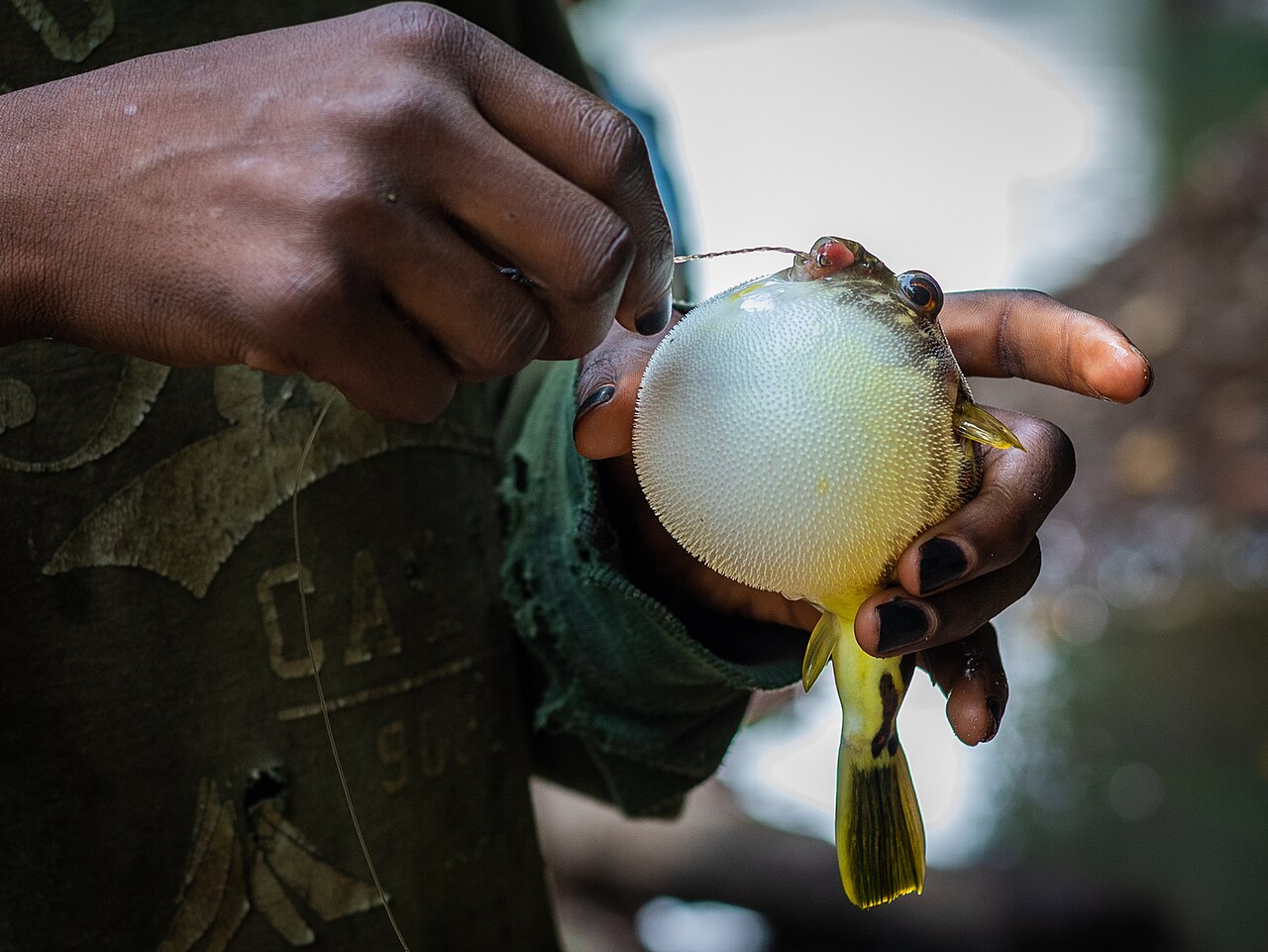
A pufferfish can inflate with either water or air. In the water, the default choice is water, because it is readily available and the fish can expel it quickly to return to normal. When a pufferfish is removed from water — say, by a fisherman or an inexperienced handler — it will gulp air instead. Air inflation is riskier: it is harder to expel, can cause buoyancy problems, and in extreme cases can leave the fish floating helplessly at the surface. This is why experts strongly discourage deliberately provoking a pufferfish to inflate, and why anglers who accidentally catch one are advised to return it to the water quickly and gently.
The Muscular Pump
The mechanics are impressive. Pufferfish lack a true stomach in the conventional sense; instead, they have a large, highly elastic sac that can expand enormously. Water (or air) is drawn in through the mouth and pumped into this sac by powerful muscles in the throat and body wall. The skin is loose and pleated, allowing it to stretch far beyond its resting size, and the spines, if present, are attached to the skin rather than to a rigid skeleton, so they rise as the skin tightens.
Once inflated, the fish must hold the pressure. Specialised muscles and valves keep the water or air trapped inside. Deflating is an active process too: the pufferfish opens its mouth and uses muscular contractions to force the contents out, sometimes with a noticeable spurt. A healthy pufferfish can complete the entire inflate-deflate cycle in a matter of seconds.
Why It Is Not a Free Trick
Inflation is energetically expensive and temporarily disables the fish. An inflated pufferfish cannot swim well, cannot feed, and is essentially committed to waiting out the threat. If a predator persists, the pufferfish may be swallowed anyway — and in some cases, an inflated pufferfish has been found lodged in the throat of a larger fish, killing both parties. Inflation is a last resort, not a first response. Given the choice, most pufferfish will flee, hide in a crevice, or rely on their other defences first.
The Backup Defences: Toxins, Spines, and Warning Colours
Inflation is only one layer of the pufferfish survival strategy. The second, and arguably more important, is chemical defence. Many pufferfish contain tetrodotoxin (TTX), a potent neurotoxin that blocks sodium channels in nerve cells and can cause paralysis and death in predators, including humans. The toxin is not produced by the fish alone; it is accumulated from bacteria in their diet and by symbiotic bacteria living in their tissues. Levels vary by species, location, and season, and some species are far more toxic than others.
Tetrodotoxin is famously the reason fugu, the Japanese delicacy prepared from certain Takifugu species, must be handled by licensed chefs who have trained for years. Even so, accidental poisonings still occur, and there is no antidote — treatment is supportive care only. For predators in the wild, the lesson is simple: pufferfish are not worth the risk.
Spines provide a mechanical complement to the chemical defence. Porcupinefish have large, obvious spines that are permanently visible, while many pufferfish have smaller, less conspicuous spines that only become obvious when the skin stretches. Either way, a predator that tries to swallow an inflated pufferfish is likely to get a mouthful of sharp points.
Many species also advertise their defences with bold patterns and colours — spots, stripes, and contrasting patches — that signal "do not eat me" to would-be attackers. In the animal kingdom, this kind of warning coloration is known as aposematism, and pufferfish are textbook examples.
Pufferfish Inflation in the Wild: Real Examples
In coral reef environments such as the Great Barrier Reef, the Red Sea, and the Caribbean, pufferfish are common residents. The black-spotted pufferfish (Arothron nigropunctatus) is frequently seen hovering near coral heads, and divers who approach too closely may witness a rapid inflation response. The guineafowl pufferfish (Arothron meleagris) of the Indo-Pacific is particularly striking, appearing in two colour forms — one dark with white spots, one bright yellow — and it inflates readily when harassed.
In freshwater, the Amazon pufferfish (Colomesus asellus) is a popular aquarium species that inflates when stressed, and the Congo's giant pufferfish is large enough that its inflation is genuinely imposing. On sandy bottoms, the starry pufferfish can reach over a metre and is one of the most dramatic inflators of all.
Predators that commonly interact with pufferfish include reef sharks, groupers, moray eels, and sea snakes. In most encounters, the pufferfish either escapes or inflates, and the predator moves on. Documented cases of predators successfully eating pufferfish usually involve juveniles, weakened individuals, or species with lower toxin levels.
Does Inflating Hurt the Pufferfish?
Occasional inflation in response to a genuine threat is normal and not harmful. The problems arise when inflation is triggered repeatedly or inappropriately. Stress-induced inflation — from handling, transportation, or poor tank conditions — can exhaust a pufferfish, and air inflation out of water can trap the fish at the surface or cause internal damage. In aquariums, a pufferfish that inflates frequently is often signalling that something is wrong: cramped quarters, aggressive tankmates, or unstable water parameters.
Responsible keepers therefore avoid netting pufferfish whenever possible, using containers or bags instead, and never provoke inflation for entertainment. In the wild, the same principle applies to divers and snorkelers: observing from a respectful distance is far better than chasing a pufferfish into a defensive display.
Common Myths and Misconceptions
"Pufferfish inflate to float."
This is false. Inflation is a defence mechanism, not a buoyancy control system. Pufferfish regulate their position in the water column using their swim bladder and fins, just like other fish. An inflated pufferfish is actually less mobile, not more.
"All pufferfish are deadly."
Not all pufferfish are highly toxic, and toxicity varies widely between species and populations. However, because it is difficult for a non-expert to judge, all pufferfish should be treated as potentially dangerous. Handling them is never advisable.
"Pufferfish can inflate forever."
No. Inflation is tiring and temporary. A pufferfish that cannot deflate is in serious trouble and may need veterinary or expert intervention.
"Blowfish and pufferfish are different animals."
They are the same group. "Blowfish," "pufferfish," "globefish," and "balloonfish" are interchangeable common names. Porcupinefish are close relatives but belong to a different family.
Why Pufferfish Inflate: A Final Word
Pufferfish inflate because they are slow, soft-bodied, and delicious to a wide range of predators — and inflation is the dramatic, effective answer to that problem. By gulping water (or air) into an elastic internal sac, erecting hidden spines, and presenting a predator with an unswallowable sphere, a pufferfish turns its greatest weakness into a formidable defence. Add tetrodotoxin to the mix, and you have one of the most thoroughly protected animals in the sea.
Understanding why pufferfish inflate also comes with a responsibility. Inflation is a stress response, not a party trick. Whether you encounter a pufferfish on a reef, in a market, or in an aquarium, the kindest thing you can do is give it space and let it stay deflated. The bloated truth, in the end, is this: pufferfish would much rather swim away than blow up — and we should respect that.
❓ Frequently Asked Questions
💬 Is it true that pufferfish can die after inflating?
Inflating itself isn't automatically fatal, but it's highly stressful and energetically costly for the fish. If a pufferfish is forced to puff up repeatedly, is held out of water, or swallows air instead of water, it can suffer serious harm or death.
💬 What makes a pufferfish inflate?
Pufferfish inflate as a defense mechanism when they feel threatened or startled by a predator. They rapidly gulp water (or air if out of water) into a highly elastic stomach, ballooning into a spiky, hard-to-swallow ball.
💬 Can you touch a pufferfish when it's inflated?
You shouldn't touch or provoke a pufferfish, especially when inflated, because many species have sharp spines and some carry deadly tetrodotoxin. Handling them also stresses the fish and can cause it to inhale air, which is dangerous for it.
💬 Do pufferfish inflate on purpose or by accident?
Inflation is a deliberate reflex triggered by fear or a perceived threat, not something they do casually. They can also puff up if they're caught, chased, or suddenly exposed to air, which is why they should be left alone in the water.