- Meet the Puffin: A Small Seabird with a Big Personality
- What Makes a Puffin Colorful Beak So Striking?
- The Anatomy of the Bill
- The Famous Blue-Grey Rosette
- Why Do Puffins Have a Colorful Beak? The Real Reasons
- Hormones Drive the Transformation
- Mate Choice and Pair Bonds
- Not Just for Show: Practical Functions
- Beyond the Bill: Other Colorful Signals on a Puffin
- The Eye Ornaments
- Orange Feet
- Life on the Cliff: Diet, Behavior, and the Cost of Color
- Diet and the Sand Eel Connection
- Nesting and Chick-Rearing
- The Price of Being Bright
- Myths and Misconceptions About the Puffin Colorful Beak
- Conservation: Why the Clown-Faced Look Matters
- Conclusion: The Clown-Faced Truth
- ❓ Frequently Asked Questions
The puffin colorful beak is one of the most striking sights in the North Atlantic—a vivid triangle of orange, yellow, and blue that looks almost painted on. Yet this famous feature is also one of the most misunderstood in the bird world. That bright bill is not a permanent decoration, it is not primarily for attracting mates in the way most people assume, and it disappears for much of the year. Behind the clown-faced look lies a story of seasonal hormones, waterproofing chemistry, and the tough practicalities of raising a chick on a wind-battered sea cliff. This article unpacks what the colors actually are, why they appear when they do, what they cost the bird, and why the puffin's painted face remains such a powerful symbol of the northern seas.
Meet the Puffin: A Small Seabird with a Big Personality
The bird most people picture is the Atlantic puffin (Fratercula arctica), the only puffin species native to the Atlantic Ocean. Two related species live in the North Pacific: the tufted puffin and the horned puffin. All three belong to the auk family, Alcidae, a group of diving seabirds that also includes guillemots, razorbills, and the extinct great auk.
Atlantic puffins are compact and sturdy. Adults measure roughly 26 to 29 centimeters (10 to 11 inches) in length and weigh between 350 and 500 grams (about 12 to 18 ounces), with males typically slightly larger than females. They have black backs and wings, white bellies, and—in breeding plumage—striking white faces framed by black markings around the eyes. Their wings are short and adapted for underwater propulsion rather than soaring, which is why puffins fly with rapid, whirring wingbeats, often skimming low over the water at speeds of around 77 kilometers per hour (48 mph).
Their range spans the North Atlantic, from Maine and Newfoundland in the west to Iceland, Norway, the Faroe Islands, and the British Isles in the east, with the largest colonies concentrated in Iceland. They nest in burrows on grassy clifftops and offshore islands, often in dense colonies where thousands of pairs dig side by side. Puffins are long-lived for small birds: individuals commonly reach 20 years, and the oldest known Atlantic puffin, ringed on the Isle of May in Scotland, lived to at least 41 years.
What Makes a Puffin Colorful Beak So Striking?
The puffin colorful beak is actually a remarkable piece of biological engineering, built from several distinct plates rather than a single solid structure. The outer surface is made of keratin—the same material as human fingernails—covering a bony core. In breeding season, the bill enlarges dramatically and takes on its signature palette.
The Anatomy of the Bill
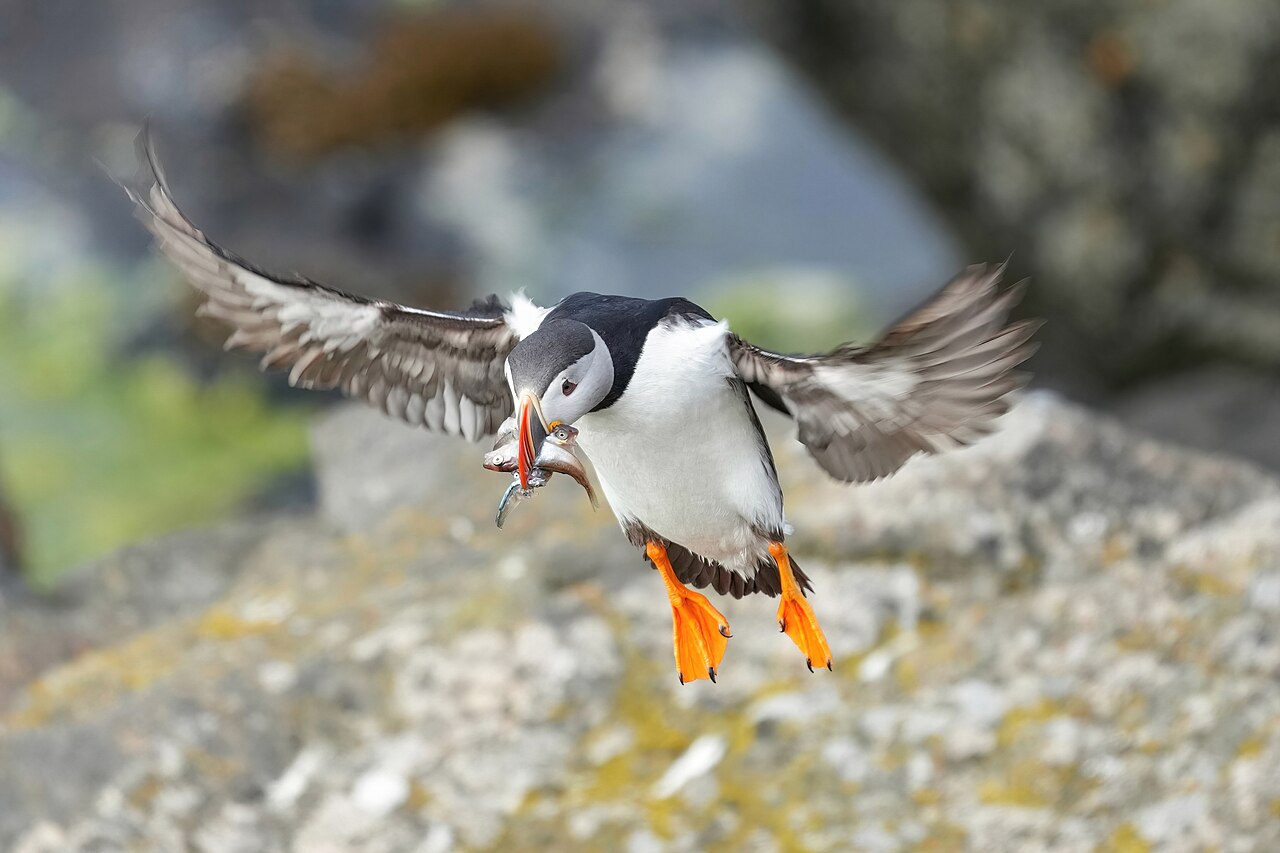
The colors come from different parts of the bill and from different mechanisms. The large, curved upper section, called the maxilla, is bright orange-red, while the tip carries a yellow-orange rosette. A pale yellow strip runs along the cutting edge, and at the base of the bill sits a small, fleshy blue-grey knob. The mouth lining itself is a vivid yellow. The colors are produced by pigments in the keratin and by the microscopic structure of the tissue, which scatters light in ways that intensify certain hues.
The Famous Blue-Grey Rosette
That blue-grey rosette at the corner of the mouth is not just decorative. It is a fleshy, swollen structure that appears only during the breeding season and is thought to help protect the eyes and bill base during the crowded, jostling life of a colony. It also serves as a visual cue: researchers have found that puffins respond to the brightness of this rosette, and it may signal individual identity or condition to neighbors.
Why Do Puffins Have a Colorful Beak? The Real Reasons
The short answer is that the puffin colorful beak is a seasonal signal tied to reproduction. But the full explanation involves hormones, mate choice, and a surprising amount of practicality.
Hormones Drive the Transformation
Puffins do not look like this all year. In late winter, rising levels of hormones—particularly testosterone and estrogen—trigger the growth of the bill's outer layers and the development of the colored plates. The bright bill is effectively a secondary sexual characteristic, a visible badge of breeding readiness. When the breeding season ends in late summer, the bird sheds the outer layers of the bill, a process called bill molting, and the bill shrinks to a smaller, duller, dark-grey version that is far less conspicuous.
Mate Choice and Pair Bonds
Puffins are socially monogamous and often return to the same mate and the same burrow year after year. Because pairs reunite on the colony, the bill's brightness may help birds confirm the condition and identity of a returning partner. Studies suggest that puffins can recognize individual bills, and the variation in bill size and color pattern may act like a name tag in a crowded colony. A bright, well-formed bill is also a sign of good health and food intake, since the bill's growth and coloration depend on adequate nutrition.
Not Just for Show: Practical Functions
The bill is not purely ornamental. Its serrated edges help puffins grip slippery fish, and the enlarged breeding-season bill may aid in digging and maintaining the burrow. The bright colors may also serve as a warning or distraction to predators and to rival puffins during disputes over nest sites.
Beyond the Bill: Other Colorful Signals on a Puffin
The bill is the headline, but a puffin's breeding appearance includes other colorful features that work together as a package.
The Eye Ornaments
During the breeding season, puffins develop a small, fleshy rosette above and behind the eye, and the eye itself is ringed with bright orange-red skin. These features fade or disappear outside the breeding season, reinforcing the idea that the entire face is a seasonal display.
Orange Feet
Puffins' webbed feet turn bright orange in the breeding season and become duller in winter. The feet are used in courtship displays and in burrow excavation, and their color intensity may signal condition to mates.
Life on the Cliff: Diet, Behavior, and the Cost of Color
A puffin's colors are expensive to produce and maintain, and understanding the bird's daily life helps explain why.
Diet and the Sand Eel Connection
Puffins are pursuit divers, using their wings to "fly" underwater in search of small fish. Their diet is dominated by sand eels, herring, sprat, and capelin, depending on the region and season. A puffin can hold several small fish crosswise in its bill at once—the record for an Atlantic puffin is around 60 fish in a single beak-load—thanks to a special hinge and a spiny tongue that pins prey in place. This fish-carrying ability is crucial: chicks need frequent, large deliveries, and parents may make several trips a day.
Nesting and Chick-Rearing
Puffins dig burrows about 70 to 110 centimeters (28 to 43 inches) long, often using their bills and feet to loosen soil. The female lays a single egg, which both parents incubate for roughly 36 to 45 days. The chick, called a puffling, stays in the burrow for about six to seven weeks before fledging, usually at night to avoid predators. During this period, the parents' bright bills are at their peak—and so is the energetic cost of feeding a growing chick.
The Price of Being Bright
Producing and maintaining a colorful bill requires energy and nutrients, and the bill's outer layers are shed and regrown each year. Some researchers have suggested that bill brightness may honestly advertise a bird's foraging success, because only well-fed puffins can afford the full display. This is the logic of honest signaling: the ornament is costly, so it is hard to fake.
Myths and Misconceptions About the Puffin Colorful Beak
Because puffins are so photogenic, several myths have taken hold. Here are the most common ones, corrected.
- Myth: Puffins are colorful all year. In reality, the bright bill is a breeding-season feature. In winter, the bill is smaller, darker, and much less conspicuous.
- Myth: The bill is painted or permanently bright. The colors come from keratin plates and pigments that grow and are shed annually.
- Myth: Puffins are closely related to penguins. They are not. Penguins are flightless southern seabirds; puffins are flying northern auks. Their similar black-and-white pattern is an example of convergent evolution.
- Myth: The bill is only for mating. It also helps with gripping fish, digging burrows, and social signaling.
- Myth: Puffins are rare everywhere. Some colonies are large and stable, but others have declined sharply, particularly in parts of the North Sea and Iceland, due to food shortages and climate change.
Conservation: Why the Clown-Faced Look Matters
Puffins are listed as Vulnerable on the IUCN Red List, and several populations are in serious decline. The causes are largely tied to the sea: warming waters shift the distribution of sand eels and other prey, making it harder for parents to feed chicks. Overfishing, pollution, and disturbance at colonies add pressure. Because the bright bill is a seasonal signal of breeding condition, researchers can use bill appearance and chick-feeding rates as indicators of colony health. Protecting forage fish stocks and safeguarding nesting islands are among the most effective conservation measures.
Conclusion: The Clown-Faced Truth
The puffin colorful beak is far more than a charming oddity. It is a seasonal ornament built from keratin, driven by hormones, and shaped by the demands of courtship, chick-rearing, and survival on some of the North Atlantic's harshest coastlines. It fades each winter and returns each spring, a reliable signal that the breeding season has begun. Understanding that cycle turns a simple, funny-looking bird into a window onto the health of northern marine ecosystems—and a reminder that the most spectacular features in nature are usually the ones with the most practical purposes.
❓ Frequently Asked Questions
💬 Why do puffins have colorful beaks?
The bright orange, yellow, and blue plates on a puffin's beak are mainly a breeding-season signal that helps attract mates and show a bird's health. Outside the breeding season, puffins shed these colorful outer plates and their beaks become much duller.
💬 Do puffins lose their colorful beaks in winter?
Yes. After breeding, puffins molt the bright outer layers of the beak, leaving a smaller, duller bill for winter. The full colors return before the next breeding season.
💬 Does the colorful beak mean a puffin is a certain sex or age?
No, both male and female puffins grow colorful beaks, so color alone doesn't reveal sex. The brightness develops as birds mature and is most pronounced during breeding season.
💬 Is the puffin's colorful beak dangerous or just for show?
It's not dangerous, but it's more than decoration. The beak is a strong tool for catching and holding fish and for digging burrows, while the bright colors serve mainly as a social and mating signal.