- What Exactly Is a Red Panda's False Thumb?
- Not a True Thumb, and Not Unique to Pandas
- How the Red Pandas False Thumb Works in Daily Life
- Feeding, Climbing, and Grooming
- Convergent Evolution: Why Red Pandas and Giant Pandas Both Have One
- Two Thumbs, Two Slightly Different Designs
- Body Size, Diet, and the Energy Budget Behind the Thumb
- What Else Do Red Pandas Eat?
- Behavior, Reproduction, and the Thumb's Role in Raising Cubs
- Conservation: A Fragile Future
- Common Myths About the Red Panda's False Thumb
- The Bigger Picture: What the False Thumb Teaches Us
- Conclusion: A Small Bone With a Big Story
- ❓ Frequently Asked Questions
The red pandas false thumb is one of the most fascinating quirks in the animal kingdom — a small, extra bone that works like a sixth digit and helps this bamboo-munching mammal grip its food with surprising precision. If you have ever watched a red panda (Ailurus fulgens) daintily peeling a bamboo shoot or holding a slice of apple, you may have assumed you were looking at a miniature version of a giant panda. You would be half right. Both animals evolved a similar solution to the same problem, but they did it independently, on different continents, tens of millions of years apart. That is the surprising truth at the heart of this story: the red panda's false thumb is not a borrowed trait from its bigger, black-and-white namesake. It is a remarkable example of convergent evolution, and it reveals just how far nature will go to turn a carnivore into a bamboo specialist.
What Exactly Is a Red Panda's False Thumb?
To understand the red pandas false thumb, you first need to know a little about red panda anatomy. Like all mammals, red pandas have five true digits on each front paw, each ending in a sharp, curved, semi-retractable claw. Those claws are excellent for climbing trees and walking along mossy branches, but they are not much use for grasping a slender bamboo stalk. That is where the false thumb comes in.
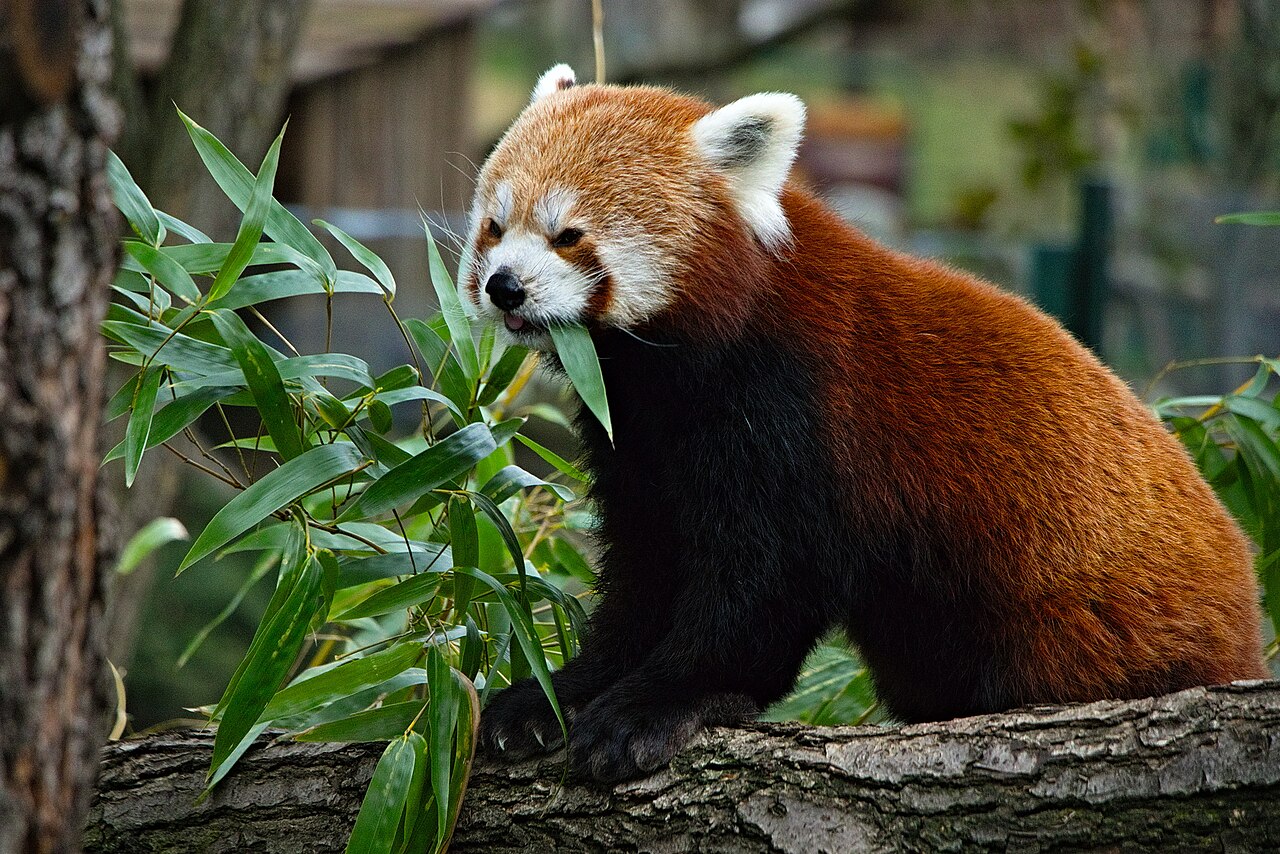
The false thumb is not a finger at all. It is an enlarged and elongated version of the radial sesamoid bone, a small bone that in most mammals sits quietly inside the wrist joint and helps stabilize the tendons passing over it. In red pandas, this sesamoid has grown into a stout, slightly curved structure that juts out from the inner side of the wrist, roughly opposite the true thumb. Covered in a fleshy pad and powered by modified wrist muscles, it functions like a thumb, allowing the animal to clamp a bamboo stem against its real fingers.
The result is a gripping mechanism that looks and works a lot like a hand. A red panda can hold a bamboo leaf bundle steady, strip leaves off a stem with its teeth, and even manipulate small objects with a dexterity that seems uncanny for a creature with such a small brain and such a specialized diet. If you have ever seen a video of a red panda clutching a grape or a piece of bamboo, you were watching the false thumb in action.
Not a True Thumb, and Not Unique to Pandas
It is worth stressing that the false thumb is not a true digit. It has no joints like a finger, and it cannot bend independently the way your thumb can. Instead, it works as a rigid lever against which the real fingers press. The radial sesamoid is also present in many other mammals, including your own wrist, but in red pandas it is dramatically enlarged and repositioned. In giant pandas, the same bone is enlarged in a similar way, but the two species are only distant relatives — more on that shortly.
How the Red Pandas False Thumb Works in Daily Life
Red pandas are native to the temperate forests of the eastern Himalayas and southwestern China, ranging across Nepal, Bhutan, northeastern India, Myanmar, and the Chinese provinces of Sichuan and Yunnan. They live at elevations of roughly 2,200 to 4,800 meters (7,200 to 15,700 feet), in cool, damp mountain forests with dense bamboo undergrowth, rhododendrons, and moss-covered trees. Their home is often cold, foggy, and wet — a world away from the tropical image many people have of pandas.
Bamboo makes up the overwhelming majority of the red panda's diet — by some estimates, 85 to 95 percent of what it eats. That is an extraordinary figure for an animal whose digestive system is still essentially that of a carnivore. Red pandas belong to the order Carnivora, and their gut is short and simple, poorly suited to breaking down tough plant fiber. They cannot digest cellulose efficiently, so they must eat enormous quantities of bamboo to extract enough energy: as much as 1.5 to 2 kilograms (3 to 4.5 pounds) of fresh bamboo leaves and shoots per day, consumed over many hours of near-continuous feeding.
This is where the false thumb becomes a survival tool rather than a curiosity. Bamboo is a grass, and its leaves are arranged in tight, narrow bundles around slender stems. To eat efficiently, a red panda needs to bring those leaves to its mouth in manageable clumps. The false thumb lets it grip a stem, pull it toward the muzzle, and shear off a mouthful with its teeth. Without that grip, feeding would be far slower and far more wasteful — and for an animal that must process kilograms of low-calorie food every day, efficiency is everything.
Feeding, Climbing, and Grooming
The false thumb is most famous for its role in feeding, but it also helps with other tasks:
- Climbing: Red pandas are excellent climbers and spend much of their time in trees, using their claws and partially opposable front paws to grip branches. The false thumb adds stability when they pull themselves upward or cling to thin limbs.
- Grooming: Like cats, red pandas groom themselves frequently. The false thumb helps them manipulate their dense, reddish-brown fur, especially around the face and chest.
- Handling food: In captivity, red pandas are often observed holding fruit, eggs, and specially formulated biscuits in their front paws, rotating them and nibbling delicately — behavior that would be far clumsier without the extra grip.
Convergent Evolution: Why Red Pandas and Giant Pandas Both Have One
Here is where the story gets genuinely surprising. Giant pandas (Ailuropoda melanoleuca) also have an enlarged radial sesamoid that functions as a false thumb, and they also eat mostly bamboo. For decades, scientists assumed this shared trait meant the two pandas were close relatives. After all, they share a name, a diet, a habitat, and a thumb. Surely they must be cousins?
Genetics told a different story. Modern molecular studies have shown that red pandas and giant pandas are not closely related at all. Giant pandas are true bears, belonging to the family Ursidae. Red pandas are the sole living members of their own family, Ailuridae, and their closest living relatives are thought to be raccoons, skunks, and weasels — though even that relationship is distant and has been debated for decades. Their lineages split deep in the evolutionary past, probably more than 30 million years ago.
So how did two unrelated animals end up with the same solution? The answer is convergent evolution: when different species face the same environmental challenge, natural selection can produce strikingly similar adaptations. Both pandas live in Asian mountain forests where bamboo is abundant, and both are descended from meat-eating ancestors. Both needed a way to grasp slippery bamboo stems. In both lineages, the same anatomical raw material — the radial sesamoid bone — was available, and in both it was enlarged and repurposed by selection. The thumbs are analogous, not homologous: similar in function, but not inherited from a common ancestor.
Even more remarkable, recent fossil research has pushed the red panda's false thumb much further back in time than anyone expected. In 2022, paleontologists described Magerictis imperialensis, an extinct relative of the red panda from the Middle Miocene of Spain, roughly 11 to 12 million years ago. Its fossilized wrist already showed an enlarged radial sesamoid. That means the red panda lineage was developing a false thumb long before giant pandas did — and long before either species became as specialized as it is today. The red panda, in other words, may have gotten there first.
Two Thumbs, Two Slightly Different Designs
Although the two false thumbs serve the same purpose, they are not identical. The giant panda's radial sesamoid is larger and more robust, and it works alongside a second enlarged bone in the wrist. The red panda's version is smaller and more slender, matched to the animal's much smaller body size and to its habit of stripping leaves rather than snapping thick bamboo culms. Red pandas also eat more bamboo leaves, while giant pandas focus more on stems and shoots. Different menus, slightly different tools.
Body Size, Diet, and the Energy Budget Behind the Thumb
Understanding the false thumb means understanding the strange economics of being a bamboo eater. Red pandas are small — roughly the size of a large house cat. They measure about 50 to 64 centimeters (20 to 25 inches) from head to body, with a bushy tail adding another 28 to 59 centimeters (11 to 23 inches). Adults weigh between 3 and 6.2 kilograms (6.6 to 13.7 pounds), with males generally larger than females. Their thick fur, including fur-covered soles, keeps them warm in freezing mountain conditions.
Because bamboo is so nutrient-poor, red pandas have evolved a low-energy lifestyle. They move slowly, rest often, and have relatively low metabolic rates for their size. They are also crepuscular — most active at dawn and dusk — and largely solitary outside the breeding season. A typical wild red panda may live 8 to 10 years, while animals in human care can reach 12 to 14 years, with some individuals living even longer.
Every adaptation in a red panda's body is shaped by the need to squeeze calories out of a tough, abundant, low-value food. The false thumb is one piece of that puzzle, alongside a powerful jaw, broad molars, a long tongue, and a digestive tract that, while imperfect, extracts what it can. Bamboo is everywhere in their habitat — but eating it is a full-time job, and the thumb makes that job possible.
What Else Do Red Pandas Eat?
Bamboo dominates, but red pandas are not strict specialists. They also eat:
- Fruit and berries, especially in summer and autumn when these are available.
- Insects and larvae, which provide valuable protein and fat, particularly for nursing mothers and growing cubs.
- Small vertebrates and bird eggs, eaten opportunistically.
- Roots, grasses, and fungi, taken when other foods are scarce.
Their occasional carnivory is a reminder of their ancestry — and a hint that the false thumb, useful as it is for bamboo, sits on a body that was originally built for a very different menu.
Behavior, Reproduction, and the Thumb's Role in Raising Cubs
Red pandas are solitary and territorial, marking their ranges with scent from glands on their tails and anal region. They communicate with chirps, whistles, and a distinctive "quack-snort" alarm call. Despite their gentle appearance, they are capable of standing on their hind legs and raising their front paws when threatened, a posture that makes them look larger and more intimidating.
Breeding typically occurs in late winter to early spring, with a gestation of roughly 90 to 145 days, including delayed implantation. Females give birth to one to four cubs, most often two, in a nest of twigs, leaves, and moss inside a hollow tree or rock crevice. Newborn cubs are blind, deaf, and weigh only about 100 to 130 grams (3.5 to 4.6 ounces) — tiny, pale, and completely dependent. Their eyes open at around 18 days, and they begin to leave the nest at about three months. They stay with their mother until roughly eight to ten months old, and reach sexual maturity at around 18 months.
During those early months, the false thumb plays a supporting role. Mothers use their front paws to rearrange bedding, groom cubs, and handle food while nursing. Cubs, meanwhile, begin practicing the gripping motions that will later let them feed on bamboo. The thumb is not something they must learn, but the coordination to use it well develops with age and experience.
Conservation: A Fragile Future
Red pandas are classified as Endangered by the International Union for Conservation of Nature (IUCN). Their total wild population is estimated at fewer than 10,000 mature individuals, and some estimates put it considerably lower. The main threats are habitat loss and fragmentation from logging, agriculture, and human settlement; poaching for their pelts and for the pet trade; and accidental capture in snares set for other animals. Climate change is an additional concern, as warming temperatures push suitable bamboo habitat upslope.
Conservation efforts include protected areas across Nepal, India, Bhutan, Myanmar, and China, anti-poaching patrols, community education programs, and captive breeding. The Red Panda Network, based in Nepal, works with local "forest guardians" to monitor wild populations, while zoos around the world participate in coordinated breeding programs. The false thumb may be a marvel of evolution, but it cannot protect the red panda from habitat destruction. That job falls to people.
Common Myths About the Red Panda's False Thumb
Because the false thumb is so unusual, it has attracted its share of misunderstandings. Here are a few of the most common:
- Myth: Red pandas are a type of bear. False. They belong to their own family, Ailuridae, and are more closely related to raccoons and weasels than to bears.
- Myth: The false thumb is a real sixth finger. False. It is an enlarged wrist bone, not a digit, and it lacks the joints of a true finger.
- Myth: Red pandas inherited the thumb from giant pandas. False. The two species evolved it independently through convergent evolution.
- Myth: The thumb is only used for eating bamboo. Not quite. It also assists with climbing, grooming, and handling a variety of foods.
- Myth: Red pandas are the same species as giant pandas. False. They differ in size, family, coloration, and evolutionary history. The shared name "panda" comes from a Nepali word, roughly nigalya ponya, meaning "bamboo eater."
The Bigger Picture: What the False Thumb Teaches Us
The red panda's false thumb is more than a biological oddity. It is a case study in how evolution works with the materials at hand. Nature did not invent a new finger for the red panda; it took a small, unremarkable bone already present in the wrist and enlarged it, reshaped it, and put it to a new use. The same thing happened, separately, in giant pandas. Two lineages, two continents, one problem, one solution — arrived at twice.
That is the surprising truth. The red panda's false thumb is not a hand-me-down from a famous relative. It is the product of millions of years of selection acting on a bamboo-eating carnivore in the misty forests of the Himalayas. It is a reminder that evolution is not a ladder of progress but a tinkerer, endlessly repurposing what already exists. And it is a reminder that some of the most remarkable adaptations in nature are also among the smallest — a bone the size of a thumbnail, doing the work of a thumb.
Next time you see a red panda on a branch, clutching a bamboo stem with that odd, deliberate grip, remember what you are watching: a living fossil of an experiment that began over ten million years ago, and a quiet triumph of convergent evolution.
Conclusion: A Small Bone With a Big Story
The red pandas false thumb is an enlarged wrist bone that acts as a sixth digit, letting this small Himalayan mammal grip bamboo stems, strip leaves, climb branches, and groom its fur with surprising precision. It evolved independently from the similar structure in giant pandas, making the two species a textbook example of convergent evolution. Combined with a low-energy lifestyle, a bamboo-heavy diet, and a body built for cold mountain forests, the false thumb helps explain how an animal descended from carnivores became one of the world's most specialized herbivores. It is a tiny adaptation with an outsized role — and a powerful reminder of how inventive, and how patient, evolution can be.
❓ Frequently Asked Questions
💬 Is the red panda's false thumb the same as a giant panda's?
No, they evolved independently. Red pandas have an enlarged radial sesamoid bone in the wrist, while giant pandas have a modified wrist bone plus a fleshy pad, so the two structures are an example of convergent evolution rather than shared inheritance.
💬 What is the red panda's false thumb actually used for?
It acts as a sixth finger that helps the red panda grip and strip bamboo shoots and leaves, its main food. It also assists with climbing and handling other foods like fruit and eggs.
💬 If the false thumb isn't a real finger, what is it made of?
It is an enlarged radial sesamoid bone, a bone that normally sits inside a wrist tendon. In red pandas this bone is much bigger than usual and works together with a fleshy pad to function like an opposable thumb.
💬 Does the false thumb mean red pandas are closely related to giant pandas?
No, red pandas are the only living members of their own family, Ailuridae, and are more closely related to raccoons, skunks, and weasels than to giant pandas. Their similar thumb is a striking case of two unrelated bamboo-eating lineages solving the same problem in the same way.