- What Exactly Is Salamander Slime?
- Mucus Glands vs. Granular Glands
- Why Salamander Slime Matters for Survival
- 1. Preventing Desiccation
- 2. Helping With Respiration
- 3. Slipping Away From Predators
- 4. Fighting Infection
- 5. Communication and Chemical Signaling
- The Chemistry Behind Salamander Slime
- Sticky Defenses
- Real Salamanders, Real Slime: Examples From Around the World
- How Salamanders Manage Their Slime
- Behavioral Hydration
- Slime and Shedding
- Misconceptions and Human Interactions
- Why You Shouldn't Lick a Newt
- The Slippery Truth
- ❓ Frequently Asked Questions
Salamander slime is one of the most misunderstood substances in the animal kingdom—at once a punchline, a survival tool, and a sophisticated piece of biological engineering. Anyone who has picked up a salamander knows the sensation: cool, soft skin that seems to slip through your fingers like a wet bar of soap. That coating isn't random goo. It is a multi-purpose secretion produced by glands embedded in the skin, and it keeps salamanders alive in ways that range from the mundane to the extraordinary. In this article, we'll dig into what salamander slime actually is, why amphibians depend on it so heavily, and what it tells us about one of the most secretive vertebrate groups on Earth.
What Exactly Is Salamander Slime?
Salamander slime is a watery secretion produced by glands in the animal's skin, primarily mucus glands but also granular glands that release more potent compounds. The mucus itself is largely made of glycoproteins—protein molecules studded with sugar chains—suspended in water. When these molecules absorb moisture, they form a slick, gel-like layer that coats the entire body. It's chemically similar in principle to the mucus that lines your own nose and throat, though the salamander version is produced in far greater volume and serves a much wider range of functions.
The skin of a salamander is not like a lizard's. Most salamanders have no scales at all; their skin is smooth, thin, and richly supplied with glands and blood vessels. In fact, the skin is so permeable that many species can absorb water and even oxygen directly through it. That permeability is a double-edged sword. It allows salamanders to breathe and stay hydrated without drinking, but it also means they lose water rapidly in dry air—and it makes them vulnerable to infection, irritants, and predators. The slime layer is the answer to both problems.
Mucus Glands vs. Granular Glands
Salamander skin contains two broad categories of glands. Mucus glands are numerous, small, and dedicated to producing the slippery coating that keeps the skin moist. Granular glands are larger and often concentrated in specific regions—along the back, on the tail, or behind the eyes—and they secrete defensive chemicals. In some species, these granular secretions are sticky and adhesive; in others, they are toxic. The familiar wet sheen on a salamander is mostly the work of mucus glands, but the two systems work together as an integrated defense and hydration strategy.
Why Salamander Slime Matters for Survival
The reasons salamanders produce so much slime can be grouped into a handful of critical functions. Each one addresses a real physiological or ecological challenge that these animals face every day.
1. Preventing Desiccation
Salamanders are amphibians, and most amphibians are highly sensitive to water loss. Their skin is not waterproof, so water evaporates from their bodies continuously. A moist slime layer slows that evaporation dramatically by creating a barrier of water-saturated gel at the skin surface. Species that live in dry or seasonally arid habitats—such as the tiger salamander (Ambystoma tigrinum), which ranges across much of North America—rely on this coating plus behavioral tricks like burrowing and nocturnal activity to survive. Without slime, a salamander could lose water faster than it could replace it, and dehydration would follow within hours.
2. Helping With Respiration
Many salamanders, especially those in the family Plethodontidae (the lungless salamanders), breathe entirely through their skin and the lining of their mouths. This process, called cutaneous respiration, requires the skin to stay moist—gases must dissolve in water to pass through the skin. The slime layer keeps the surface wet enough for oxygen to diffuse in and carbon dioxide to diffuse out. Lungless salamanders make up roughly two-thirds of all salamander species, so this is not a niche trick; it's a fundamental reason slime is non-negotiable for most of the group.
3. Slipping Away From Predators
A slippery body is hard to grab. When a bird, snake, raccoon, or even a curious human tries to seize a salamander, the slime layer reduces friction and gives the animal a chance to wriggle free. Some species combine slipperiness with a writhing, tail-lashing escape response. The effect is enhanced by the salamander's flexible body and, in many species, a tail that can be dropped and regrown—a process called caudal autotomy—to distract a predator while the animal escapes.
4. Fighting Infection
Salamander slime is not just lubricant; it's also a first line of immune defense. Amphibian skin secretions contain antimicrobial peptides—short protein molecules that can disrupt bacterial and fungal cell membranes. Research on amphibian skin has identified hundreds of such peptides, and salamanders are no exception. Because salamanders often live in damp soil, leaf litter, and pond water teeming with microbes, this chemical shield matters. It helps explain why salamanders can spend weeks in muddy burrows without succumbing to infections that would quickly overwhelm a less protected animal.
5. Communication and Chemical Signaling
Slime can carry information. During breeding season, many salamanders release pheromones through skin glands, and the mucus layer helps disperse these chemical signals into the water or air. Male red-spotted newts, for example, fan pheromone-laden water toward females during courtship. In some species, glandular secretions also signal alarm or aggression. The slime layer, in other words, doubles as a delivery system for chemical messages.
The Chemistry Behind Salamander Slime
What makes salamander slime so effective is its molecular structure. The glycoproteins in mucus are long, chain-like molecules that trap large amounts of water, forming a viscous, cohesive gel. This gel is thixotropic in some contexts—meaning its viscosity changes depending on how it's disturbed—which helps explain why a salamander can seem almost dry when still but becomes remarkably slippery when handled.
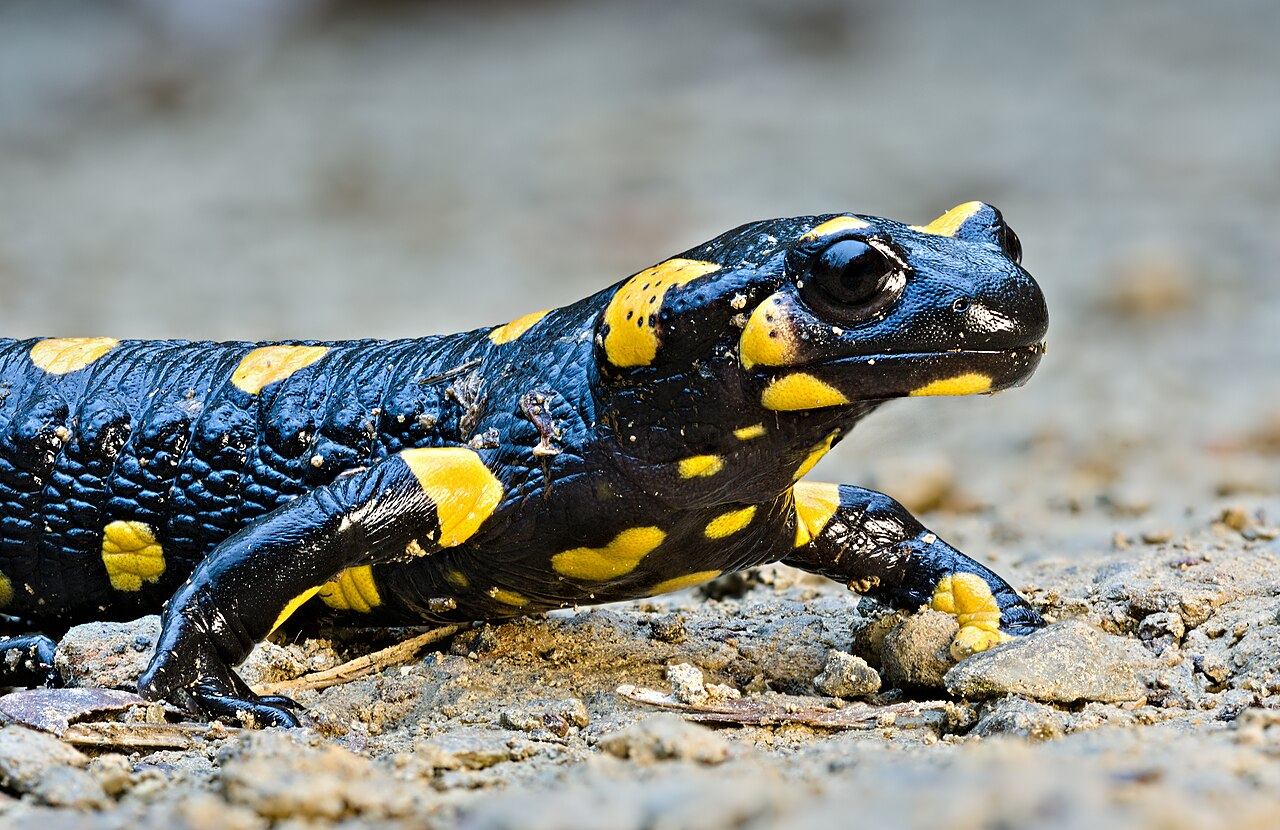
The defensive secretions from granular glands are a different story. Some species produce alkaloid toxins, including steroidal alkaloids and, in certain newts, tetrodotoxin—a potent neurotoxin also found in pufferfish. The rough-skinned newt (Taricha granulosa) of the Pacific Northwest is famous for this: its skin contains enough tetrodotoxin to kill an adult human if ingested, and it has co-evolved with garter snakes that have developed resistance to the toxin. Other salamanders, such as the fire salamander (Salamandra salamandra) of Europe, excrete alkaloids from parotoid glands behind the eyes when threatened. These chemicals are not the same as the slippery mucus, but they are part of the same skin-gland system, and they work alongside the slime to make salamanders unappealing meals.
Sticky Defenses
Not all salamander slime is slippery. Some species produce adhesive secretions that can gum up a predator's mouth or bind its limbs. The marbled salamander and certain plethodontids can release sticky substances from tail glands when attacked. This "glue defense" is another reminder that salamander skin secretions are versatile tools rather than a single substance.
Real Salamanders, Real Slime: Examples From Around the World
Salamanders are distributed across the Northern Hemisphere, with the greatest diversity in North America and East Asia. Their slime strategies vary with habitat and lifestyle.
- Eastern red-backed salamander (Plethodon cinereus): A small, lungless woodland species common in eastern North America. It grows to about 5–10 cm (2–4 inches) and lives in moist leaf litter. It relies entirely on skin respiration and slime for moisture, and it can be found in densities of more than one per square meter in good habitat.
- Tiger salamander (Ambystoma tigrinum): One of the largest terrestrial salamanders, reaching up to about 33 cm (13 inches). It burrows in soil and is more drought-tolerant than many species, thanks in part to its thick slime coating.
- Chinese giant salamander (Andrias davidianus): The largest amphibian in the world, capable of exceeding 1.5 meters (5 feet) in length. Its loose, wrinkled skin produces copious mucus, which helps reduce friction in fast-flowing water and may aid in skin respiration.
- Axolotl (Ambystoma mexicanum): A fully aquatic salamander that retains its larval gills into adulthood. Its slime layer helps protect against infection in the warm, still waters of its native Xochimilco canals in Mexico.
- Fire salamander (Salamandra salamandra): A striking black-and-yellow European species that secretes defensive alkaloids from its skin glands when threatened.
How Salamanders Manage Their Slime
Producing slime costs energy and water, so salamanders regulate it carefully. They seek out damp microhabitats—under logs, rocks, leaf litter, and in burrows—where humidity stays high and water loss is slow. Many species are nocturnal, emerging at night when the air is cooler and moister. Some, like the lungless woodland salamanders, have no lungs and must keep their skin wet to breathe at all, so they are especially tied to moist environments.
Behavioral Hydration
Salamanders don't drink in the conventional sense. Instead, they absorb water through their skin, often by pressing their bellies against wet soil or moss. The slime layer facilitates this absorption. In dry conditions, some species can enter a state of estivation—a summer dormancy—burrowing deep and slowing their metabolism until rains return.
Slime and Shedding
Salamanders shed their skin periodically, and the slime layer is renewed in the process. Unlike snakes, which shed in one piece, many salamanders shed in fragments and often eat the shed skin. This behavior recycles nutrients and removes a potential source of infection.
Misconceptions and Human Interactions
Salamander slime has inspired plenty of myths. Some people believe that touching a salamander will cause warts or poison them—neither is true for most species. The slime is harmless to humans in the vast majority of cases, though a few species (notably certain newts) carry toxins that can cause irritation if you rub your eyes after handling them. The safest practice is to handle salamanders as little as possible, with wet hands, and to wash afterward.
It's also worth noting that salamander slime is not a sign of disease or dirt. A shiny, moist salamander is a healthy salamander. A dry, dull-skinned salamander is likely stressed or ill. Because their skin is so permeable, salamanders are also highly sensitive to environmental pollutants, which is why biologists use them as indicators of ecosystem health. Acid rain, pesticides, and habitat drying can all compromise the slime layer and, by extension, the animal's ability to breathe, hydrate, and defend itself.
Why You Shouldn't Lick a Newt
This bears repeating: the rough-skinned newt's tetrodotoxin is a serious neurotoxin. There are documented cases of people becoming ill—and in rare cases dying—after swallowing newts on dares. Admire salamander slime from a respectful distance.
The Slippery Truth
Salamander slime is far more than a curiosity. It is a hydration system, a respiratory aid, a slippery escape mechanism, an antimicrobial shield, and a chemical signaling medium, all rolled into one thin, glandular layer of skin. It reflects the evolutionary bargain that amphibians struck: a permeable skin that allows them to breathe and absorb water, paired with a mucus coating that makes that permeability survivable. From the tiny red-backed salamander in a Vermont forest to the enormous Chinese giant salamander in a mountain stream, slime is the common thread that lets these animals thrive in damp, hidden corners of the world. The next time you see a salamander slip through your fingers, you'll know exactly why—and you'll have a little more respect for the remarkable biology behind that wet, wonderful coating.
❓ Frequently Asked Questions
💬 Why do salamanders have slime?
Salamander slime is a mucus layer secreted by glands in the skin that keeps the animal moist, which matters because most salamanders breathe partly through their skin. It also protects against infection, helps them slip away from predators, and reduces friction as they move.
💬 Is salamander slime poisonous?
For most species the slime itself is harmless to humans, but some salamanders, such as newts, secrete toxins like tetrodotoxin in their skin. Always wash your hands after handling one and never let a child or pet put a salamander in their mouth.
💬 Can you get sick from touching a salamander's slime?
Serious illness is rare, but the slime can carry bacteria such as Salmonella, and some species have irritating or toxic secretions. Wash your hands with soap and water afterward, and avoid touching your eyes or mouth before you do.
💬 Why does salamander slime feel so slippery, and does it dry out?
The mucus is mostly water plus long sugar-protein molecules called mucins, which make it slick and hold moisture against the skin. If a salamander dries out, that layer fails and the animal can suffocate or dehydrate, which is why they stay in damp habitats.