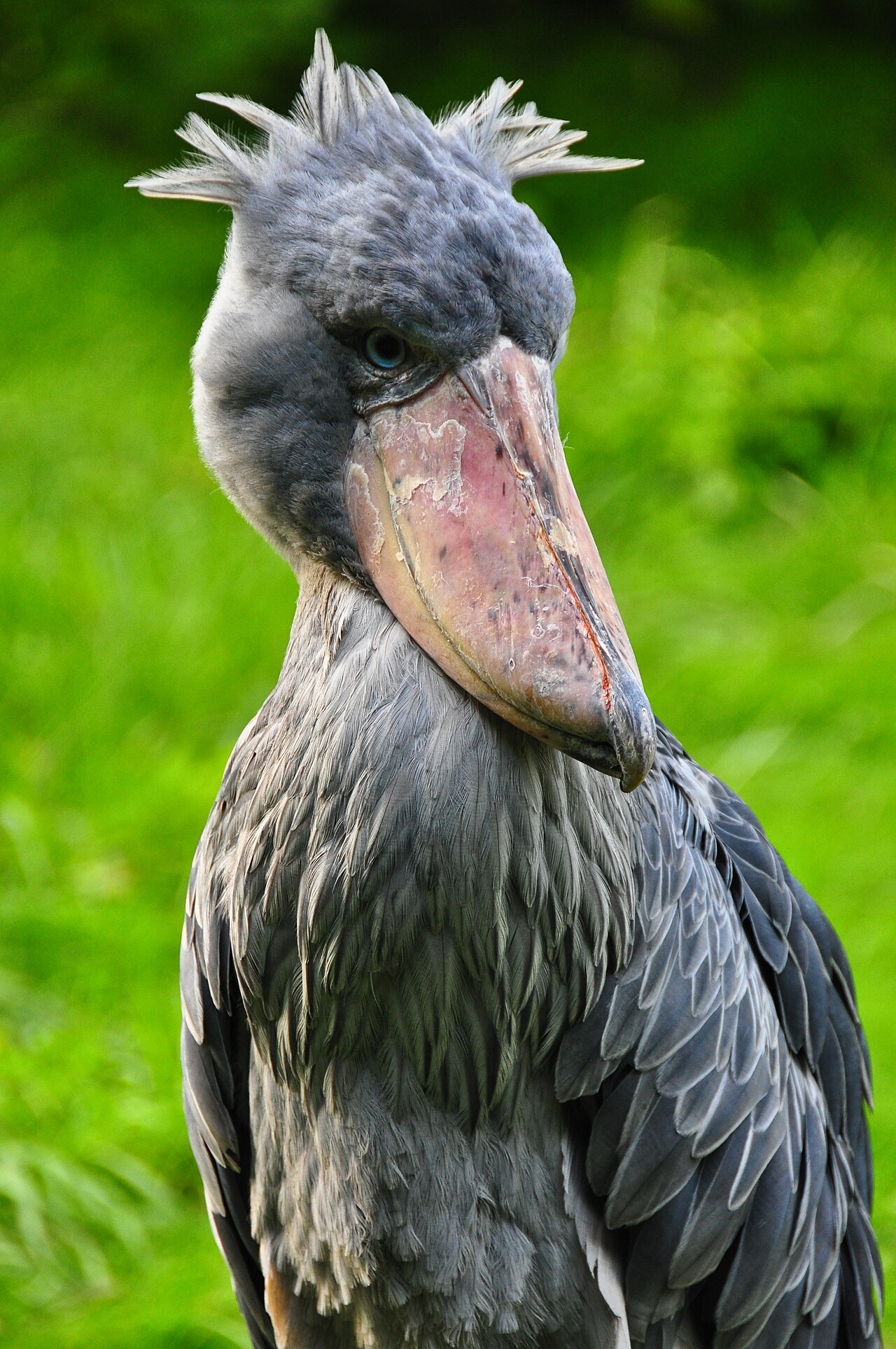
- The Anatomy of the Shoebill Stare: Built for Fixation
- Why the Bill Makes the Stare Worse
- The Shoebill Stare Is a Hunting Technique, Not a Threat
- The "Collapse" Attack
- The Creepy Truth About Their Social Behavior and Staring
- Known for Their Silence
- The Habitat That Forged the Shoebill Stare
- Climate and Prey Availability
- The Prehistoric Connection: Why It Looks So Alien
- Lifespan and the Long Game of Staring
- Conservation Status and the Future of the Stare
- Conclusion: The Stare Is a Window into a Vanishing World
The shoebill stare is one of the most unnerving sights in the natural world—a prehistoric-looking bird holding perfectly still, its massive, hooked bill aimed at you, and its piercing yellow eyes locked onto your soul with an intensity that feels almost human. Unlike the quick, darting glances of most birds, the shoebill (Balaeniceps rex) fixates on its target with a statuesque, unblinking gaze that has spawned countless internet memes and earned it nicknames like "the bird that looks like it wants to kill you." But this eerie stare isn't a sign of malice or supernatural awareness. It is a highly evolved, practical hunting adaptation, a product of anatomy, patience, and a very specific survival strategy in the swamps of East Africa. To understand the creepy truth behind the stare, we have to look at the bird's brain, its habitat, and the ruthless efficiency of its hunting technique.
The Anatomy of the Shoebill Stare: Built for Fixation
The first reason the shoebill stare feels so intense is purely physical. Unlike owls, which have large, forward-facing eyes fixed in their sockets, shoebills have eyes set on the front of a wide, flat face—but with a crucial twist. Their eyes are positioned relatively far forward compared to most wading birds, giving them a significant degree of binocular vision. This means both eyes can focus on the same object simultaneously, which is essential for accurate depth perception. When a shoebill stares at you, it is literally seeing you in three dimensions with a high degree of precision, something that most herons and storks cannot do.
Furthermore, the shoebill's eyes are encased in a bony ring called the sclerotic ring, which limits eye movement within the socket. To look at something off to the side, the bird cannot simply roll its eyes; it must turn its entire head. This results in a mechanical, deliberate motion that is unsettling to observe. The bird will slowly swivel its head, fix its gaze, and then hold that position for minutes at a time. This lack of rapid, involuntary eye movement (saccades) makes the shoebill appear as if it is making a conscious, almost confrontational choice to stare. The yellow iris also contrasts sharply with the greyish-blue plumage, making the eye itself a prominent, striking feature against the muted swamp background.
Why the Bill Makes the Stare Worse
You cannot separate the shoebill stare from its bill. The bill is not small or delicate; it is a massive, shoe-shaped structure that can measure up to 24 centimeters (9.4 inches) long and 20 centimeters (7.9 inches) wide. When the bird points this bill at you, it acts as a visual arrow, directing your attention to the eyes. The hook at the tip of the upper mandible adds a layer of menace, resembling a raptor's talon. The combination of the oversized bill and the motionless eyes creates a silhouette that is entirely unique among birds. It looks less like a bird and more like a statue carved by an ancient civilization, which explains why the stare feels so alien and intense to human observers.
The Shoebill Stare Is a Hunting Technique, Not a Threat
The most common misconception about the shoebill stare is that it is a sign of aggression or curiosity toward humans. In reality, the stare is a highly specialized hunting technique known as "watch-and-wait" or "stand-and-stay." Shoebills are ambush predators in the truest sense. Their primary prey is the marbled lungfish (Protopterus aethiopicus), which can grow up to 2 meters long and lives in the oxygen-poor, murky waters of papyrus swamps. These lungfish are not easy to catch; they are agile, slippery, and dwell in dense vegetation where visibility is near zero.
To catch them, the shoebill does not wade actively like a heron. Instead, it stands motionless on floating vegetation or at the edge of a channel, often for hours, with its head pointed downward. This is where the stare comes in. The bird uses its acute binocular vision to scan the water's surface for subtle disturbances—the ripple of a lungfish surfacing to breathe, the movement of a catfish, or the wiggle of a frog. The intense stare is a state of hyper-focus, a way of filtering out all other distractions in the noisy, bustling swamp environment.
The "Collapse" Attack
When the shoebill finally spots its prey, it does not leap into the water. Instead, it performs a behavior that researchers call the "collapse." The bird simply falls forward, using the weight of its body and its massive bill to plunge headfirst into the water. The bill acts like a giant pair of tongs, snapping shut around the prey with incredible force. This entire sequence—the long stare, the stillness, and the sudden collapse—is a strategy to conserve energy in a habitat where food is not always abundant. The stare is the first phase of the attack; it is the weapon being aimed before it is fired. This patient, calculated approach is why shoebills have a hunting success rate that is remarkably high for a large predator, estimated at around 60% or more, compared to the relatively low success rates of active hunters like cheetahs.
The Creepy Truth About Their Social Behavior and Staring
Another layer to the creepy truth is that shoebills are largely solitary and highly territorial. They do not live in flocks, and even mated pairs will maintain separate hunting territories within their shared home range. When two shoebills meet, or when a human intrudes too close to a nest, the stare takes on a different meaning. It becomes a threat display. A shoebill will fix its gaze on the intruder, lower its head, and begin clattering its bill—a rapid, machine-gun-like sound made by snapping the upper and lower mandibles together. This is not a friendly greeting; it is a warning.
Interestingly, shoebills are not naturally aggressive toward humans. In fact, wild shoebills are known for being remarkably tolerant of human observers, which is why photographers can get such stunning close-ups. They will allow a person to approach within a few meters, all the while maintaining that intense stare. This behavior is likely due to their evolutionary history—they have no natural predators as adults, so they do not perceive humans as a direct threat until provoked. The stare, in this context, is not a promise of violence but a calculation: "Are you a threat, or are you just standing in my swamp?" This tolerance, combined with the unblinking gaze, makes the bird seem almost contemplative, as if it is judging your very existence. That is the part that unsettles people—it feels like the bird is thinking deeply about you, when in reality it is simply deciding whether to resume hunting.
Known for Their Silence
The intensity of the stare is amplified by the bird's silence. Shoebills are not vocal birds. They do not call, sing, or squawk like other waterfowl. The only sounds they make are the bill-clattering display, a low mooing sound made by chicks begging for food, and a rare, deep "pop" that adults make during courtship. When you encounter a shoebill, it is usually in complete silence. In the natural world, a predator that stares silently is far more unnerving than one that screeches. The silence suggests a cold, calculated patience. It is the same feeling you get when a cat stares at a bird through a window—but magnified by the bird's sheer size (they can stand up to 140 cm or 4.6 feet tall with a wingspan of up to 2.6 meters) and prehistoric appearance.
The Habitat That Forged the Shoebill Stare
To truly understand the stare, you must understand the environment in which it evolved. Shoebills are endemic to the dense, impenetrable papyrus swamps and marshy wetlands of East-Central Africa, primarily in South Sudan, Uganda, Uganda's Murchison Falls area, Zambia, and the Democratic Republic of Congo. The most famous population resides in the Mabamba Swamp in Uganda, which has become a haven for birdwatchers seeking the shoebill. This habitat is not a pristine, clear lake; it is a labyrinth of floating vegetation, deep mud, and stagnant, tea-colored water. Visibility in the water is almost zero, and the ground is unstable.
In this environment, active hunting is impossible. A bird that wades and pecks would sink into the muck or alert prey with the vibrations of its footsteps. The shoebill's solution was to evolve a hunting style that relies on absolute stillness and extreme visual acuity. The stare is the only way to detect prey in a world where you cannot see beneath the surface. The bird stands on a platform of flattened papyrus, often using the same spot for days, and simply waits for a lungfish to come to the surface to gulp air. This is why shoebills are often described as "statues" in the wild—they can stand so still that small birds and dragonflies will land on them.
Climate and Prey Availability
The seasonal flooding of these swamps also dictates the shoebill's hunting schedule. During the dry season, water levels drop, concentrating lungfish and catfish in smaller pools. This is when the shoebill's patience pays off most. They will stake out a single pool and stare into it for hours, knowing that eventually, a lungfish will have to surface. This is not a casual glance; it is a survival necessity. A shoebill that cannot stare effectively is a shoebill that starves. The intense focus is literally the difference between life and death in a habitat where food can be scarce and seasonal.
The Prehistoric Connection: Why It Looks So Alien
The creepy truth also has roots in evolutionary history. Shoebills are not closely related to storks, herons, or cranes, despite superficial similarities. Genetic analysis has placed them in their own family, Balaenicipitidae, with their closest living relatives being the pelicans. However, their fossil record suggests they are an ancient lineage that has remained relatively unchanged for millions of years. Their skull structure, particularly the shape of the bill and the position of the eyes, is reminiscent of some extinct theropod dinosaurs and early birds. When a shoebill stares at you, you are looking at a face that has been staring at prey since the Miocene epoch. It is a living fossil, and its gaze carries the weight of that ancient lineage.
This is why the stare feels "creepy" rather than merely "focused." Our brains are wired to recognize familiarity in animal faces, but the shoebill triggers an uncanny valley effect. It has the upright posture of a stork, the bill of a prehistoric creature, and the eyes of a bird of prey, all combined in a way that doesn't match any known category in our mental database. The stare is the focal point of this confusion. It makes us feel like we are being observed by something that is not quite a bird, but something older and more deliberate.
Lifespan and the Long Game of Staring
Adding to the intensity is the shoebill's impressive lifespan. In the wild, shoebills are estimated to live between 35 and 50 years, and in captivity, they have lived up to 50 years. This is an exceptionally long life for a bird of its size. This longevity means that a shoebill may spend decades staring at the water in the same swamp. They are not frantic, short-lived creatures; they are long-term investors in their territory. This slow-paced lifestyle is reflected in their behavior. They breed slowly, with a single chick raised every two to three years, and the parents invest enormous time in feeding and protecting the young.
When a shoebill stares, it is not in a hurry. It has years of experience, and it knows that patience is its greatest asset. This long-term perspective is palpable in its gaze. It doesn't blink nervously or shift its weight. It simply waits, knowing that time is on its side. For a human observer, being stared at by an animal that has been doing this for decades, and which may outlive you, is a humbling and slightly eerie experience. You are being watched by a master of patience.
Conservation Status and the Future of the Stare
Sadly, this incredible creature is under threat. The International Union for Conservation of Nature (IUCN) lists the shoebill as Vulnerable, with an estimated population of only 3,300 to 5,300 mature individuals remaining in the wild. The primary threats are habitat destruction (draining of swamps for agriculture), disturbance by humans, and illegal capture for the exotic pet trade. The shoebill stare, once a symbol of wild patience, is now becoming a symbol of a species on the brink. Conservation efforts in Uganda and other countries are focused on protecting the papyrus wetlands and promoting ecotourism, which allows people to observe the stare in its natural context without harming the birds. The future of this remarkable bird depends on our willingness to preserve the murky, difficult swamps it calls home.
Conclusion: The Stare Is a Window into a Vanishing World
The shoebill stare is not creepy because the bird is evil or aggressive. It is creepy because it is a perfect, unapologetic adaptation to a harsh and hidden world. It is the gaze of a predator that has mastered the art of waiting, a hunter that relies on stillness and precision rather than speed and noise. The next time you see a video of a shoebill staring into the camera, remember that you are not looking at a villain. You are looking at a survivor. You are looking at millions of years of evolution distilled into a single, unblinking moment. The stare is a reminder that in the wild, the most patient hunter is often the most successful. And as the swamps of East Africa shrink, that stare becomes a precious, fleeting glimpse of a world that is slowly disappearing. It is less a threat and more a question: will we be patient enough to save it?