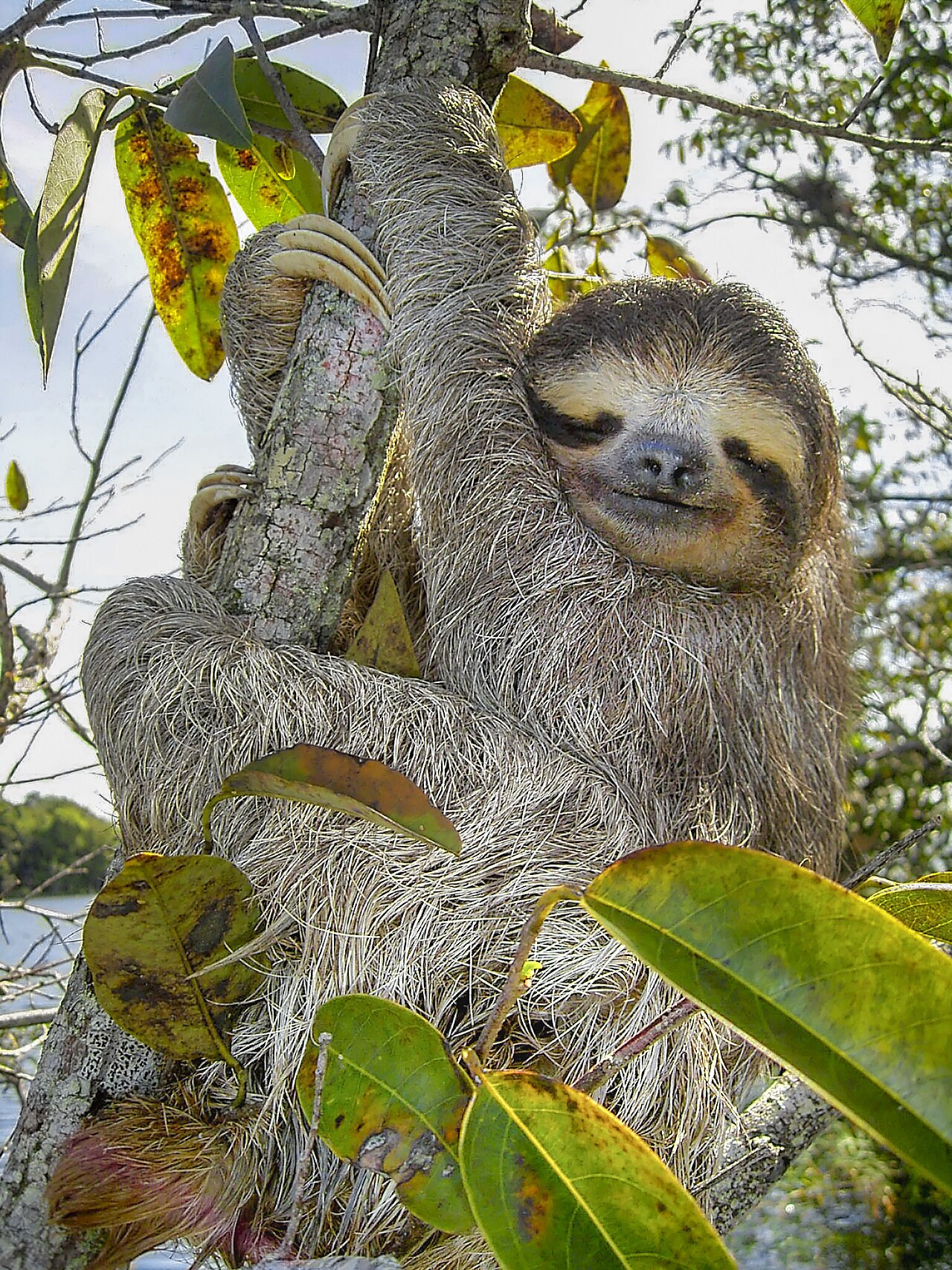
- Why Do Sloths Poop So Infrequently? The Basics of a Very Slow Digestion
- How Long Does It Actually Take?
- Why Do Sloths Poop on the Ground? The Dangerous Climb Down
- One Theory: The Moth and the Algae
- Why the Moth Theory May Be Incomplete
- Other Explanations: Communication, Disease Avoidance, and Latrines
- What Sloth Poop Actually Looks Like (and Why It Matters)
- Two-Toed vs. Three-Toed: Different Habits
- How Often Do Sloths Poop Compared to Other Animals?
- What Happens If a Sloth Cannot Poop?
- A Note on Sloth Conservation
- The Takeaway: A Slow Life, a Strange Ritual
- ❓ Frequently Asked Questions
If you have ever watched a sloth for any length of time, you have probably wondered about the strangest question in animal biology: why do sloths poop so rarely, and why do they go to such absurd lengths to do it? A healthy adult three-toed sloth climbs down from the safety of the canopy roughly once every seven to ten days, digs a small hole at the base of a tree, relieves itself, covers the evidence, and then slowly hauls itself back up — an exhausting, dangerous ritual that can take hours and costs the animal a huge share of its daily energy budget. It is one of the most puzzling behaviors in the animal kingdom, and after decades of study, scientists still argue about what it is actually for.
Why Do Sloths Poop So Infrequently? The Basics of a Very Slow Digestion
To understand the weekly bathroom trip, you first have to understand the sloth's engine. Sloths are arboreal folivores, meaning they live in trees and eat leaves — and leaves are one of the worst foods on Earth in terms of nutritional value. A typical diet consists of tough, fibrous, chemically defended leaves from trees such as Cecropia, Inga, and various fig species, plus occasional buds, tender shoots, and — very rarely — insects or carrion.
Leaves are low in calories, high in cellulose, and often laced with toxins. To cope, sloths have evolved a combination of traits that would be a disaster for most mammals:
- A very large, multi-chambered stomach that works somewhat like a fermentation tank, holding a huge volume of leaf matter for long periods.
- Slow passage rate. Food can take anywhere from several days to over a month to travel through the digestive tract, depending on the species and study.
- Low metabolic rate. A sloth's metabolism is roughly 40 to 45 percent lower than what would be expected for a mammal of its size, and its core body temperature is correspondingly low — often around 30 to 34 degrees Celsius (86 to 93 degrees Fahrenheit), fluctuating with ambient temperature.
Because digestion is so slow and the stomach contents so enormous — a sloth's stomach can make up a third of its total body weight — waste simply accumulates slowly. There is no need for daily elimination. The animal produces small amounts of feces at long intervals, and the whole system is built around extracting every possible calorie from a meager diet.
How Long Does It Actually Take?
The numbers are genuinely startling. In two-toed sloths (Choloepus species), food has been estimated to take anywhere from about 6 hours to 20 hours in some parts of the gut, but the overall retention time for the full digestive process is far longer — often reported at several days. In three-toed sloths (Bradypus species), the process is even slower, with food retention times that can stretch past a week and, in some reports, well beyond that. The result is that a three-toed sloth typically defecates only about once every seven to ten days, and sometimes less often.
The payoff is efficiency. A sloth extracts a remarkable amount of energy from a diet that would starve a similarly sized monkey, and it does so while remaining almost perfectly still. Sloths sleep around 15 to 20 hours a day in the wild and move so little that algae actually grows in the grooves of their fur, giving them a greenish tint that doubles as camouflage.
Why Do Sloths Poop on the Ground? The Dangerous Climb Down
Here is where the story turns from merely odd to genuinely bizarre. Most arboreal mammals — monkeys, squirrels, possums — simply drop their waste from the canopy. It falls, it disappears into the leaf litter, and the animal never leaves the safety of the branches. Sloths do not do this. Instead, a three-toed sloth will descend from the canopy, often from 15 to 30 meters (50 to 100 feet) up, find a suitable spot near the base of a tree, and perform a small, almost ceremonial defecation.
The process looks like this:
- The sloth climbs down headfirst, an awkward and slow maneuver for an animal built to hang upside down.
- It reaches the ground and, using its powerful front claws, digs a shallow depression or latrine pit.
- It defecates, then urinates, and in some cases the waste is deposited in the same spot used previously by the same individual.
- It may cover the waste with leaves or simply leave it, then begins the long climb back up.
This is a high-stakes outing. Sloths on the ground are nearly helpless. They cannot run, they cannot fight effectively, and their top speed on land is around 0.2 kilometers per hour — roughly 0.1 miles per hour. Predators such as jaguars, ocelots, harpy eagles, and even feral dogs take advantage of these ground visits. Studies of sloth mortality have found that a significant proportion of deaths occur during or shortly after these descent-and-defecation events. For an animal whose entire survival strategy is based on being invisible and unreachable, voluntarily walking into predator territory every week seems like a catastrophic design flaw.
One Theory: The Moth and the Algae
The most famous explanation for this behavior involves an unlikely partnership between the sloth, a species of moth, and algae that live in the sloth's fur. The story goes roughly like this:
Sloths host specialized moths (Cryptoses species) in their fur. When the sloth descends to defecate, female moths — which are often carrying eggs — leave the fur, lay their eggs in the fresh dung, and die. The eggs hatch into larvae that feed on the dung, then pupate and emerge as adult moths, which fly up into the canopy to find a new sloth host. Meanwhile, the moths that live and die in the sloth's fur provide nutrients — nitrogen in particular — that fertilize the algae growing in the fur. The algae, in turn, provide the sloth with camouflage and possibly a small amount of supplementary nutrition when the sloth grooms itself.
This "three-way symbiosis" was popularized by a widely cited 2014 study in Proceedings of the Royal Society B, and it remains the most famous hypothesis. It is elegant, memorable, and frequently repeated in nature documentaries. It is also increasingly questioned.
Why the Moth Theory May Be Incomplete
Later research has raised serious problems with the idea that moths drive the behavior. For one thing, the timing does not always line up: moths are present in sloth fur year-round, but defecation frequency does not obviously track moth life cycles. For another, the nutritional benefit of algae to the sloth is debated — it may be negligible. And crucially, the moth theory does not explain why the behavior persists in two-toed sloths, which also descend to defecate but host far fewer moths and have different fur ecology.
Critics have pointed out that a behavior this costly — one that measurably increases the risk of death — is unlikely to be maintained purely to support a moth population. Evolution does not usually favor animals that endanger themselves for the benefit of insects.
Other Explanations: Communication, Disease Avoidance, and Latrines
Several alternative or complementary hypotheses have been proposed:
- Scent marking and communication. Sloth dung carries chemical signals. Depositing it at specific, reused latrine sites near tree bases could advertise an individual's presence to rivals or potential mates. Sloths are generally solitary, so chemical communication may matter more than it appears.
- Parasite and disease control. Defecating away from the canopy may reduce the buildup of parasites and pathogens where the animal spends most of its time. Dropping waste from above would scatter it across branches and leaves the sloth regularly contacts.
- Nutrient cycling for the tree. By fertilizing the base of a specific tree — often a tree the sloth regularly feeds in — the sloth may be supporting its own food source. Some researchers have noted that sloths tend to use the same trees repeatedly, which is consistent with a kind of unintentional farming.
- Ancient behavior, now vestigial. It is possible that ground defecation made more sense for ancestral sloths, including the giant ground sloths that lived during the Pleistocene and were the size of elephants. Modern tree sloths may be stuck with an inherited behavior that no longer pays off.
The honest scientific answer is that no single explanation has been proven. The behavior is almost certainly the product of multiple pressures, and the moth-algae story may be one thread in a much more tangled web.
What Sloth Poop Actually Looks Like (and Why It Matters)
Sloth feces are not what most people imagine. Because digestion is so slow and the diet is so fibrous, the droppings are typically dry, dark, and compact — more like small pellets or a dense, fibrous mass than the soft waste of a fruit-eating animal. They are also relatively odorless compared to the dung of many mammals, which may be another adaptation: less smell means fewer predators and parasites attracted to the site.
Researchers use sloth dung in several ways. It can be analyzed to determine diet composition, since leaf fragments and seeds remain identifiable. It can be tested for hormones to measure stress and reproductive status. And in some studies, latrine sites have been mapped to understand how far sloths travel and how they use their home ranges. A single sloth's home range is surprisingly small — often just a few hectares — and the weekly trip to the ground is one of the few times it moves any real distance.
Two-Toed vs. Three-Toed: Different Habits
It is worth separating the two living sloth families, because they behave quite differently:
- Three-toed sloths (Bradypus): Smaller, with three claws on each limb, they are the classic "once a week" poopers. They are strictly arboreal, eat almost nothing but leaves, and are famous for the ground descent. They have seven neck vertebrae, allowing them to rotate their heads up to about 270 degrees.
- Two-toed sloths (Choloepus): Larger — up to about 8 to 9 kilograms (18 to 20 pounds) — with two claws on the front limbs. They have a more varied diet including fruits and possibly small prey, and they also descend to defecate, though perhaps less rigidly on a weekly schedule. They have only six neck vertebrae.
Both types share the slow metabolism, the low body temperature, the algae-tinted fur, and the general strategy of being a living, hanging leaf-processing machine. But the extreme weekly ground pilgrimage is most strongly associated with the three-toed sloths.
How Often Do Sloths Poop Compared to Other Animals?
For context, consider how unusual the sloth's schedule is:
- Humans: typically once a day to once every few days.
- Dogs and cats: once or twice a day.
- Cows: 10 to 15 times a day, producing enormous volume.
- Rabbits: continuously, with two types of droppings.
- Sloths: roughly once every 7 to 10 days, sometimes longer.
The sloth's digestive strategy is closer to that of a ruminant in slow motion. It is not that sloths are lazy in a moral sense — they are metabolically conservative, and every behavior is tuned to conserve energy in an environment where calories are scarce and predators are plentiful.
What Happens If a Sloth Cannot Poop?
Because the digestive system is so slow and the stomach so large, constipation and impaction are genuine risks for sloths, especially in captivity. Sloths in zoos and rescue centers are sometimes kept on diets that differ from their wild fare, and improper nutrition can lead to serious gastrointestinal problems. Wildlife veterinarians who work with sloths report that digestive issues are among the most common medical concerns, and that a sloth which has not defecated for an unusually long time may require intervention.
This is also why handling wild sloths is stressful for them. Stress can disrupt the delicate digestive rhythm, and in rehabilitation settings, caretakers often go to great lengths to replicate natural conditions — including providing appropriate leaf species and minimizing disturbance — to keep the gut moving.
A Note on Sloth Conservation
Sloths face real threats across their range, which stretches from Central America through much of tropical South America. Habitat loss from deforestation, road mortality, and the illegal pet trade are major concerns. The famous sloth sanctuary in Costa Rica and various rescue organizations have highlighted how vulnerable these animals are, partly because their slow reproduction — a single offspring roughly once a year after a gestation of about six months for three-toed sloths, longer for two-toed — makes population recovery difficult.
Understanding why sloths poop the way they do is not just trivia. It matters for conservation because it tells us how sensitive these animals are to changes in their environment. If a sloth's weekly trip to the ground depends on specific tree species, soil conditions, and low predator pressure, then disrupting any of those factors can have outsized consequences.
The Takeaway: A Slow Life, a Strange Ritual
The short answer to why sloths poop only once a week is that their food is poor, their digestion is extraordinarily slow, and their metabolism is tuned to conserve every possible calorie. The long answer is that the behavior is wrapped up in one of the strangest ecological puzzles in the animal kingdom: a weekly, life-threatening descent to the forest floor that may exist to support a community of moths and algae, to mark territory, to avoid parasites, or simply because evolution has not found a better way.
Either way, the sloth remains one of the most remarkable animals on Earth — a creature that has turned slowness into a survival strategy, and whose bathroom habits have kept biologists arguing for decades. The next time you see a sloth hanging motionless in a tree, remember: it is not being lazy. It is running a very efficient, very patient, and very strange biological machine.
❓ Frequently Asked Questions
💬 How often do sloths actually poop?
Sloths typically poop about once a week, though some individuals may go as long as every 10 to 14 days. That works out to roughly 4 to 8 times a month instead of daily like most mammals.
💬 Why do sloths climb down from trees to poop?
Sloths descend from the canopy to poop at the base of a tree, which is risky because they are slow and vulnerable to predators like jaguars and harpy eagles. Scientists think this behavior may help fertilize their favorite trees or play a role in mating communication.
💬 What makes sloth poop so slow?
Sloths have an extremely slow metabolism and digest food very gradually, so waste builds up slowly in their bodies. Their large, slow-moving digestive system means they simply don't need to defecate often.
💬 Is sloth poop dangerous to humans?
Sloth feces can carry parasites and bacteria, so it should never be handled with bare hands. In the wild, it's also a key nutrient source for insects and plants around the tree where the sloth poops.