- Why Do Snakes Shed Their Skin? The Core Reasons
- Growth
- Repair and Parasite Removal
- Maintaining Sensory Ability
- How Snakes Shed Their Skin: A Step-by-Step Process
- Stage 1: The Blue Phase
- Stage 2: Clearing
- Stage 3: The Shed Itself
- Stage 4: Inside-Out and Complete
- What Snakes Shed Their Skin Looks Like Across Species
- Why Some Snakes Shed Their Skin More Often Than Others
- Age and Growth Rate
- Diet and Nutrition
- Temperature and Metabolism
- Humidity and Hydration
- The Dangers of a Bad Shed
- Retained Eye Caps
- Retained Skin on the Tail
- Signs of a Problem
- What to Do With a Shed Snake Skin
- Common Myths and Misconceptions
- Conclusion: The Scaly Truth About Shedding
- ❓ Frequently Asked Questions
Every few weeks or months, depending on the species, a snake does something that looks like a magic trick: it crawls out of its own skin. When snakes shed their skin, they don't just flake off a few dead cells the way humans do — they emerge from a complete, inside-out copy of themselves, often in one continuous, ghostly tube. For a creature with no limbs, no eyelids, and no fur to groom, this process is one of the most important events in its life. It's how a snake grows, repairs damage, and stays alive in some of the harshest environments on Earth.
Why Do Snakes Shed Their Skin? The Core Reasons
Shedding — scientifically called ecdysis — is not a sign of disease or distress. It is a normal, essential biological cycle. There are several reasons snakes do it, and they all come down to survival.
Growth
A snake's skin does not stretch indefinitely. The outer layer, called the epidermis, is made largely of keratin — the same tough protein found in human fingernails and hair. Once that layer is fully formed, it is essentially dead tissue. As the snake's body grows, the old skin becomes tight and must be replaced. Young, fast-growing snakes may shed every two to four weeks during their first year. A hatchling corn snake, for example, might shed every three weeks while it doubles in length, whereas a fully grown adult of the same species may shed only three or four times a year.
Repair and Parasite Removal
Shedding also renews the skin's surface. Scrapes, minor wounds, and abrasions from squeezing through rocky crevices are shed away with the old layer. Just as importantly, external parasites like mites and ticks are removed along with the discarded skin, giving the snake a fresh, clean surface. This is one reason a snake that has been living in damp, dirty conditions often looks dramatically healthier immediately after a good shed.
Maintaining Sensory Ability
Snakes have no eyelids — instead, a clear, fixed scale called the spectacle (or brille) covers each eye. This window must be renewed regularly, or vision becomes cloudy. The same applies to the scales covering the mouth and nostrils, which carry chemical and touch receptors. Shedding keeps these sensory structures sharp, which matters enormously for a predator that relies on smell and vibration as much as sight.
How Snakes Shed Their Skin: A Step-by-Step Process
A shed is not a sudden event. It is the final act of a process that takes one to two weeks and happens in clearly observable stages.
Stage 1: The Blue Phase
About a week before shedding, a snake's colors dull and its eyes turn a milky blue-gray. This is caused by fluid building up between the old outer skin and the new skin forming underneath. During this period, many snakes become reclusive, refuse food, and hide more than usual. Their vision is poor, which makes them feel vulnerable. A ball python in the blue phase will often sit in its hide for days, and a wild rattlesnake may stay coiled in a sheltered spot until its eyes clear.
Stage 2: Clearing
The eyes clear and the colors brighten again — which surprises many new keepers, who think the shed has already happened. In reality, the fluid has been reabsorbed, and shedding is now only a day or two away. The skin looks loose and slightly wrinkled, especially around the neck and belly.
Stage 3: The Shed Itself
The snake rubs its snout against a rough surface — a rock, a branch, bark, or the wall of an enclosure. The old skin splits at the lips, and the snake then crawls forward, pushing the skin backward over its body. Because the skin is attached at the tail, the snake essentially walks out of it. The entire process usually takes less than an hour, though it can take longer if humidity is low.
Stage 4: Inside-Out and Complete
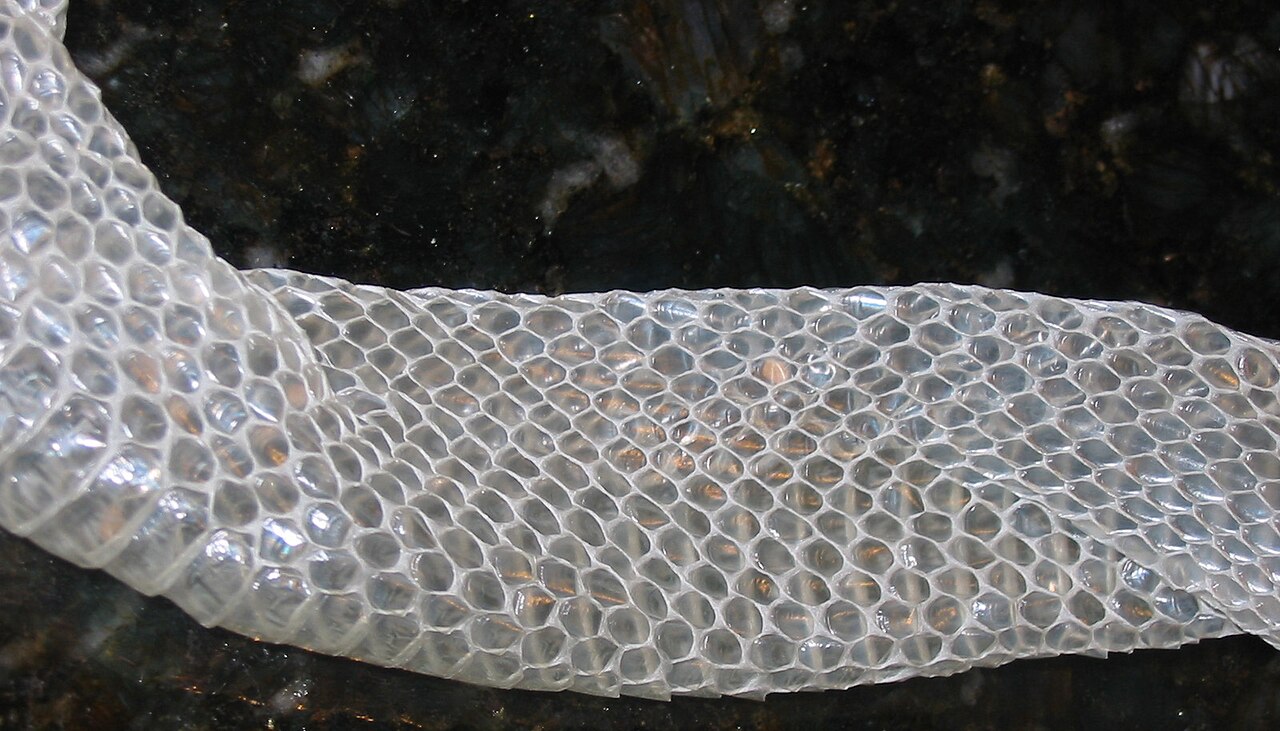
The result is a single, intact, inside-out tube of skin, often including the eye caps and the tips of the tail. Finding a complete shed — sometimes called a "shed" or "slough" by keepers — is a sign of a healthy snake. A shed that comes off in pieces, or leaves patches behind, usually points to a problem with humidity, hydration, or health.
What Snakes Shed Their Skin Looks Like Across Species
The mechanics are similar across the roughly 3,900 known snake species, but the details vary. Here are some real-world examples that show how different snakes handle ecdysis.
- Ball python (Python regius): Native to West and Central Africa, adults typically reach 3 to 5 feet. They shed every 4 to 6 weeks as juveniles and every 6 to 8 weeks as adults. They need humidity around 60 to 70 percent to shed cleanly.
- Corn snake (Pantherophis guttatus): A North American species that grows to about 4 to 6 feet and can live 15 to 20 years in captivity. Hatchlings shed every 2 to 4 weeks; adults shed 3 to 4 times a year.
- King cobra (Ophiophagus hannah): The world's longest venomous snake, reaching up to 18 feet (5.5 meters). It sheds 4 to 6 times a year, and its diet consists mainly of other snakes.
- Reticulated python (Malayopython reticulatus): The longest snake species, capable of exceeding 20 feet (6 meters). A snake this large may take several hours to complete a shed and can leave a skin tube long enough to stretch across a room.
- Garter snake (Thamnophis sirtalis): A small, common North American species, usually 2 to 3 feet long. It sheds frequently during its active season, sometimes every 3 to 4 weeks.
Desert species like the sidewinder rattlesnake often produce drier, more brittle sheds and may shed less often than tropical species, since growth and metabolic rates are slower in arid habitats. In contrast, a green tree python living in a humid rainforest environment may shed every 6 to 8 weeks year-round.
Why Some Snakes Shed Their Skin More Often Than Others
Frequency of shedding is not random. It is driven by several interacting factors.
Age and Growth Rate
Young snakes shed most often because they are growing fastest. A hatchling may shed every two weeks; a mature adult of the same species may shed only three times a year. Once a snake reaches full size, shedding becomes primarily about maintenance rather than growth.
Diet and Nutrition
A well-fed snake grows faster and sheds more often. A snake eating large meals regularly — such as a boa constrictor taking a rat every two weeks — will shed more frequently than a snake eating sporadically. Malnourished snakes may shed rarely, and the sheds are often incomplete.
Temperature and Metabolism
Snakes are ectotherms, meaning their body temperature depends on their environment. Warmer temperatures raise metabolism, which speeds growth and shedding. A snake kept at the low end of its ideal temperature range may shed half as often as one kept at the optimal range.
Humidity and Hydration
Humidity is critical. A snake needs adequate moisture to loosen the old skin. In a dry enclosure, the shed can stick, especially around the eyes and tail tip. This is why keepers provide a humid hide — a box filled with damp sphagnum moss — when a snake is approaching a shed.
The Dangers of a Bad Shed
When shedding goes wrong, it is called dysecdysis. It is one of the most common health issues in captive snakes, and it can be serious.
Retained Eye Caps
If the spectacle fails to come off, it can dry, crack, and impair vision. Repeated retained eye caps can damage the eye underneath and, in severe cases, lead to infection or blindness. Never peel an eye cap off manually — it can tear the cornea. Instead, increase humidity and let the snake shed it naturally.
Retained Skin on the Tail
Skin that stays wrapped around the tail tip acts like a tight band. Over multiple sheds, it can constrict blood flow and cause tissue death. This is a genuine emergency and often requires a veterinarian to remove the retained skin safely.
Signs of a Problem
- Skin coming off in small, dry flakes rather than one piece
- Patches of dull, retained skin after the shed
- Cloudy or wrinkled eye caps that persist
- Refusal to eat for an extended period after shedding
- Redness, swelling, or discharge around the eyes or mouth
In the wild, a snake with a bad shed is at a real disadvantage. Impaired vision makes hunting harder, and retained skin can slow movement. This is one reason wild snakes seek out humid microhabitats — under logs, in burrows, or near water — when it is time to shed.
What to Do With a Shed Snake Skin
Finding a shed skin is a fascinating experience. If you come across one in the wild, you can often identify the species by counting scales, examining the pattern, and looking at the head shape. The shed is a perfect mold of the snake's outer surface, including the scale arrangement on the belly, which is unique to each species.
In captivity, keepers often keep sheds as records. A complete shed shows that the snake is healthy and growing. Some researchers use shed skins for DNA analysis, since the skin contains epithelial cells with usable genetic material. This is a non-invasive way to study wild snake populations without ever handling the animal.
It is worth noting that a shed skin is not dangerous. It carries no venom and cannot harm you. However, in some regions, a fresh shed may attract ants or other insects, so it is best to remove it from an enclosure promptly.
Common Myths and Misconceptions
Shedding has generated plenty of folklore over the centuries. Here are a few myths worth clearing up.
- Myth: Snakes shed because they are sick. In fact, shedding is a sign of health. A snake that never sheds is more likely to be ill.
- Myth: Snakes shed all at once, instantly. The process takes one to two weeks, with the actual removal taking under an hour.
- Myth: All snakes shed in one piece. Most healthy snakes do, but some species and individuals naturally shed in larger fragments.
- Myth: You should help a snake shed by pulling the skin. Never do this. Pulling can tear the new skin underneath and cause injury or infection.
- Myth: A shed skin means the snake has grown a lot. Growth is one factor, but shedding also happens for repair and maintenance, even in adults that have stopped growing.
Conclusion: The Scaly Truth About Shedding
Shedding is one of the most remarkable adaptations in the animal kingdom. When snakes shed their skin, they are not just replacing a layer of dead cells — they are renewing their armor, sharpening their senses, removing parasites, and making room for growth. The process is driven by hormones, timed by temperature and humidity, and repeated dozens of times over a lifetime that can span 20 years or more in some species.
For anyone who keeps or observes snakes, understanding ecdysis is essential. A clean, complete shed is a simple but powerful indicator of good health. A problematic shed is an early warning sign that something in the environment — humidity, temperature, or nutrition — needs adjustment. Whether you are watching a corn snake slip out of its skin in a home terrarium or finding a translucent tube on a forest trail, you are witnessing one of nature's most efficient and elegant renewals. The scaly truth is simple: to grow, to heal, and to survive, a snake must occasionally leave itself behind.
❓ Frequently Asked Questions
💬 How often do snakes shed their skin?
Most healthy adult snakes shed every 4 to 8 weeks during active growing periods, while young, fast-growing snakes may shed every 1 to 2 weeks. Frequency depends on species, age, food intake, and temperature, so it varies widely.
💬 How long does it take a snake to shed its skin?
The entire shedding cycle takes roughly 1 to 2 weeks, but the actual moment of peeling off the old skin usually lasts only minutes to a few hours. You'll often notice cloudy eyes and dull colors for several days before the shed.
💬 What should I do if my snake's shed skin is stuck or comes off in pieces?
A stuck or patchy shed usually means the enclosure is too dry, so raise the humidity and provide a humid hide or a shallow soak in lukewarm water. Never peel the skin off yourself, as this can tear the new skin underneath and cause infection.
💬 Do snakes shed their skin because they are growing?
Growth is the main reason, since a snake's skin doesn't stretch indefinitely and must be replaced as the body gets bigger. Shedding also removes worn skin and external parasites, so even adult snakes that have stopped growing still shed regularly.