- What Exactly Counts as an Octopus Eight Arms Arrangement?
- Eight Arms, Zero Bones
- The Evolutionary Reason Behind Octopus Eight Arms
- From a Foot Full of Snails to a Crown of Arms
- The Squid Comparison
- Why Eight Arms Are Better Than Six or Ten
- Walking on the Seafloor
- Reaching Into Cracks
- Defense and Camouflage
- How Eight Arms Actually Work: A Distributed Nervous System
- Arms That Think for Themselves
- Two Rows of Suckers
- Real Octopuses and Their Real Arms
- Losing an Arm: Regeneration and Survival
- How Regrowth Works
- Autotomy and Distraction
- What the Octopus Eight Arms Design Teaches Us
- Conclusion: Eight Was Never an Accident
- ❓ Frequently Asked Questions
The octopus eight arms arrangement is one of the most recognizable body plans in the animal kingdom, yet it is also one of the most misunderstood. Most people can picture the tangle of suckered limbs spilling out of a rock crevice, but far fewer can explain why there are exactly eight, why those arms behave almost like independent creatures, and what happened to the two extra limbs that the octopus's ancestors apparently once had. The answers stretch across more than 500 million years of evolution, through the strange mathematics of underwater movement, and into the nervous system of an animal that may be the most intelligent invertebrate on Earth.
What Exactly Counts as an Octopus Eight Arms Arrangement?
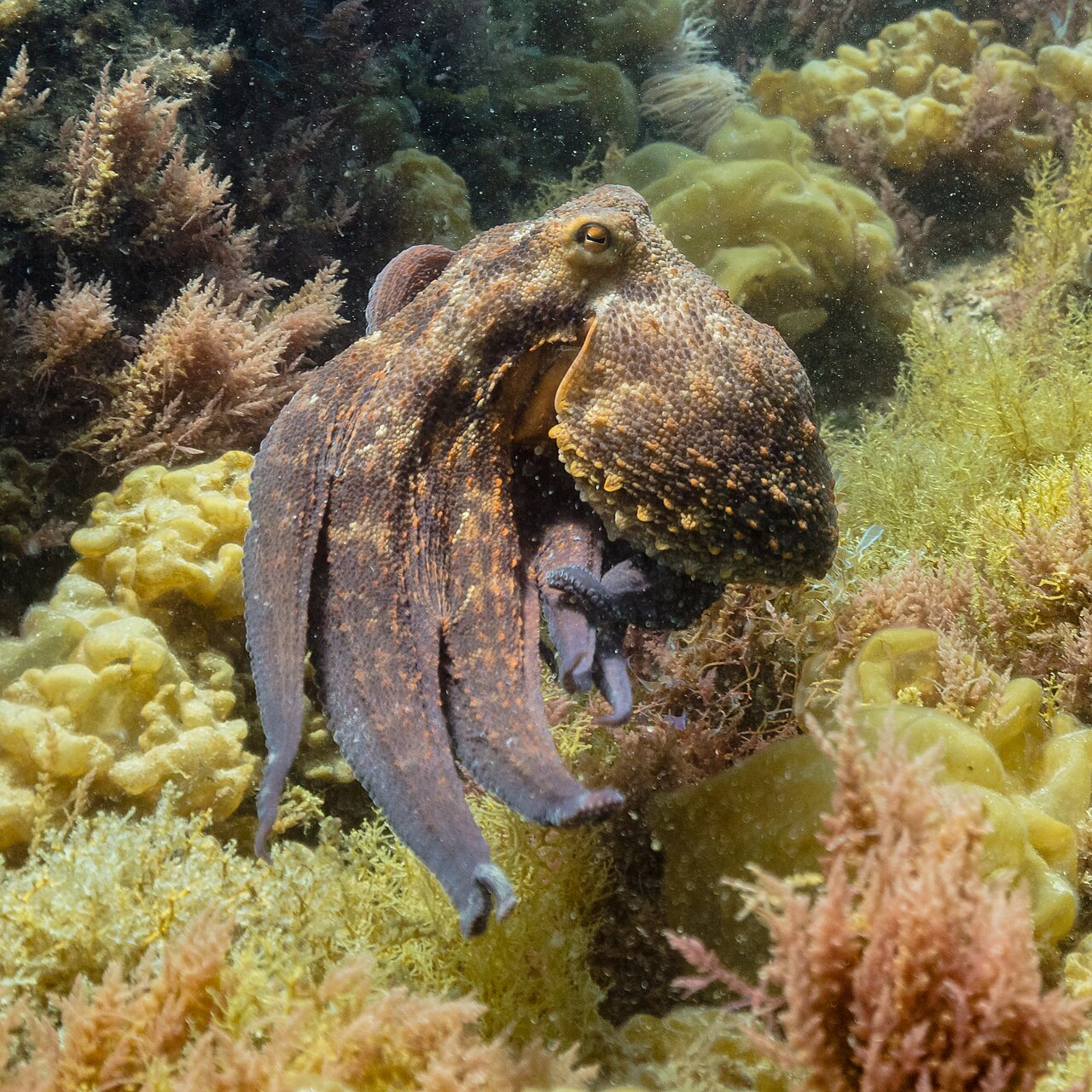
First, a quick piece of biological bookkeeping. An octopus does not have eight legs, and it does not have eight tentacles. It has eight arms, and the distinction matters to zoologists.
Tentacles are typically longer, thinner appendages tipped with suckers or sticky pads only at the very end. Squid and cuttlefish have eight arms plus two long feeding tentacles, giving them ten appendages in total. The nautilus, that living fossil of the cephalopod world, can have more than ninety thin, sucker-less cirri. An octopus, by contrast, has eight muscular arms that are lined with suckers along most of their length and are joined at the base by a web of skin.
Eight Arms, Zero Bones
The word "octopus" itself comes from Greek roots meaning "eight-footed," and the name has been attached to the animal for thousands of years. What makes the eight arms so remarkable is that they contain no bones and no rigid joints whatsoever. An octopus is essentially a bag of muscle and soft tissue with a beak in the middle — which means it can squeeze its entire body through any gap wider than its beak, the only hard part it cannot compress. In aquariums, octopuses have been recorded escaping through openings the size of a coin.
Each arm is powered by bundles of muscle running in three directions, allowing the limb to bend, shorten, twist, and stiffen on command. This "muscular hydrostat" design is the same principle behind an elephant's trunk and a human tongue, but the octopus scales it up across eight separate limbs at once.
The Evolutionary Reason Behind Octopus Eight Arms
To understand why the count is eight, you have to go back to the deep ancestry of the mollusks. The octopus's remote ancestors were not sleek hunters at all. They were slow, shelled creatures that crawled across the seafloor, and their bodies were built on a repeating, segmented plan.
From a Foot Full of Snails to a Crown of Arms
Early mollusks had a single flat "foot" used for creeping along. Over time, in the lineage that became cephalopods, that foot split into multiple muscular projections arranged in a ring around the mouth. Fossil evidence from the Cambrian period, roughly 500 million years ago, shows shelled cephalopods with long, straight cones and clusters of grasping appendages. Some of these ancient forms appear to have had ten or more limbs.
So the octopus did not gain arms — it lost them. The leading explanation is that two of the ancestral appendages were either reduced to nothing or folded into the surrounding anatomy as the octopus lineage adopted a life of crawling and squeezing into tight spaces. Losing two limbs may have made the body more compact and streamlined, which is a real advantage for an animal that lives in cramped dens and hunts in narrow reef crevices.
The Squid Comparison
The clearest evidence for this "lost limbs" idea is the squid. Squid retain eight arms plus two specialized tentacles that shoot out to capture prey. Those two tentacles are thought to be the evolutionary siblings of the limbs the octopus no longer has. In other words, the octopus eight arms count is a case of subtraction, not addition.
Why Eight Arms Are Better Than Six or Ten
Counting limbs is not arbitrary. The number of arms an animal carries shapes how it moves, hunts, and hides, and eight appears to hit a sweet spot for the octopus's particular lifestyle.
Walking on the Seafloor
Many octopuses, especially bottom-dwelling species like the common octopus (Octopus vulgaris), move across the seabed by pushing themselves along with their arms rather than swimming. Swimming is fast but expensive: jetting water through the siphon drains energy quickly and leaves the animal exposed. Crawling with arms is slower but far more efficient.
Researchers studying octopus locomotion have found that the animals often use their back arms as makeshift legs, walking in a somewhat stiff, jointed gait that frees the front arms for exploring and grabbing. Having eight limbs provides redundancy — if one arm is lost to a predator, the octopus can still move and hunt effectively. Regrowth is possible, but it takes weeks, so spare limbs matter.
Reaching Into Cracks
Octopuses are masters of the crevice. They den in rock holes, bottle fragments, and abandoned shells, and they hunt by reaching into gaps where prey hides. Each arm can bend at any point along its length, so eight limbs give an octopus the ability to probe several openings at once. A single arm can extend, feel around, grab a crab, and withdraw it without the brain ever needing a precise map of the surroundings.
Defense and Camouflage
Eight arms also fold neatly around the body. When an octopus tucks itself into a ball, the arms wrap over the head and mantle, presenting a smooth, featureless blob to predators. Combined with chromatophores — pigment cells that can change color and texture in under a second — this makes the animal nearly invisible against coral, sand, or algae. Fewer arms would leave gaps; more would be harder to coordinate.
How Eight Arms Actually Work: A Distributed Nervous System
Here is where the octopus stops behaving like anything familiar. Roughly two-thirds of an octopus's neurons are located not in its brain but in its arms. Each arm contains a dense network of nerve tissue that can process sensory information and issue movement commands on its own.
Arms That Think for Themselves
Experiments have shown that a severed octopus arm will still reach toward a stimulus, curl around it, and try to bring it toward where a mouth would be. The arm is not simply a puppet on a string; it has a degree of local autonomy. This is often described as a distributed intelligence, where the central brain sets goals — "grab that crab," "retreat into the den" — and the arms work out the mechanics.
This design solves a serious problem. With eight flexible limbs and no joints, the number of possible positions is astronomically large. If the brain had to calculate every angle of every arm, it would be overwhelmed. Instead, the arms handle much of the computation themselves, and the brain receives a simplified summary.
Two Rows of Suckers
Each arm of most octopus species carries two rows of suckers running down its length, and a large common octopus can have well over 1,500 suckers in total. Suckers are not just suction cups; they are also chemotactic organs. An octopus can effectively taste with its arms, detecting chemicals in the water and on surfaces it touches. In blind tests, octopuses have distinguished between objects by touch alone, deciding whether something is food without ever seeing it.
Real Octopuses and Their Real Arms
The eight-arm blueprint is shared across roughly 300 known species, but the animals themselves vary enormously in size, habitat, and habit.
- Common octopus (Octopus vulgaris): Found in temperate and tropical waters worldwide, including the Mediterranean and the Atlantic. It typically reaches 60–90 centimeters in total length and weighs 3–10 kilograms. Lifespan is short — usually 12 to 18 months. Diet includes crabs, clams, snails, and small fish.
- Giant Pacific octopus (Enteroctopus dofleini): The largest species, inhabiting the cold North Pacific from California to Japan. Arm span can exceed 4 meters, and large individuals have weighed over 50 kilograms, with some historical reports of considerably more. Lifespan is around 3 to 5 years, unusually long for an octopus.
- Blue-ringed octopus (Hapalochlaena spp.): Tiny animals of the Indo-Pacific, often under 12 centimeters across, that carry a powerful neurotoxin called tetrodotoxin. Their bright blue rings flash as a warning. They are among the most dangerous marine animals to handle.
- Mimic octopus (Thaumoctopus mimicus): Discovered in Indonesia in the 1990s, this species uses its arms to impersonate other animals — flattening them to resemble a flatfish, or spreading them in a star shape to mimic a lionfish or sea snake.
- Dumbo octopus (Grimpoteuthis spp.): Deep-sea dwellers found at depths of 3,000 to 4,000 meters or more, named for the ear-like fins on their heads. They flap those fins to swim rather than jetting, and they are among the deepest-living octopuses known.
Habitat ranges from shallow tide pools and coral reefs to abyssal plains. Diets are broadly carnivorous: crustaceans, mollusks, worms, and occasionally small fish. Most species are solitary and fiercely territorial, and many are nocturnal, hunting under cover of darkness and hiding by day.
Losing an Arm: Regeneration and Survival
An octopus that loses an arm to a moray eel, a seal, or a grouper is not doomed. Octopuses can regenerate lost limbs, and the process is genuinely impressive.
How Regrowth Works
After injury, tissue at the stump forms a blastema — a mass of undifferentiated cells that will rebuild muscle, nerve, and suckers. A small arm may regrow in a matter of weeks, while a full-length limb can take several months. The regrown arm is usually functional, though it may be slightly shorter or have irregular sucker spacing.
Regeneration is not free. It demands energy and protein, and an octopus that is already nearing the end of its short life may not have time to complete the process. Because most octopus species die shortly after reproducing, a lost arm late in life is often permanent in practice.
Autotomy and Distraction
Some octopuses can deliberately shed an arm when grabbed, a behavior called autotomy. The detached limb continues to writhe and twitch, drawing a predator's attention while the octopus slips away. It is a costly but effective escape strategy, and it is only possible because the arms are semi-independent.
What the Octopus Eight Arms Design Teaches Us
The octopus is a natural experiment in doing a lot with a little. It has no skeleton, no protective shell, a lifespan often measured in months, and a brain organized nothing like our own — yet it solves problems that would challenge a mammal.
Captive octopuses have learned to unscrew jars from the inside, navigate mazes, and spray water at lights that annoy them. They recognize individual human keepers and respond differently to people they dislike. In the wild, they use coconut shells and discarded glass as portable shelters, carrying them across the seafloor for later use.
None of this would be possible with a simpler limb arrangement. The octopus eight arms system gives the animal eight independent sensory probes, eight grasping tools, eight walking legs, and eight camouflage panels — all controlled by a nervous system that delegates most of the work to the limbs themselves. It is a body plan shaped by half a billion years of squeezing into cracks, and it may be one of the most efficient solutions to movement and manipulation that evolution has ever produced.
Conclusion: Eight Was Never an Accident
The octopus eight arms count is not a quirky coincidence or a random number pulled from the sea. It is the product of a long evolutionary story in which an ancestor with more limbs traded quantity for compactness, flexibility, and control. Those eight boneless, sucker-lined arms let an octopus walk, swim, taste, grab, hide, and regrow — often all at once. Combined with a distributed nervous system that puts two-thirds of its neurons in the limbs, the octopus achieves a kind of intelligence that is genuinely alien to us. So the next time you see one pressed into a rock crevice, remember: those eight arms are not just limbs. They are eyes, hands, legs, and a second brain, all wrapped into one remarkable animal.
❓ Frequently Asked Questions
💬 Do octopuses really have eight arms, or are some of them legs?
Octopuses have eight appendages that are all technically arms, since each is lined with suckers along most of its length. The confusion comes from two of them, the rear pair, being used mainly for walking and pushing off the seafloor.
💬 Why do octopuses have eight arms instead of six or ten?
Eight arms give octopuses enough flexible, sucker-covered limbs to grab prey, pry open shells, and explore crevices while still moving efficiently. Since they have no bones, each arm can bend and reach in almost any direction, and eight is enough to cover their body without adding wasteful bulk.
💬 Can an octopus survive if it loses an arm?
Yes, octopuses can regrow lost arms, and many survive losing one or even more to predators. The regrown arm usually takes several months to reach full size and function, and the octopus often favors the remaining arms in the meantime.
💬 Do octopus arms have a mind of their own?
In a sense, yes: roughly two-thirds of an octopus's neurons are in its arms, letting each arm act semi-independently to explore and grab things. The central brain sets the goal, but the arms handle much of the fine control on their own.