- Why Do Sloths Move So Slowly? The Metabolic Puzzle
- The Role of Body Temperature
- Sloths Move Slowly to Survive on a Leaf-Only Diet
- The Cost of a Four-Stomach System
- Anatomy Built for Hanging, Not Running
- Why They Cannot Jump or Leap
- The Predator Evasion Strategy: Camouflage Over Speed
- Sloths Move Slowly Because of Their Low-Calorie, High-Toxin Diet
- The Gut Microbiome and the Slow Digestion Cycle
- Comparing Sloths to Other Slow Mammals
- Do Sloths Ever Move Fast? The Surprising Truth
- Conclusion: The Art of Doing Less
When you picture a sloth hanging upside down in the rainforest, the first thing that comes to mind is its almost comical, deliberate slowness—but the real reason sloths move slowly is a masterclass in evolutionary energy conservation, not laziness. These Neotropical mammals, which belong to the suborder Folivora, have traded speed for survival in a world where being quick is usually the key to staying alive. Their sluggish pace is not a flaw; it is a highly specialized adaptation to a low-calorie diet, a unique muscle structure, and a lifestyle spent almost entirely in the treetops. In this article, we will unpack the physiology, ecology, and surprising history behind why these animals have become the undisputed champions of slow motion.
Why Do Sloths Move So Slowly? The Metabolic Puzzle
The most direct answer to the question of why sloths move slowly lies in their extraordinarily low metabolic rate. Unlike most mammals, which have a basal metabolic rate (BMR) that fuels constant activity, a sloth’s BMR is roughly 40–45% lower than what you would expect for an animal of its size. A typical three-toed sloth (genus Bradypus) weighs between 3.5 and 4.5 kilograms (8–10 pounds), yet it burns energy as if it were a much smaller creature. This is a direct consequence of their diet.
Sloths are obligate folivores—meaning they eat almost exclusively leaves. Leaves are abundant in the rainforest canopy, but they are also incredibly poor in nutrients. Most of the mass of a leaf is indigestible cellulose, and the digestible portions are sparse and hard to extract. To make matters worse, many of the leaves sloths eat contain toxic compounds that would be lethal to other mammals. Sloths have evolved a multi-chambered stomach, similar to a cow’s, that hosts symbiotic bacteria capable of slowly breaking down cellulose over a period of up to a month for a single meal.
Because their food is so energy-poor, sloths simply cannot afford to spend energy on rapid movement. Every muscle contraction, every leap between branches, and every burst of speed would burn calories they cannot easily replace. The result is a deliberate, almost reptilian pace. In fact, a sloth’s average ground speed is just 0.24 kilometers per hour (0.15 mph), and even when alarmed, they rarely exceed 0.5 kilometers per hour. In the trees, they are slightly faster, moving at about 3 meters per minute, but this is still far slower than any other mammal of similar size.
The Role of Body Temperature
Another critical piece of the metabolic puzzle is body temperature. Most mammals maintain a constant, warm body temperature of around 37°C (98.6°F), which requires a high energy input. Sloths, however, have a variable body temperature that ranges from 30°C to 34°C (86°F to 93°F), depending on the ambient temperature. This ectothermic-like flexibility means their enzymes and cellular processes work at a slower rate. When the rainforest cools at night, a sloth’s body temperature drops, further reducing its energy needs. This poikilothermic tendency is why sloths are often seen basking in sunbeams that penetrate the canopy—they are passively warming themselves to save energy.
Sloths Move Slowly to Survive on a Leaf-Only Diet
The connection between diet and locomotion cannot be overstated. A typical three-toed sloth consumes only about 25–30 grams (0.9–1.1 ounces) of leaves per day. To put that in perspective, a single average-sized leaf from a Cecropia tree weighs about 2 grams, so a sloth eats roughly 15 leaves in 24 hours. This is an astoundingly small amount for a mammal of its size. Compare this to a similar-sized monkey, like the pygmy marmoset, which eats fruits, insects, and gum and consumes a much larger proportion of its body weight daily.
Because leaves are so low in calories, a sloth’s digestive system is designed for maximum retention time. Food can take anywhere from 2 weeks to 1 month to pass through the entire digestive tract. This slow digestion is paired with a slow movement strategy. If a sloth were to run, climb quickly, or jump, it would require quick-release glucose, which its body simply does not produce efficiently. Instead, sloths rely on a steady, low-level supply of volatile fatty acids produced by gut fermentation, much like a horse on a hay diet.
This dietary limitation also explains why sloths have a very specific habitat requirement. They are found only in the lowland and montane tropical rainforests of Central and South America, from Honduras to northern Argentina. These forests provide a year-round supply of young leaves, which are slightly more nutritious and less toxic than mature leaves. Sloths are known to be selective, often preferring leaves from trees in the genera Cecropia, Ficus, and Inga. This selective feeding means they often have to travel between specific trees, but they do so at a pace that matches their energy budget.
The Cost of a Four-Stomach System
Sloths have four stomach compartments, a feature they share with ruminants like cows and deer. However, unlike cows, sloths do not chew cud. Instead, the food moves through the chambers in a continuous, slow process. The sheer physical weight of a full stomach can account for up to 30% of a sloth’s body weight. Carrying this heavy, semi-liquid mass is energetically expensive, which is another reason why sloths move slowly—they are literally weighed down by their own digestive system. A full stomach also makes them less agile and more vulnerable to falling, so they compensate by moving with extreme caution, keeping at least three limbs attached to a branch at all times.
Anatomy Built for Hanging, Not Running
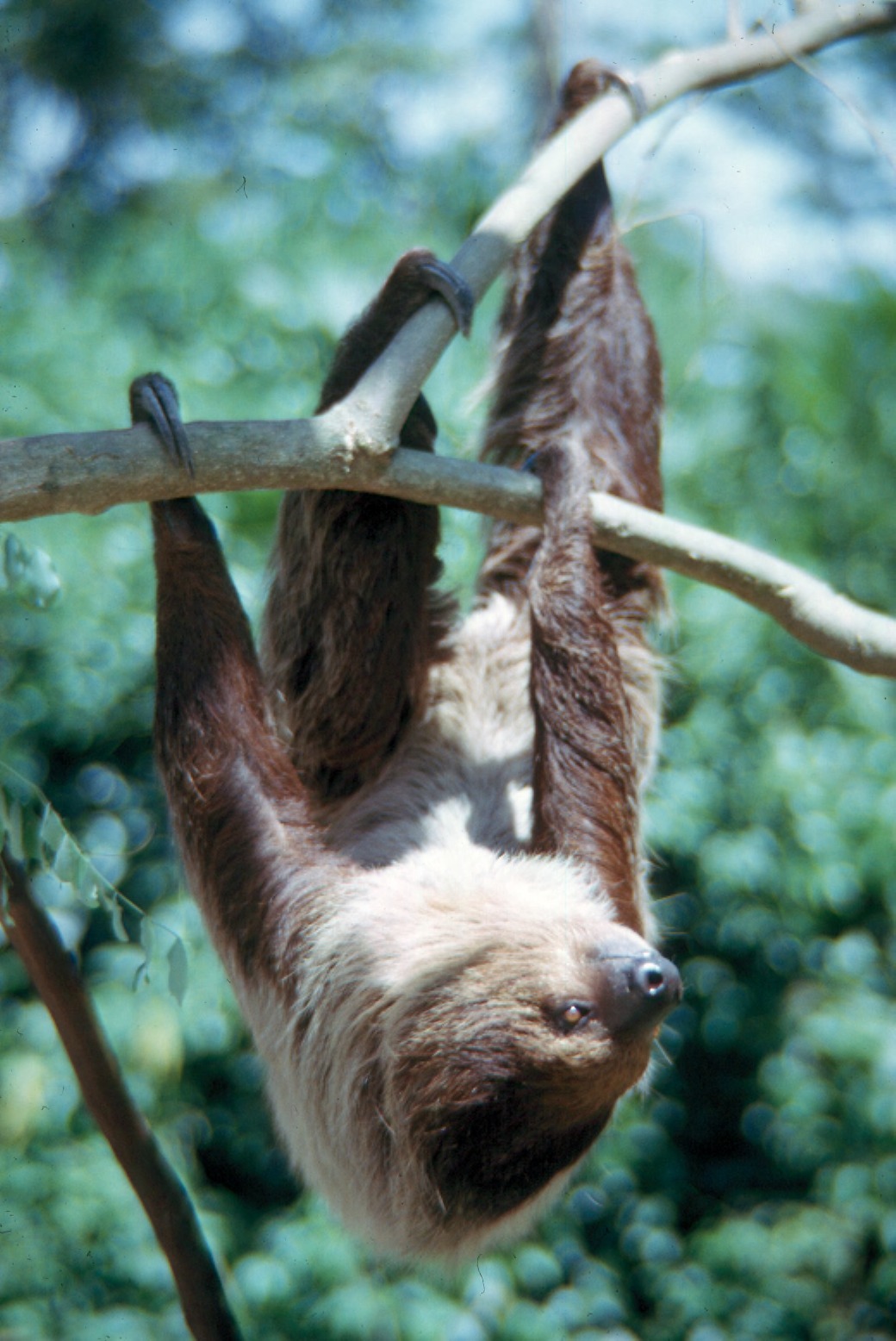
Beyond metabolism, the physical anatomy of a sloth is a powerful explanation for their slow movement. Sloths have long, gangly forelimbs that are 50% longer than their hind limbs. This is a perfect adaptation for reaching and pulling branches, but it is terrible for walking on the ground. On the rare occasions when sloths descend to the forest floor—which they do about once a week to defecate—they must drag themselves using their front claws, a motion that is slow, awkward, and exposes them to predators like ocelots and jaguars.
Their muscles are also fundamentally different from those of other mammals. Sloths have a remarkably low proportion of fast-twitch muscle fibers. Fast-twitch fibers are responsible for explosive, rapid movements, while slow-twitch fibers are for endurance and sustained contraction. In sloths, about 70–80% of their muscle mass is slow-twitch, and these fibers have a lower density of mitochondria than in other animals. This means they can hold a grip for hours without fatigue, but they cannot generate speed. A sloth’s grip strength is legendary—they can hang from a branch for over 24 hours without using any additional energy, thanks to a tendon-locking mechanism in their claws that requires no muscular effort.
This anatomy also explains their iconic upside-down posture. Their internal organs are attached to the ribcage and pelvis in a unique way, preventing them from pressing down on the diaphragm when inverted. This allows for easier breathing while hanging, but it restricts their ability to rotate their bodies quickly. A sloth cannot twist its torso to look behind itself; it must slowly turn its entire head, which can rotate up to 270 degrees, to see what is behind it.
Why They Cannot Jump or Leap
Many arboreal animals, like monkeys and squirrels, move quickly by leaping between branches. Sloths cannot do this. Their joints, particularly in the shoulders and hips, have a limited range of motion compared to other climbers. The ball-and-socket joints in their shoulders are oriented in a way that allows for a wide arc of overhead reach but prevents the quick flexion needed for jumping. Instead, sloths use a “reach-and-pull” locomotion. They extend a front limb, hook their claws around a branch, and then pull their body forward, often with their hind limbs moving in a slow, hand-over-hand fashion. This method is energy-efficient because it uses the animal’s weight to do the work, but it is inherently slow.
The Predator Evasion Strategy: Camouflage Over Speed
One of the most common misconceptions is that sloths are slow because they are defenseless. In reality, their slowness is a sophisticated predator avoidance strategy. In the dense rainforest canopy, movement is the most easily detected cue for visual predators like harpy eagles and spectacled owls. A fast-moving animal stands out; a slow-moving one does not. Sloths have evolved to be nearly invisible. Their fur is a coarse, brownish-green color, and it is actually a miniature ecosystem. The fur is host to two types of symbiotic algae: Trichophilus welckeri and Cryptococcus species. These algae grow in the grooves of the sloth’s hair, giving it a greenish tint that blends perfectly with the surrounding foliage.
This camouflage is so effective that a sloth can be hanging in plain sight and remain undetected by both predators and researchers. Furthermore, sloths are most active at night, which reduces their exposure to diurnal raptors. When they do move, they do so so slowly that they appear to be swaying in the breeze, not fleeing. This strategy works because sloths have a very low body mass and do not need to flee to escape; they simply need to not be seen. Their slow movement, combined with their green algae coat, allows them to disappear into the canopy.
Their slow movement also reduces the likelihood of injury. Falling from the canopy is a leading cause of death for sloths. A fall from 30 meters (100 feet) can be fatal, and even a minor fall can result in broken bones. By moving slowly and deliberately, sloths minimize the risk of a misstep. They also use a unique defensive posture when threatened—they swing their arms in a slow, sweeping arc, using their 8–10 centimeter (3–4 inch) claws as weapons. This is not a fast strike, but it is powerful enough to deter most predators.
Sloths Move Slowly Because of Their Low-Calorie, High-Toxin Diet
Let’s return to the dietary angle with more specificity, as it is the root cause of their slow lifestyle. The leaves that sloths eat are not just low in calories; they are also loaded with secondary compounds like alkaloids, tannins, and phenols. These chemicals are produced by plants to deter herbivores. To cope with this, sloths have evolved a slow liver detoxification system. This system is efficient but slow, meaning that if a sloth ate a large quantity of leaves quickly, it would be overwhelmed by toxins. Their slow movement ensures that they do not overexert themselves while digesting, which could lead to toxin accumulation.
Additionally, the sloth’s stomach is not very acidic compared to other mammals. This lower acidity allows the symbiotic bacteria to survive, but it also means that protein breakdown is slower. As a result, sloths have a very low nitrogen excretion rate. They conserve amino acids, which are crucial for tissue repair and muscle maintenance. This conservation is essential because their diet is so low in protein. If they moved quickly and burned through their protein stores, they would rapidly lose muscle mass and starve.
This is why sloths have one of the lowest energy expenditures of any mammal. A study published in the Journal of Mammalogy found that a sloth in its natural habitat uses only about 0.5 kilocalories per minute, which is roughly 10–15% of the energy expenditure of a similar-sized mammal. This extreme energy conservation is why sloths can survive on such a sparse diet. Their slow movement is not a choice; it is a physiological necessity.
The Gut Microbiome and the Slow Digestion Cycle
The sloth’s gut microbiome is another underappreciated factor in their slow movement. The bacteria in their stomachs are highly specialized and are passed from mother to infant through the process of coprophagy—the infant eats a small amount of its mother’s feces to acquire the necessary microbes. This microbiome is so sensitive that a change in diet, such as being fed the wrong leaves in captivity, can cause digestive failure. The fermentation process in the stomach produces gases, which is why sloths are often seen with visibly distended abdomens. This bloating adds to their discomfort and reduces their desire to move.
Furthermore, sloths have a remarkably slow rate of gastric emptying. A meal of leaves can take up to 150 hours to leave the stomach. This means that a sloth is almost always carrying a full stomach, which, as mentioned, adds significant weight. This is also why sloths defecate only once every 5 to 8 days. This infrequent defecation is a huge energy expenditure—they must descend from the safety of the canopy to the ground to dig a hole and bury their feces. This activity, which takes about 30 minutes, is the most dangerous part of a sloth’s life, and it is also the fastest they ever move. They rush (relatively speaking) to complete the task and climb back up. This weekly descent is a major reason why sloths have a lifespan of 20–30 years in the wild—the risk of predation during these descents is extremely high.
Comparing Sloths to Other Slow Mammals
To fully understand why sloths move slowly, it is helpful to compare them to other slow animals. The slow loris (Nycticebus spp.) is a primate that also moves slowly, but for a different reason—it uses toxic bites to defend itself, so it does not need speed. The koala, another folivore, has a similarly slow pace but is still faster than a sloth because it has a higher metabolic rate and does not hang upside down. The giant panda, which eats bamboo, is also slow, but it has a more robust digestive system and can move quickly when threatened.
What sets sloths apart is their combination of low metabolic rate, inverted posture, and extreme dietary specialization. They are the only mammals that have evolved a lifestyle entirely around hanging upside down and eating leaves. This extreme specialization has been so successful that sloths have existed for over 30 million years. The extinct giant ground sloths, such as Megatherium, were the size of elephants and moved slowly as well, but they were too large to climb trees and eventually went extinct. The two-toed and three-toed sloths that survive today are the only remnants of a once-diverse group.
Do Sloths Ever Move Fast? The Surprising Truth
Despite their reputation, sloths are not entirely incapable of speed. In fact, when startled or threatened by a predator, a sloth can move at a surprising burst of speed for a short distance. This is called a “burst response,” and it involves a temporary spike in adrenaline. In the water, sloths are actually quite fast. They are excellent swimmers, using their long forelimbs to perform a powerful doggy-paddle stroke. They can swim three times faster than they can move on land, reaching speeds of up to 0.8 kilometers per hour (0.5 mph). This is crucial for crossing rivers and flooded forests, which are common in their habitat.
However, this burst of speed is extremely taxing. After a short burst of rapid movement, a sloth will often need to rest for hours to recover its heart rate and oxygen levels. This is because their muscles rely primarily on aerobic metabolism, and a sudden anaerobic burst produces lactic acid that they cannot clear quickly. So, while they can technically move fast for a few meters, they pay for it dearly. This is why they only use this speed as a last resort.
Conclusion: The Art of Doing Less
In the end, the question of why sloths move slowly reveals a fascinating story of evolutionary trade-offs. Their slow pace is a direct result of a low-calorie, high-toxin diet, a drastically reduced metabolic rate, a unique muscle fiber composition, and a digestive system that takes up to a month to process a single meal. They are not lazy; they are perfectly adapted to a niche that requires minimal energy expenditure. By moving slowly, they avoid predators through camouflage, conserve precious calories, and live a surprisingly long life—up to 40 years in captivity. In a world that values speed, the sloth is a testament to the power of doing less. Their slow, deliberate movements are not a weakness but a brilliant survival strategy that has allowed them to thrive in the rainforest for millions of years. Next time you see a sloth, remember that it is not moving slowly because it has to; it is moving slowly because that is the secret to its success.