- What Exactly Is a Tapir Trunk?
- A Nose That Works Like a Hand
- Why the Tapir Trunk Is a Survival Superpower
- 1. Reaching Food in Tangled Habitats
- 2. Snorkeling and Swimming
- 3. A Chemical Sensor on Overdrive
- 4. Social and Reproductive Signaling
- The Four Living Tapir Species and Their Trunks
- How the Trunk Differs Between Species
- A Living Fossil With a Modern Toolkit
- Reproduction and Lifespan
- Common Myths About the Tapir Trunk
- How the Trunk Fits Into a Tapir's Daily Life
- Communication and Scent Marking
- Why This Matters for Conservation
- Conclusion: The Jungle Truth About the Tapir Trunk
- ❓ Frequently Asked Questions
Look at a tapir, and the first thing you notice is the tapir trunk — a strange, flexible, drooping snout that looks like a cross between an elephant's trunk and a pig's snout, bolted onto a body shaped like a bulldozer. For centuries, naturalists were baffled by this creature. Some thought it was a giant anteater. Others classified it as a kind of hippopotamus or a weird rhino. Even today, people who see one for the first time often ask the same question: why would an animal evolve something so odd?
The answer, as it turns out, is a masterclass in evolutionary problem-solving. That short, muscular proboscis is not a decorative quirk — it is a precision tool, a snorkel, a food detector, and a mating signal all rolled into one. In this article, we will unpack the real biology behind the tapir's nose, explore how the four living species use it in wildly different habitats, and explain why this ancient animal still looks like it wandered out of a prehistoric forest.
What Exactly Is a Tapir Trunk?
First, a crucial clarification: a tapir does not have a true trunk like an elephant. An elephant's trunk is formed from the fused nose and upper lip, contains no bones, and is powered by an estimated 40,000 muscle fascicles. It can lift hundreds of kilograms and reach high into trees.
The tapir trunk is a much more modest structure. It is a fleshy, prehensile proboscis formed mainly from the nose and upper lip, and it is short — usually only 10 to 20 centimeters (4 to 8 inches) long, depending on the species. It has no bones either, but it is packed with muscle and richly supplied with nerves. It cannot lift logs or spray water, but it can curl, wiggle, grip, and probe with remarkable dexterity.
Think of it less as an elephant trunk and more as a highly specialized, mobile snout — closer in function to a pig's disc-like nose, but longer, more flexible, and far more precise. That distinction matters, because every behavior a tapir performs with its trunk is calibrated to what that snout can actually do.
A Nose That Works Like a Hand
When a tapir forages, it does not simply sniff the ground. It uses the trunk as a manipulator. The tip curls around leaves, twigs, and fruit, pulling them toward the mouth. In dense undergrowth, this lets the animal browse selectively without trampling an entire patch of vegetation. Researchers observing Baird's tapirs in Central America have noted that individuals can strip leaves from a branch one at a time, much the way a primate might use its fingers.
Why the Tapir Trunk Is a Survival Superpower
Evolution rarely produces a feature this elaborate without a strong payoff. For tapirs, the trunk solves at least four distinct problems at once, and understanding those problems explains why the structure persists across all four living species.
1. Reaching Food in Tangled Habitats
Tapirs are browsers and frugivores, not grazers. Their diet includes leaves, shoots, buds, aquatic plants, and a wide variety of fallen fruit — figs, palm fruits, and wild mangoes are favorites where available. In a tropical rainforest, that food is scattered, often hidden under leaf litter or tangled in vines.
A long, flexible snout lets a tapir investigate a food patch without committing its whole body to it. The animal can push its trunk into a hollow log, under a root mass, or between thorny bromeliads, sniff out whether something edible is there, and extract it. That is a huge advantage for a large, relatively slow-moving herbivore that cannot afford to waste energy wandering.
2. Snorkeling and Swimming
This may be the most surprising function of all. Tapirs are excellent swimmers — arguably among the best of all large land mammals. Their riverside and swampy habitats make water a daily part of life, and the trunk plays a starring role.
When a tapir swims, it can raise the tip of its trunk above the surface and breathe while the rest of its head and body remain submerged. This is effectively a built-in snorkel. It allows the animal to cross flooded rivers, escape predators, and feed on aquatic vegetation without constantly lifting its heavy head.
The Lowland tapir (Tapirus terrestris) of South America is the most water-oriented of the group and is frequently observed wading through flooded forests in the Amazon basin. During the wet season, when vast areas of forest become inundated, this ability turns a flooded landscape from a barrier into a highway.
3. A Chemical Sensor on Overdrive
Tapirs have poor eyesight by mammalian standards. Their world is dominated by smell and hearing. The trunk concentrates an enormous number of olfactory receptors at the very front of the face, letting the animal sample the air and the ground continuously as it moves.
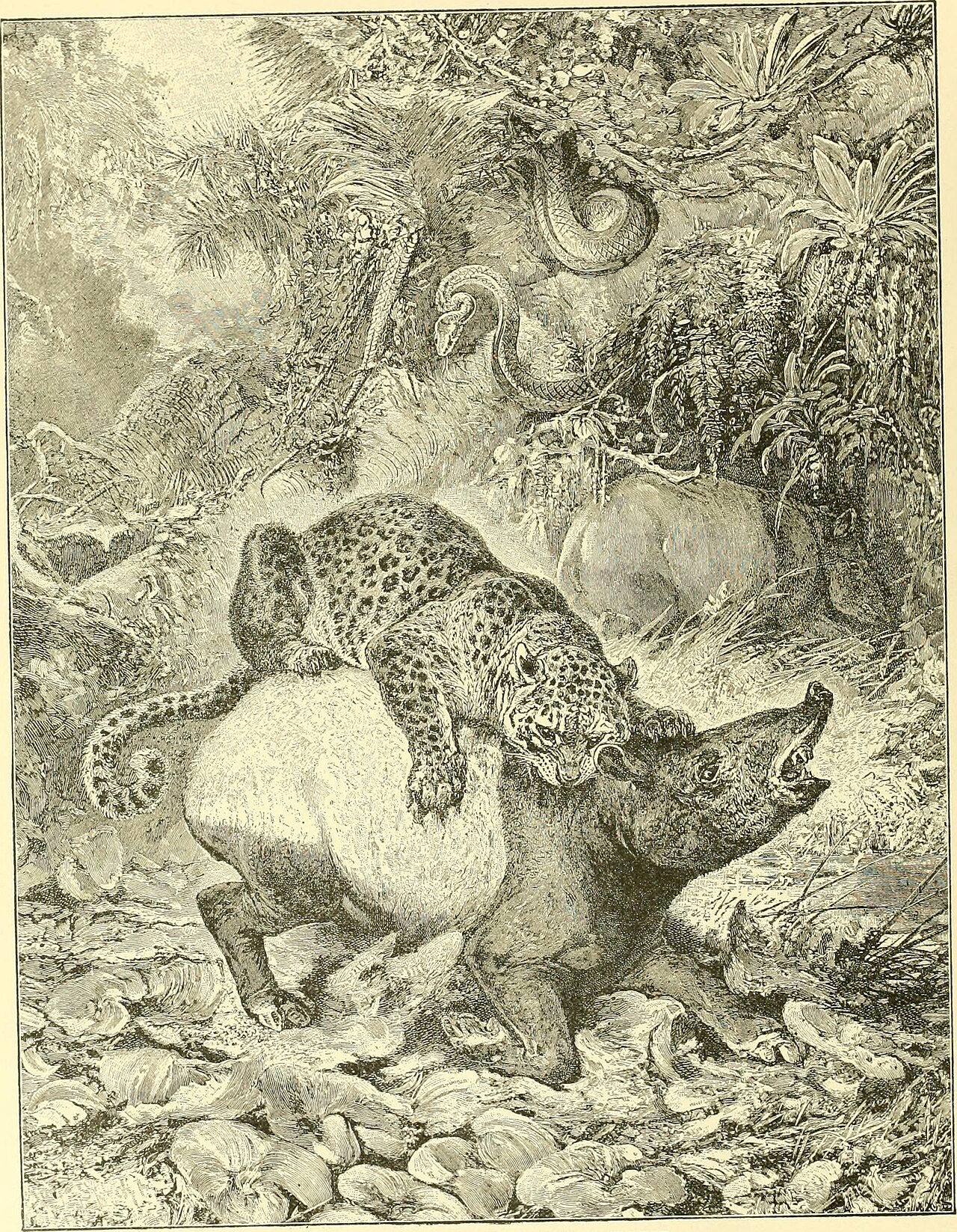
This matters for two reasons. First, it helps locate ripe fruit, which may be hidden beneath a meter of leaf litter. Second, it helps detect predators. Tapirs are prey for jaguars, pumas, and — for the Malayan tapir — tigers. A tapir that smells a cat before seeing it has a real chance of escaping into water or dense cover.
4. Social and Reproductive Signaling
Tapirs are largely solitary and largely silent, but they are not asocial. They communicate heavily through scent. Both males and females use the trunk to investigate urine and scent marks left by other tapirs, and males in particular will follow a female's scent trail during estrus.
During courtship, tapirs engage in a distinctive behavior sometimes called "nose-to-nose" or flehmen-like sampling, where the trunk plays a central role in assessing a potential mate's reproductive state. In a species that may only encounter another adult a few times a year, this chemical messaging is essential.
The Four Living Tapir Species and Their Trunks
There are four recognized living species of tapir, all in the family Tapiridae and the order Perissodactyla — the same order as horses and rhinos. Despite their pig-like appearance, tapirs are odd-toed ungulates, meaning they are genuinely more closely related to a horse than to a pig.
- Lowland tapir (Tapirus terrestris) — South America, Amazon basin and surrounding forests. Weight: 150–250 kg (330–550 lb). Dark brown with a distinctive low mane along the neck. Highly aquatic.
- Baird's tapir (Tapirus bairdii) — Central America and northern South America, from southern Mexico to Colombia. Weight: 150–300 kg (330–660 lb). The largest New World tapir. Listed as Endangered.
- Mountain tapir (Tapirus pinchaque) — Andean cloud forests of Colombia, Ecuador, and Peru, at elevations up to 4,500 meters (14,800 ft). Weight: 130–200 kg (290–440 lb). The smallest and hairiest species, with a thick woolly coat for cold conditions.
- Malayan tapir (Tapirus indicus) — Southeast Asia, including Sumatra, Peninsular Malaysia, and Thailand. Weight: 250–320 kg (550–700 lb). The largest species, famous for its striking black-and-white color pattern.
How the Trunk Differs Between Species
All four species have a tapir trunk, but the details vary. The Lowland and Baird's tapirs have relatively long, robust proboscises suited to foraging in flooded forests and dense undergrowth. The Malayan tapir's trunk is also well developed and is used extensively in the murky rainforest of Southeast Asia, where vision is limited and scent is everything.
The Mountain tapir is the outlier. Its trunk is proportionally shorter and its coat is dramatically thicker, an adaptation to the freezing, misty páramo and cloud forest it calls home. It uses its snout to root through cold, wet vegetation and mossy ground for tender shoots — a different problem requiring a slightly different tool.
A Living Fossil With a Modern Toolkit
Tapirs are often called living fossils, and the label is fair. The lineage has existed for roughly 50 million years, and early tapir relatives once ranged across North America, Europe, and Asia. Fossil forms such as Heptodon looked remarkably like modern tapirs but lacked the full proboscis, suggesting the trunk evolved gradually as the animals specialized for forest browsing.
What is striking is how little the basic body plan has changed. The tapir is a successful design: a low-slung, compact, forest-adapted browser with a prehensile snout, strong legs for climbing and swimming, and a digestive system built for processing fibrous plant material. It has survived ice ages, the rise and fall of continents, and the arrival of new predators.
What it has not survived well is us. All four species are now threatened. The Malayan tapir is Endangered, Baird's tapir is Endangered, the Mountain tapir is Endangered, and the Lowland tapir is listed as Vulnerable. Habitat loss, hunting, and road mortality are the main drivers. In Southeast Asia, the Malayan tapir is frequently killed on highways that cut through its forest home.
Reproduction and Lifespan
Tapirs are slow breeders, which makes their decline harder to reverse. After a gestation period of about 13 months — one of the longest of any perissodactyl — a female gives birth to a single calf. Newborn tapirs are strikingly patterned with brown fur and pale stripes and spots, camouflage that mimics dappled forest light. This juvenile pattern fades by around six months of age.
Calves are able to stand and walk within hours of birth and begin sampling solid food within a few weeks, though they continue nursing for several months. Sexual maturity arrives at roughly two to four years. In the wild, tapirs are thought to live 25 to 30 years; in captivity, some individuals have exceeded 35 years.
Common Myths About the Tapir Trunk
Because tapirs are elusive and rarely seen, misinformation about them spreads easily. Let us clear up a few persistent myths.
- Myth: Tapirs are related to pigs. False. They are odd-toed ungulates, closer to horses and rhinos. The pig-like snout is a case of convergent evolution, not kinship.
- Myth: The trunk is used to spray water or dust. False. Tapirs cannot spray. The trunk is for smelling, grasping, and breathing at the surface while swimming.
- Myth: Tapirs are aggressive. Mostly false. They are shy and prefer to flee. However, a cornered tapir can bite fiercely, and females with calves should be given a wide berth.
- Myth: All tapirs look alike. False. The Malayan tapir's black-and-white pattern is unmistakable, while the Mountain tapir's woolly coat and the Lowland tapir's mane are distinctive in their own right.
How the Trunk Fits Into a Tapir's Daily Life
A day in the life of a tapir is largely a search for food and safety. Tapirs are mostly crepuscular and nocturnal, meaning they are most active at dawn, dusk, and through the night. This helps them avoid humans and some predators, and it suits their excellent sense of smell.
During a typical foraging bout, a tapir moves slowly through the undergrowth, trunk lowered, sampling the ground constantly. When it detects something edible, the trunk curls and pulls the item toward the mouth. After feeding, it often seeks water — to drink, to cool off, and to escape. Tapirs frequently defecate in water, a habit that may serve to hide their scent from predators.
They also use well-worn trails through the forest, sometimes creating networks of paths that other animals use. In the Amazon, these trails are so consistent that researchers can map tapir movement by following them.
Communication and Scent Marking
Tapirs mark territory and communicate largely through urine and scent glands. Males spray urine on vegetation, and both sexes investigate these marks with the trunk. This chemical conversation helps solitary animals avoid unnecessary conflict and find each other when it matters.
Vocalizations exist too — whistles, clicks, and snorts — but they are used sparingly. The trunk, in a sense, does much of the talking.
Why This Matters for Conservation
Tapirs are what ecologists call seed dispersers. They eat large quantities of fruit and deposit the seeds miles away, helping forests regenerate. In the Amazon, tapirs are among the most important large-bodied dispersers for certain palm and fig species. Lose the tapir, and the forest itself begins to change.
They are also umbrella species: protecting the large, connected habitats tapirs need automatically protects countless smaller animals and plants. Their sensitivity to habitat fragmentation makes them a useful indicator of ecosystem health.
The threats are familiar but severe. Deforestation for agriculture and palm oil, road building, hunting for bushmeat, and climate-driven changes to cloud forests all chip away at tapir populations. Conservation efforts focus on protected areas, wildlife corridors, and road-crossing structures such as underpasses, which have proven effective in Malaysia and Brazil.
Conclusion: The Jungle Truth About the Tapir Trunk
The tapir trunk is not a weird accident of evolution. It is a compact, multi-purpose tool that lets a large, slow-breeding forest mammal eat selectively, swim safely, smell danger, and find a mate in a dark, tangled world. It is shorter than an elephant's trunk and far less famous, but in the flooded forests of the Amazon and the misty cloud forests of the Andes, it is just as essential.
Understanding the tapir trunk is really about understanding the tapir itself. Every feature of this animal — its low body, its strong legs, its excellent sense of smell, its patience — is built around a life lived quietly in dense vegetation and murky water. The trunk is the interface between that animal and its environment, the point where biology meets behavior.
And that is the jungle truth: the tapir's odd nose is not odd at all. It is exactly what a forest-dwelling, fruit-eating, river-crossing, scent-driven survivor needs. The only strange thing is that we ever found it strange in the first place.
❓ Frequently Asked Questions
💬 Is a tapir's trunk actually a trunk like an elephant's?
No, it's not a true trunk. It's a flexible, fleshy snout formed mainly from the nose and upper lip, much shorter and simpler than an elephant's trunk, though it serves a similar grasping and sniffing role.
💬 What is the tapir's trunk used for?
Tapirs use their prehensile snout to grab leaves, fruit, and shoots, pluck food from branches, and forage along the forest floor. It also enhances their sense of smell, helping them detect predators and find food in dense jungle.
💬 Why did tapirs evolve this weird snout instead of a normal nose?
The snout is an adaptation to their forest habitat and browsing lifestyle, letting them reach and pull food more efficiently than a rigid nose would. It's a case of convergent evolution, giving tapirs a tool similar in function to, but independently evolved from, an elephant's trunk.
💬 Are tapirs related to elephants or pigs?
Tapirs are most closely related to horses and rhinos, not pigs or elephants, despite their pig-like appearance. Their trunk-like snout evolved separately, making it a striking example of convergent evolution.