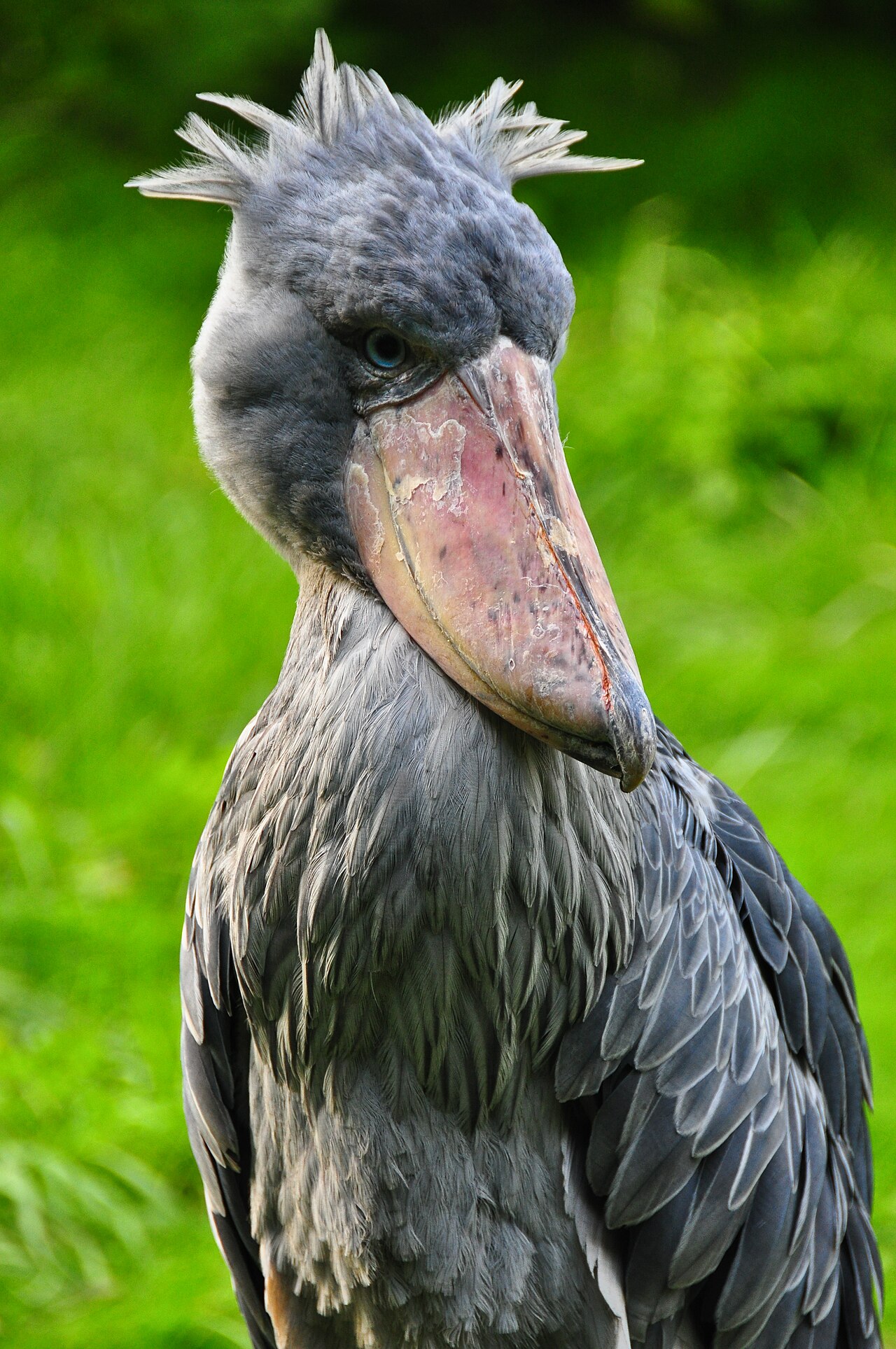
The shoebill stork beak is arguably the most formidable, bizarre, and perfectly engineered anatomical weapon possessed by any living bird. Instantly recognizable for its clog-like silhouette, this massive appendage defines the entire existence of the shoebill, a strange and ancient species that roams the dense papyrus swamps of East Africa. It is not merely a mouth; it is a crushing vise, a sharpened harpoon, and a survival tool that has remained virtually unchanged for millions of years. In this article, we will explore the fascinating evolutionary mechanics, the brutal hunting strategies, and the sheer biological power packed into the face of one of the bird world's most iconic living fossils.
Anatomy of a Monster: The Exact Dimensions of the Shoebill's Beak
To truly understand why the shoebill stork needs such an enormous beak, one must first appreciate its exact dimensions and structural composition. The beak acts as the bird's primary interface with the world, and its architecture is unlike anything else in the avian kingdom.
Size, Shape, and Structural Might
The beak of a fully grown shoebill is a masterclass in functional design. It measures between 7.4 to 9.4 inches (19 to 24 centimeters) in length and boasts a staggering width of 4 to 5 inches (10 to 12 centimeters). This gives it the distinct silhouette of a Dutch wooden clog, which is precisely where the bird gets its name—a direct translation from the Arabic phrase Abou Markhob, meaning "father of a slipper."
- Length: Up to 9.4 inches (24 cm) from base to tip.
- Width: Between 4 and 5 inches (10-12 cm) at the broadest point.
- Hooked Nail: The upper mandible ends in a sharp, curved hook that is razor-thin.
- Sharp Edges: Unlike the rounded beaks of waterfowl, the shoebill's mandibles feature incredibly sharp outer edges.
This bill is not lightweight or hollow. It is a dense, robust structure reinforced by a highly modified skull and anchored by some of the strongest neck muscles of any wading bird. The sheer weight of the beak forces the shoebill to
❓ Frequently Asked Questions
💬 How big is a shoebill stork's beak?
A shoebill's beak can reach up to 9 inches (23 cm) long and about 5 inches (13 cm) wide, making it the third-largest bird beak in the world after the pelican and the stork. Its impressive size and hooked tip give it a shoe-like shape, which is where the bird gets its name.
💬 Why is the shoebill stork's beak so big?
The massive beak is an evolutionary adaptation for hunting large, slippery prey like lungfish, catfish, and even baby crocodiles in the murky swamps of East Africa. Its sharp edges and hooked tip allow the shoebill to grasp, crush, and decapitate tough prey with precision.
💬 What does a shoebill stork use its beak for?
The shoebill primarily uses its beak as a powerful hunting tool: it stands motionless in shallow water and then lunges forward to clamp down on prey, often severing it in half. It also uses the beak for nest building and drinking, and the wide bill helps create a 'clattering' sound during mating displays.
💬 Can a shoebill stork's beak hurt a human?
Yes, a shoebill's beak is sharp-edged and capable of delivering a very strong, damaging bite, though the bird is not naturally aggressive toward humans. In captivity, they may snap at handlers or visitors if they feel threatened, so it's best to keep a respectful distance.